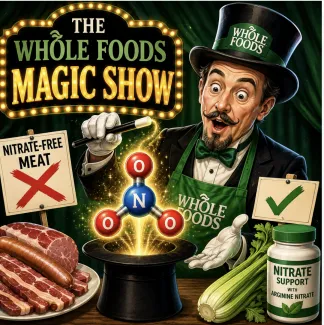
Nitrites are making news again (and again). A new 20-year study reports that men with the highest intake of nitrites had a 23% higher risk of colorectal cancer. These results are far from conclusive anyhow, but biochemically they’re even stranger. Suffice it to say that nitrate is readily converted to nitrite in the body, especially in saliva, so I'm puzzled by a study that finds a cancer association with one but not the other (the study itself will be evaluated in another article).
Sounds simple enough. Except it's not. Vegetables are loaded with nitrate, and some supposedly “nitrate-free” meats are cured with nitrate-rich celery powder. Pretty sketchy if you ask me. And who better to exploit this confusion than Whole Foods? Because that's exactly what they do.
Whole Foods chemists, an incongruity if ever there were one, must have a helluva job. They somehow must explain to suckers customers how the same chemical can be both good and bad for you. And also how an inorganic salt can be "organic" depending on its source. This takes a degree of creativity, and Whole Foods is nothing if not creative, especially when it comes to science.
Let's start with meat. The company is quite clear that preserving meat with nitrates is a big no-no.

Let’s nix the synthetic nitrites and nitrates.
While they occur naturally in some foods in small amounts, nitrates and nitrites are often added to preserve bacon, ham, hot dogs, sausages, and deli meats. Whole Foods Market does not sell products with synthetic nitrates or nitrites
Source: Whole Foods Website: Let's Not Mess With Nature
I think they ought to change their motto a bit...

...because when it comes to science, especially chemistry, Whole Foods is totally out to lunch. Here's why.
WHOLE FOODS' CRAZY CHEMISTRY
"While [nitrates] [1] occur naturally in some foods in small amounts…"
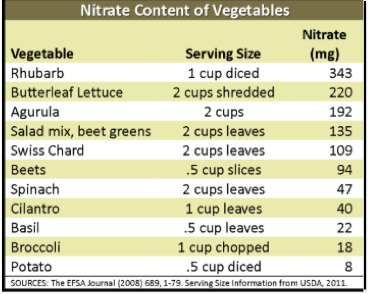
Nonsense. Nitrates are found in vegetables — and not in small amounts. Vegetables are, by far, the primary source of nitrates in our diet, accounting for 80 percent of our nitrate intake. No, "some foods" do not contain "small amounts" of nitrate. Vegetables contain a whole lot of it.
 .
.
Nitrate content of vegetables. Sources: European Food Safety Authority, USDA.
PERENNIAL MISUSE OF THE TERM "SYNTHETIC"
- "Whole Foods Market does not sell products with synthetic nitrates or nitrites"
This statement is technically correct, but misleading, perhaps intentionally so. Sodium nitrate is sodium nitrate, no matter its source. The chemical is made in factories, in plants (the green kind), and by your body (more on that later), and the resulting nitrate ions are indistinguishable. It is dishonest to imply that there is any difference in the nitrate ions themselves. Here's a demonstration:
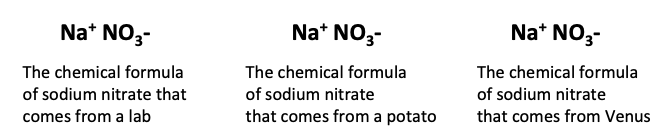
NITRATE IONS DON’T KNOW (OR CARE) WHERE THEY COME FROM
Something else that Whole Foods probably doesn't want you to know is that avoiding nitrate in one particular food doesn't make it go bye-bye. It's clever marketing to claim that nitrate-free beef is somehow superior while minimizing the nitrate content of vegetables.
But this doesn't matter either. Eating nitrate-free preserved meat, nitrate-laden vegetables, or nothing at all doesn't change the fact that your body produces plenty of nitrate on its own:
"Although fruit and vegetables contribute 11-41% of exogenous nitrite dietary intake ... this amount is overshadowed by the endogenous reduction of secreted salivary nitrate to nitrite"
Source: "Food sources of nitrates and nitrites: the physiologic context for potential health benefits." American Journal of Clinical Nutrition
Just to be sure, your crack ACSH research team went above and beyond to make absolutely sure that there aren’t a bunch of unrelated nitrate ions running around the globe trying to figure out their origin.
It’s a non-problem:
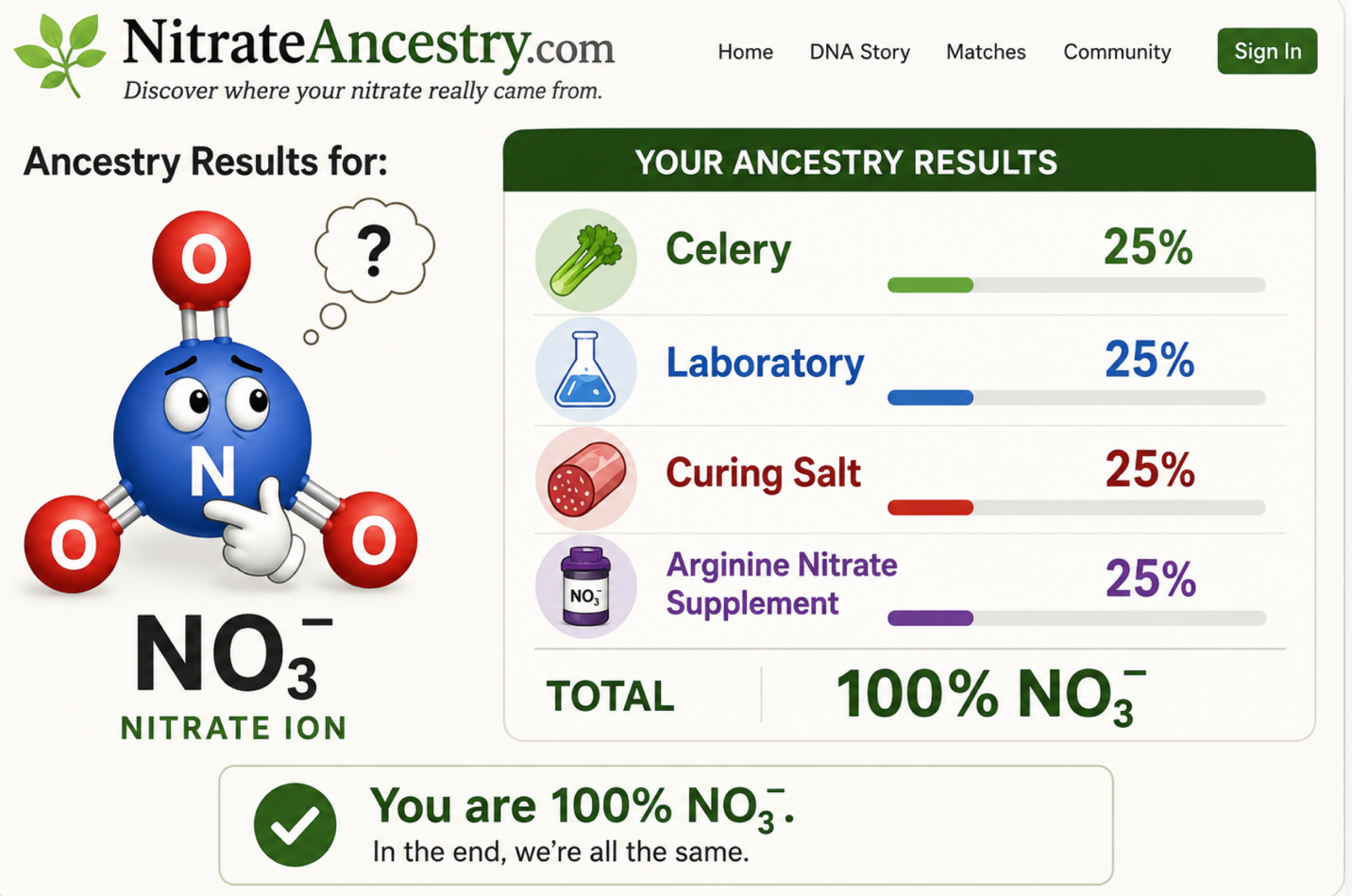
SHAMELESS
This last part borders on hilarious. Whole Foods sells the following online.
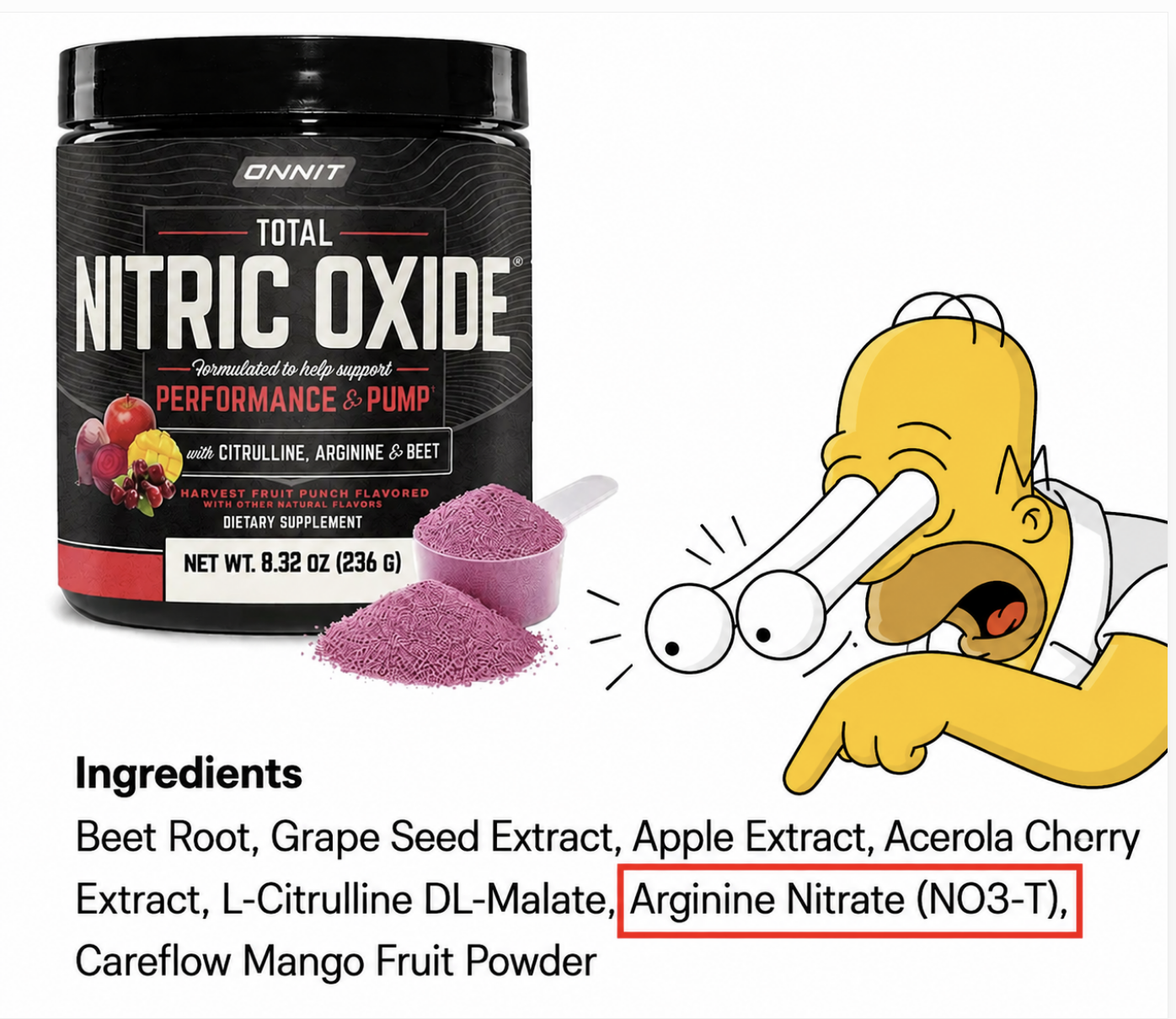
Take a look at the ingredients. In addition to beetroot, it contains arginine nitrate (NO3-T). That's not nitrate hiding in a vegetable. It's an actual nitrate salt.
Once it dissolves, the nitrate ion from arginine nitrate is the same NO₃⁻ ion you get from sodium nitrate because soluble nitrate salts dissociate in water.
The nitrate doesn't remember (or care) whether it came from sodium nitrate, arginine nitrate, or celery.
So “synthetic nitrates” are verboten when they're used to preserve meat, but Whole Foods is perfectly happy to sell 1.4 grams of an amino-acid nitrate salt per serving as a dietary supplement.
Apparently nitrate's health effects depend on which aisle you're standing in.
LET'S REVIEW
- Whole Foods wants you to believe that the small amount of nitrate/nitrite in meat is something worth avoiding, so you should buy their nitrate-free meat.
- They neglect to tell you that vegetables are the largest source of nitrate in our diet.
- They either don't know (or won't say) that your body produces plenty of nitrate on its own.
- Some supposedly nitrate-free meat is cured with nitrate-rich celery powder.
- Whole Foods sells a dietary supplement containing 1.4 grams of arginine nitrate per serving.
- I should have become a Whole Foods scientist. Or maybe a magician. Not much difference. Then I wouldn't be living in my car.
NOTE:
[1] Some phony health sites will tell you that nitrates are OK; it is nitrites that are harmful. Nice try. Nitrates are converted to nitrites in your body, especially in the gut and in saliva. The two aren't identical, but treating “natural” nitrate and added nitrite as if they inhabit completely separate chemical universes is Whole Stupid.

Josh Bloom
Dr. Jonathan (Josh) Bloom, ACSH's Director of Chemical and Pharmaceutical Sciences, earned his Ph.D. at the University of Virginia and completed postdoctoral training at the University of Pennsylvania. During his 20-plus years in drug discovery at Wyeth, his research group discovered the antibiotic Tygacil®, approved in 2005. He holds 25 issued patents and has authored 35 academic papers. Since joining ACSH in 2010, he has written more than 2,000 articles and dozens of op-eds for major newspapers, including The Wall Street Journal and Chicago Tribune.