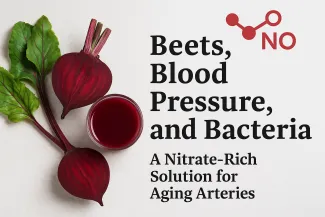
Beets are a recent addition to the pantheon of “super foods,” providing not only nutrition but that MAHA “food as medicine” boost. A new study lends credence to the health claim, while also introducing an interesting nutritional twist. To understand beet juice, we need to explore nitric oxide (NO), a molecule essential for vascular function.
Nitric Oxide, the body’s natural vasodilator
Imagine your cardiovascular system as a vast arterial highway. The flow of blood along that highway is controlled in part by the heart, which provides the bulk of the motive force, and the elasticity of the blood vessels that expand and contract in a counterrhythm to the heart’s beat. Nitric oxide (NO) is formed by the actions of the enzyme nitric oxide synthetase on L-arginine, an amino acid, in the NOS pathway. The NO created causes blood vessels to dilate, lowering blood pressure.
As we age, our ability to produce NO through the standard pathway declines; however, a dietary workaround exists that begins in the mouth, starting with the reduction of dietary nitrate to nitrite. But it can only happen when our microbiome lends a metabolic hand.
Epidemiologic nutritional studies have long indicated that green leafy vegetables and some fruits, typically what we find in the Mediterranean diets offers some protection against adverse cardiovascular events. A common feature of these foods is higher levels of inorganic nitrates, as can be found in today’s super food hero, beets and beetroot juice.
When you consume foods rich in dietary nitrate (like beetroot), it’s your mouth’s oral microbiome that’s crucial. These mouth bacteria possess the unique ability to transform the dietary nitrate into nitrite. This nitrite then travels into your bloodstream, where it can be converted into NO, helping your blood vessels relax and widen.
The Experiment: Three Lanes, One Destination
In a clever study, researchers recruited 75 healthy adults, 39 young (18–30 years old) and 36 older (67–79 years old), and ran them through three two-week treatments separated by a break:
- Nitrate-rich beetroot juice (BR) – our super food hero
- Placebo beet juice (PL) – all the taste, none of the nitrates
- Antiseptic mouthwash (MW) – a killer of our oral microbial neighborhood
Participants drank juice or used the mouthwash twice daily during treatment. Everyone maintained their usual diets and activities, and the mouthwash round was placed last to minimize any lingering effects on oral bacteria. Researchers measured changes in blood pressure, nitric oxide levels, and the oral microbiome. This design helped isolate the impact of both dietary nitrate and oral hygiene on “vascular health,” especially as we age.
Nitrates, Pressure, and Age
Beetroot juice boosted nitric oxide: Drinking nitrate-rich beet juice significantly raised (tenfold) blood levels of nitrate and nitrite, compared to placebo or mouthwash. However, a significant distinction is evident: the older adults experienced a substantially greater increase in these beneficial nitrite levels compared to the young after consuming the beetroot juice. This suggests that older adults might have a heightened capacity or need for this dietary pathway to produce these beneficial precursors.
Beetroot juice lowered blood pressure by a clinically significant four mmHg or more, but the most apparent benefits were seen in the older group; the young with lower initial blood pressures didn’t show the same improvement. Moreover, it was clear that the pressure reduction for older adults was directly linked to the greater blood nitrite levels. Why?
Mouth bacteria mattered: The beet juice changed the bacteria within the oral microbiome, especially in older adults. For older adults, dietary nitrate led to a decrease in potentially “harmful” bacteria known to divert nitrate away from NO production. Concurrently, promoting “beneficial” bacteria that restore NO precursors, shifting the oral ecosystem's metabolism towards greater nitrite production. Beetroot juice also altered the oral flora of the young adults; however, the changes in flora differed and overall generated a less pronounced metabolic shift towards greater nitrite production. The placebo juice and mouthwash had no dramatic change in the overall mix of mouth bacteria for either age group, although mouthwash did reduce the diversity (variety) of bacteria in young people. In this instance, it seems that diversity matters.
Mouthwash blocked the benefits: Using an antiseptic mouthwash, which kills bacteria, wiped out helpful oral microbes and reduced blood vessel flexibility, especially in young adults. While the mouthwash did not significantly alter nitrite or nitrate concentrations in this study, the reduction in biodiversity was associated with impaired vascular reactivity in young adults. This reactivity measures how well blood vessels can widen and relax in response to a challenge.
Diet, Age, and the Microbiome
Food has nutritional consequences mediated by our bacterial companions, which are not typically found on food labels.
The study showed that what we eat, how old we are, and our microbiomes, in this instance those in our mouths, work together - sometimes beautifully, sometimes not - profoundly influence our cardiovascular health. The key to this age-specific benefit lies in how the beetroot juice rebalances the oral microbiome in older adults to favor an alternative metabolic path as their primary pathway ages and “fails.” It serves as a reminder that what we put in our mouths, whether it's food or mouthwash, has a dynamic and far-reaching impact on our internal bodily functions. When it comes to nitrate-rich diets, older adults may have more to gain—as long as they don’t rinse the benefits away.
Avoiding Nutritional Dogma, Old and New
This study is a compelling case for approaching cardiovascular health not just with medications, but with the strategic use of food and respect for the microbiome. That is the kernel of truth lying at the heart of MAHA’s nutritional concerns. However, when guidance comes from the beliefs of wellness experts, it leaves us no better off than the beliefs of the old dietary guard that MAHA wishes to push aside. This study demonstrates that nutritional guidance for one group may have a greater or lesser impact on another. We should be humble in confronting our lack of nutritional knowledge. Nutritional guidance should avoid hard and fast rules and numbers that reek more of scientism than science.
Source: Ageing modifies the oral microbiome, nitric oxide bioavailability and vascular responses to dietary nitrate supplementation Free Radical Biology and Medicine DOI: 10.1016/j.freeradbiomed.2025.07.002
Article Pop Quiz:
Which group saw the biggest improvement in blood pressure after sipping beetroot juice?
A) The young and the restless.
B) Boomers and up.
C) Kale enthusiasts.
D) Everyone equally—because life is fair.
Correct Answer: B) Boomers and up.
Turns out that for beet juice, aging has its perks. Older adults (ages 67–79) showed a significantly greater boost in blood nitrite levels and a clinically meaningful drop in blood pressure after sipping nitrate-rich beetroot juice. It seems their aging vascular systems are primed to benefit from beetroot juice, as long as they don’t rinse the benefits away with antiseptic mouthwash.

Chuck Dinerstein, MD, MBA
Director of Medicine
Charles Dinerstein, MD, MBA, is the Medical Director of the American Council on Science and Health. A vascular surgeon with more than 25 years of clinical experience, he brings a physician's understanding of medical decision-making, an appreciation for scientific uncertainty, and a broader perspective on healthcare economics and policy to his writing.