Four years ago, I wrote in an article, “One of society’s greatest challenges is understanding and determining what is fact, what is hype, and what is simply not true.” This article was about PFAS, and unfortunately, today, four years later, the issue has worsened, and the fear is spreading. It is time to rethink our regulatory approach to PFAS.
What are PFAS?
PFAS, or per- and polyfluoroalkyl substances, are a group of chemicals that contain carbon-fluorine bonds. These bonds are very strong, making them resistant to degradation.
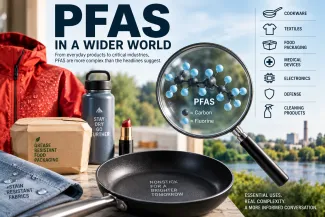
In 2011, a paper formalized the definition of PFAS, including a structural definition covering 268 individual compounds. This definition exploded under the International Organization for Economic Cooperation and Development (OECD) in 2021 to include any substance with at least one fully fluorinated carbon atom – a definition covering over 7 million compounds. PFAS compounds are used in over a million unique products worldwide, including nonstick cookware, waterproof and stain-resistant fabrics, grease-proof food packaging, firefighting foam, cosmetics, cleaning products, and paints.
This broad definition includes chemicals with very different physical, environmental, and biological properties. PFAS play a vital role in industries such as defense, where they are used in weapon platforms, ships, submarines, torpedo systems, and tanks; electronics, for producing semiconductors; and medical devices, including catheters, pacemakers, and radiological machinery.
PFAS came to public attention in the early 2000s because of contamination of water supplies near some manufacturing plants producing nonstick cookware.
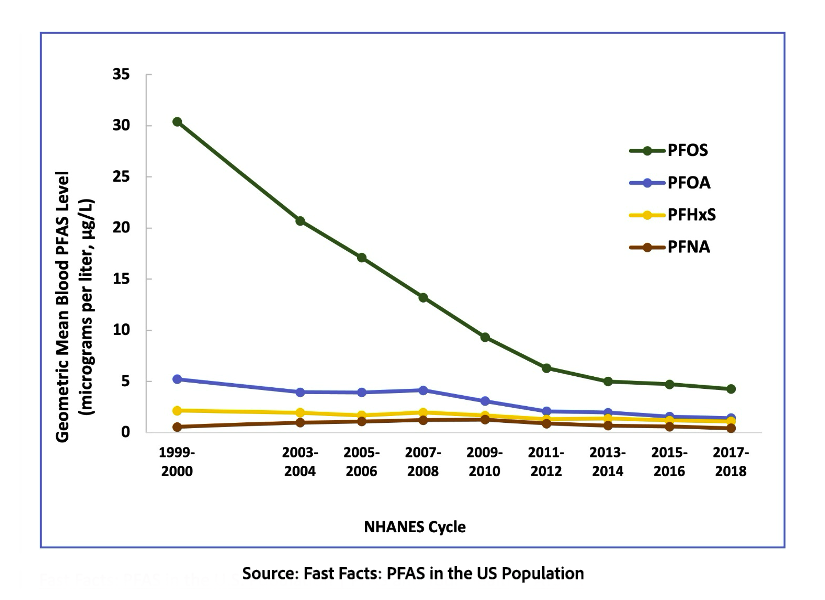
By 2015, all production of PFOA and PFOS, the two most common PFAS, had ceased in the U.S., but other PFAS replaced them. Very low levels of PFOA and PFOS are still being found in the environment. These chemicals, also known in the press as “forever chemicals”, are not “forever”, as shown in the graph; exposure has dramatically decreased in the U.S. population over the years.
Health Effects
Contrary to media reports, there has been no direct link between exposure to PFAS and human health effects. The data comes from animal studies that use doses far above those found in the environment, making it difficult to extrapolate these effects to humans.
A recent review summarized 15 misconceptions about the health effects of PFOA and PFOS, stating that, contrary to media reports, these chemicals have not been shown to affect the immune system, a developing fetus, the heart, the liver, or the development of cancer at levels found in the environment.
A review of 28 epidemiological studies that examined PFOS and cancer reported that “Overall, the evidence for an association between cancer and PFOS remains sparse.” The review found no consistent association between PFAS and cancer across studies, with limited evidence for an association of PFOA with testicular cancer. However, testicular cancer is rare and rarely fatal, and only three studies reported on this association.
One explanation for the positive results sometimes seen in animal studies but not in humans is that these studies are conducted in rats and mice at very high doses. These animals are much more prone to PFAS toxicity because they have a specific protein (peroxisome proliferator-activated receptor gamma) that makes them much more sensitive than humans.
Another explanation, as discussed by Dr. Edward Calabrese, is that PFAS can induce hormesis, a biphasic dose-response relationship in which low doses cause adaptive, nontoxic, or beneficial effects, while high doses cause toxic effects. This helps explain why humans are not seeing effects from environmental levels of PFAS: at parts-per-trillion levels, they act as mild stressors rather than causing toxic injury.
Current Approaches to Regulating PFAS
In the early 2000s, sensationalized news stories about the health effects of Teflon pans due to PFOA led people to needlessly throw out pots and pans. News stories ignored the fact that PFOA is not the Teflon coating itself; it is a processing aid burned off during Teflon manufacture, leaving only trace residues in the finished nonstick coating.
Today, in a deja vu moment, several states are attempting to set laws banning PFAS in food packaging, cosmetics, pesticides, textiles, and cookware. Five states, Vermont, Connecticut, Colorado, Minnesota, and Maine, have already enacted bans on intentionally added PFAS in cookware.
Other states, such as New Mexico and Rhode Island, have carved out exemptions for fluoropolymers in their PFAS cookware bans. Fluoropolymers are a distinct subcategory within PFAS, with significantly larger molecular sizes and more complex molecular structures than PFOA and PFOS. Their large size limits uptake in living organisms, reducing bioaccumulation, and their lower water solubility limits dispersion in the environment. They have no known human or environmental effects.
In October 2025, California Governor Gavin Newsom vetoed a bill that did not include an exclusion for fluoropolymers and would have banned the sale of nonstick cookware and other products containing intentionally added PFAS.
Governor Newsom vetoed the bill due to concerns about affordability, potential cost increases for California families, and the industry's transition timeline. Prominent chefs, including Rachael Ray, lobbied against the bill, arguing that regulated PFAS (Teflon) coatings are safe and practical for home and restaurant cooking.
Washington adopted a compromise rule requiring reporting, but not banning, intentionally added PFAS in cookware, striking a bargain between consumers who like the convenience of nonstick pans and environmental advocates who argued that scratched or overheated nonstick pans can shed toxic particles into food and the environment.
It is time to rethink our regulatory approach to PFAS. Regulating these as a group, with over 7 million compounds defined as PFAS, is not only unworkable, but is also absurd. We should not follow Europe’s approach; the European Chemicals Agency has spent the last three years debating a potential ban on the manufacture or use of PFAS in Europe, without yet reaching an agreement. What is needed is a targeted approach for PFAS with clear health data and less toxic alternatives. It is time to take fear out of this debate and base it on actual evidence.

Susan Goldhaber MPH
Susan Goldhaber, M.P.H., is an environmental toxicologist with over 40 years’ experience working at Federal and State agencies and in the private sector, with an emphasis on issues concerning chemicals in drinking water, air, and hazardous waste. Her current focus is on translating scientific data into usable information for the public.