Aging eyes may struggle to read the dinner menu, but a prescription eye drop promises to make reading glasses optional by shrinking the pupil. This clever optical workaround may provide hours of clearer vision. Yet behind the promise of freedom from glasses lie important trade-offs involving duration, dim lighting, safety, and the cost of renting better vision, one day at a time.
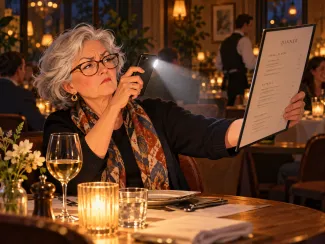
Dinner with friends increasingly involves a flashlight moment as we light up the menu and, in most cases, hold it closer or further away. That decline in our ability to focus up close is called presbyopia, derived from the Greek for “old eye.” As our demographics shift toward seniors, the incidence of presbyopia is also increasing and becomes more noticeable as we move through our middle years.
The Aging Eye: Is It the Muscle or the Lens?
The eye’s focus is naturally controlled by a dance between the lens and the ciliary muscles, a ring of smooth muscles surrounding the iris. When we look at nearby objects, those muscles contract, rounding the lens and increasing its focusing power; at a distance, the lens becomes flatter as the ciliary muscles relax. The ability to change focus is called accommodation.
As we age, the ciliary muscles weaken, and become less effective at changing the shape of the lens shape, while the lens itself becomes larger, stiffer, and less responsive to the ciliary muscles' efforts. Scientists have long debated which effect of aging matters more: the weakening muscle or the stiffening lens. Today, evidence increasingly points to the lens, rather than the muscle controlling it, as the main culprit.
This distinction is more than academic. Strengthening the muscle cannot restore the flexibility of a lens that has become progressively rigid.
Reading Glasses and Other Optical Workarounds
-
For generations, people have treated presbyopia by compensating for lost accommodation rather than reversing it. Reading glasses provide the additional optical power needed to bring nearby objects into focus. Bifocals and progressive lenses extend that correction.
- Multifocal contact lenses and, for the surgically inclined, implanted intraocular lenses provide several focal powers simultaneously, creating overlapping sharp and blurred images on the retina. The brain gradually learns to favor the sharper information and suppress the blurred, depending on whether we are looking at nearby or distant objects. Monovision LASIK works similarly by correcting one eye for distance and leaving the other slightly nearsighted, letting the brain favor whichever eye provides the clearer image.
These approaches are practical workarounds; they do nothing to alter the lens and ciliary muscles' underlying aging. For someone who has worn glasses since second grade, they offer a compelling advantage in safety and efficacy. Their primary disadvantage, another feature of aging, is that people often misplace or forget them.
While medical devices have been the mainstay of presbyopia treatment, medications can provide a workaround for accommodation.
To understand how they work, we need to discuss cameras.
The Pinhole Principle: Seeing More with Less Light
By reducing a camera's opening, its aperture, the depth of field increases, meaning a greater range of distances appears acceptably sharp. When our pupils constrict, our depth of field also increases. A different set of muscles controls pupil size: the iris sphincter muscles, which we have manipulated chemically for centuries. Belladonna, Italian for beautiful woman, is a medication that, when applied to the eye, dilates the pupil; those large, dark pupils were considered a sign of beauty.
The pharmacologic treatment of presbyopia builds on our experience with drugs that constrict the pupil, known as miotics, originally used to treat glaucoma. [1] By narrowing the pupil, these medications create a pinhole effect that increases depth of focus. Like other treatment approaches, they do not restore the aging lens's flexibility. In 2021, the FDA approved 1.25% pilocarpine, the first eye drop approved specifically for presbyopia, providing several hours of improved near vision. However, pilocarpine acts on both the iris sphincter and ciliary muscles, potentially causing headaches, accommodative spasms, and temporary blurred distance vision.
An Old Drug Finds a New Job
In July 2025, the FDA approved a 1.44% ophthalmic solution of aceclidine (VIZZ) to treat adult presbyopia. Aceclidine, like pilocarpine, has been marketed in Europe as a treatment for glaucoma. Unlike pilocarpine, aceclidine preferentially affects the iris sphincter, producing substantial pupil constriction with little effect on the ciliary muscle. Its greater specificity reduces the unwanted changes in distance vision of pilocarpine.
In clinical trials, VIZZ reduced the median pupil diameter to about 1.8 millimeters, compared with roughly 2.7–3 millimeters reported with pilocarpine 1.25%. The pupillary restriction lasted longer, up to 10 hours, making it a once-daily medication for most of us.
Ten Hours of Clearer Vision? Read the Fine Print
About 70–75% of treated eyes improved by at least three lines on a near-vision chart [2], compared with about 10–15% receiving placebo. Improvement was measurable within 30 minutes. That finding comes with a caveat: the trial dose of 1.75% exceeds the FDA-approved dose of 1.44%, which was dialed back to balance efficacy with local tolerability, relying on pharmacodynamic modeling to bridge the data. While we are on caveats, we need to mention that “up to 10-hour improvement.” Only 40% of participants maintained meaningful near-vision benefit through 10 hours; far fewer maintained it for the maximum reported duration.
Sharper Print, Dimmer Light, and Other Trade-offs
Clinical trials also identified adverse effects. Many were burning or tingling upon administering the drops, eye redness, or headaches, all generally mild and without lasting consequences. Two are worth mentioning. First, restricting pupil size, along with increasing depth of field, reduces the amount of light entering the eye, which explains the 16% of study participants who reported transient dimming or blurred vision. Our 50- or 60-year-old lenses have already lost a significant percentage of light transmission, and aceclidine can compound that loss. For someone reading outdoors or working at a well-lit computer, that trade-off may be acceptable. The irony is that a medication designed to free us from reading glasses may work less comfortably where we most want that freedom: a dimly lit restaurant.
Second, there are very rare risks of retinal damage, loss of central visual acuity, and floaters, including moving shadows in your vision, due to local changes in the vitreous associated with prolonged use of these types of medications. Although the study reports no such incidents, the sample size and study duration were too small and short to rule out these rare events.
To Buy or Rent?
Aceclidine does not fundamentally change our understanding of presbyopia or its biological treatment. It offers an alternative to conventional optical correction, replacing an external device with a temporary pharmaceutical effect. Perhaps we might consider this a paradigm shift in treatment. However, there is no free lunch, and the exchange introduces cost considerations.
A month’s supply costs $79 and is not considered a medical necessity, resulting in poor or no insurance coverage. Daily contact lenses, another cosmetic choice with recurring costs, run about half of acclidine’s monthly payment. A multi-pack of non-prescription “readers” can cost $5 to $10.
VIZZ's “value proposition” is a recurring convenience subscription competing with a one-time optical device. A simple dollar comparison is not entirely fair. A medication that frees someone from glasses for a particularly important meeting, a social event, or several hours of work may be worth more than its price. Being able to read a menu without searching for glasses, switch between near and distance tasks, or work without a pair of readers perched on one's nose can be genuinely appealing. For the consumer, the question is whether those benefits outweigh the cost.
The real paradigm shift isn't that we have found a way to make aging eyes young again, but that we can now choose between buying reading glasses and renting their optical effect by the day.
[1] In some forms of glaucoma, where increased pressure within the eye can damage the optic nerve, pilocarpine can, through its actions on the iris sphincter and ciliary muscles, increase aqueous humor drainage and relieve some of the built-up pressure.
[2] Unlike the familiar Snellen eye chart, which measures distance vision, near-vision charts measure our ability to distinguish progressively smaller letters at reading distance. VIZZ's clinical trials demonstrated an objective improvement of three or more lines on such charts.
Category

Chuck Dinerstein, MD, MBA
Director of Medicine
Charles Dinerstein, MD, MBA, is the Medical Director of the American Council on Science and Health. A vascular surgeon with more than 25 years of clinical experience, he brings a physician's understanding of medical decision-making, an appreciation for scientific uncertainty, and a broader perspective on healthcare economics and policy to his writing.