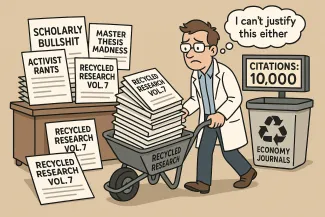
"Scholarly bullshit is defined as scholarship that is so pointless and unnecessary that even the scholar producing it cannot justify its existence,” Kirchherr defined in a provocative article published in 2022. “In essence, it is scholarship that does not contribute to the advancement of scientific knowledge… However, because of the current set-up of the academic system, the scholar feels obligated to pretend otherwise and to continue churning out this kind of work.”
Kirchherr’s field is the circular economy, which describes a system in which products and raw materials are used, repurposed, remanufactured, and recycled as much as possible before being discarded. He’d noticed that as his area of research has grown buzzier over the years, more and more seemingly worthless articles crept into the literature. As he read them, he realized they could be classified into five categories.
The first is harmless and common, and perhaps valuable to some: boring question scholarship. “These papers all begin with the same question, but each is followed by a different dataset,” Kirchherr described. For the most part, they simply replicate previous works – a respectable pursuit, but often unnecessary when the topic has already been empirically validated many times over.
The second category of scholarly bullshit is decidedly more annoying: literature reviews of literature reviews. Literature reviews can be very useful. They summarize the findings of a particular research focus – the effectiveness of recycling for instance. But as these literature reviews stack up, some scholars accumulate and review the reviews themselves. “They summarize what we already know and do not bring in any new scholarship,” Kirchherr critiqued.
A third archetype is recycled research – fitting for the circular economy field. Scholars essentially republish prior research on, for example, product-service systems, material efficiency, or product design, but rebrand it with the term “circular economy.” The editors of journals who publish these articles don’t bother to check if the research already exists in the literature.
Master thesis madness is a fourth category of scholarly bullshit, and one that is highly problematic, Kirchherr wrote. Professors insert themselves as authors on masters’ students thesis papers, garnering more citations for themselves to superficially boost their academic productivity. In the process, they encourage quantity of papers over quality.
“These pieces frequently include a messy (or no) application of theory, no more than a handful of qualitative interviews, an analysis that does not appear to be replicable and/or conclusions that are wide-sweeping, and not backed by the data,” Kirchherr described.
The final category of scholarly bullshit might be the biggest BS of all: activist rants. “These articles frequently remain experiential instead of turning theoretical and/or empirical; they attempt to build their legitimacy through general, feel-good claims instead of substantive arguments,” Kirchherr wrote. They belong in lefty, environmentalist publications, not the scientific literature.
When Kirchherr randomly selected 100 articles in three well-known sustainability-focused journals, he found that at least half fell into one of his five categories of scholarly bullshit. Scholarly bullshit is thus a common problem, one institutionalized by the academic culture of “publish or perish.” Though railed upon for years, this culture still with us today, and stronger than ever.
Kirchherr acknowledged that some of his past work could be categorized as scholarly bullshit, and potentially the present article as well.
This article originally appears in RealClear Science and it is reposted with their permission. You can find the original article as well as many others at their website RealClear Science.