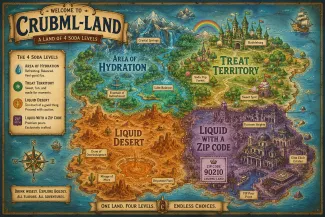
Dirty soda starts with a standard fountain soda and offers near-endless customization with flavored syrups, fruit purées, heavy cream, and coconut cream. In a state where alcohol and coffee consumption have historically been lower for religious and cultural reasons, these elaborate drinks have evolved to occupy some of the same social and ritual settings that might otherwise revolve around bars, cafés, or happy hour.
The trend has officially escaped its Utah roots and gone national. Crumbl—the bakery chain best known for selling cookies big enough for their own ZIP code—has launched a dedicated dirty soda menu at all its locations nationwide.
Predictably, social media has reacted with two extremes: equal parts “this should be illegal” and “I’ll take an extra large with extra syrup.”
Viral reports about Crumbl’s 32-ounce "Crazy Cousins" dirty soda revealed it contains a staggering 186 grams of sugar—equivalent to five cans of regular Coke—sparking a meltdown in the online wellness ecosystem. Prominent functional medicine advocate Dr. Mark Hyman called it a “metabolic disaster” that "should be illegal." The 840-calorie drink exists, but it sits at the extreme edge of a highly customizable menu rather than the default order.
More interestingly, the backlash highlights an increasingly common online nutritional split-screen. On one side, hyper-vigilant wellness influencers warn followers about ordinary blood sugar spikes, treating even a humble banana as metabolically suspect. On the other, internet culture aggressively celebrates the oversized “little treat”—the widely normalized practice of rebranding massive, high-calorie indulgences as harmless, daily acts of emotional self-care.
The Sugar Ladder: From EZ Breezy to "Charger"
What the viral outrage misses is that dirty soda is built almost entirely around customization, so there is an enormous range of calorie and sugar content. Viewed across a flexible sugar ladder, dirty sodas look like this:
Level 1 (The Diet Base): 10 to 60 Calories, 0 to 2 Grams of Sugar.
Labeling a menu staple like Crumbl’s EZ Breezy “dirty” seems unfair—it’s simply Diet Coke mixed with sugar-free coconut syrup, a squeeze of lime, and a light splash of coconut cream. The diet soda base and sugar-free syrup contribute no sugar, the coconut cream adds only a small amount of fat, and the calorie count remains modest even at larger serving sizes.
Level 2 (The Classic): 220 to 320 Calories, 40 to 60 Grams of Sugar.
This represents the baseline standard of the culture—examples include Swig's Texas Tab (Dr. Pepper, vanilla, and coconut cream) or the iconic "Dirty Dr. Pepper" (Dr. Pepper, coconut syrup, and a squeeze of lime). Here, you start with a baseline sugar load from the soda itself, then add about 100 extra calories from the flavor add-ins and cream. At this tier, a standard 16- to 24-ounce drink has moved beyond hydration and into treat territory, but it falls short of the worst excesses of dirty soda.
Level 3 (The Liquid Dessert): 350 to 500+ Calories, 60 to 90 Grams of Sugar.
This tier includes fan favorites like Swig's "Life's A Peach" (a regular Dr Pepper base with peach and vanilla syrups, plus half-and-half) or Crumbl’s "Sunshine Sipper" (Sprite layered with mango, strawberry purée, and coconut cream). When you order these in larger 24- to 32-ounce cups and stack full-sugar sodas with multiple pumps of concentrated fruit syrups and rich dairy fat, the beverage has entered liquid dessert territory.
Level 4 (The "Charger"): 600 to 840+ Calories, 120 to 186 Grams of Sugar.
This is where the viral 186-gram sugar stat becomes plausible. This peak can be reached two ways: either by heavily customizing a standard large soda, or, in the case of Crumbl's infamous "Crazy Cousins Charger," by choosing from the main menu with an energy drink base. This dirtiest of sodas layers a Red Bull with Sprite, pineapple syrup, strawberry purée, and coconut cream. In the 32-ounce version, the concentrated sugars from the energy drink and the stacked flavor additions compound rapidly to reach the headline-grabbing figures.
When a Drink Stops Being a Drink
The problem is that beverages can accumulate calories surprisingly quickly while still being mentally filed under “something to sip” rather than “something to eat.” Dirty soda pushes further into that ambiguity by borrowing from both worlds: the cultural identity of a beverage and the nutritional profile of a dessert.
It’s long been known that compensation for calories consumed as beverages is often imperfect and context-dependent—in many cases, calories consumed in liquid form do not reduce subsequent food intake as much as calories consumed as solid food.
Dirty soda introduces an extra wrinkle: added fat and a creamier texture may increase short-term feelings of fullness compared with a standard soft drink. However, what matters more than satiety (how full the drink makes you feel in the moment) is energy compensation (how much—or whether—your total daily intake actually decreases).
Feeling somewhat fuller after a creamy dirty soda does not mean your later intake will drop by an equivalent amount. The calories in a top-end indulgent dirty soda (let’s say 600–800+) are often consumed in addition to your normal meals rather than in place of them. At the top end, a full-sugar dirty soda can easily deliver several times the recommended daily limit for added sugar, leaving little room for meaningful compensation later in the day.
All that said, there is also something refreshingly transparent about dirty soda—it is unapologetic about its indulgence, and humans have always built rituals around pleasurable foods. The problems begin when an indulgence masquerades as hydration.
Dessert Math over Moral Panic
Should social media be the source of the public's foundational nutrition advice? Probably not.
New menu items need not send us into a cultural tailspin. Instead of reacting with panic, demanding bans, or waiting for wellness influencers to decode the latest food trend, the dirty soda phenomenon points to a more fundamental educational gap.
If we want consumers to navigate a world of highly customizable 32-ounce drinks, we cannot rely on TikTok personalities to teach nutrition. Nor can we wait for medical schools to intervene decades later, after metabolic habits have already formed. Nutrition education belongs much earlier.
True food freedom begins with having enough scientific literacy to make informed dietary decisions for yourself. If a student leaves school able to read a nutrition label, understand the difference between sugar, fat, and protein, and do a bit of practical math, they no longer need someone online to tell them whether a menu item is poison or self-care.
They can look at the Crumbl dirty soda menu and recognize the largest orders for what they are: neither hydration nor a metabolic disaster—just another huge cookie, this time with a straw.

Angela Dowden
Angela Dowden is a British health journalist, author, and Registered Nutritionist. She has nearly 30 years’ experience bringing food, nutrition, and health science to life for international audiences through her print and online work.