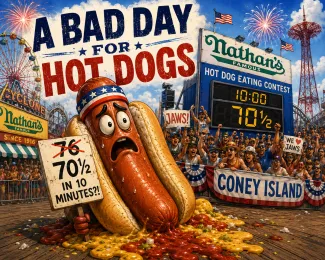
For years, the face of this ritual has been the competitive eater known as “Jaws,” Joey Chestnut, a man whose name now belongs to the Fourth of July almost as much as fireworks, potato salad, and arguments about whether ketchup belongs on a hot dog. Chestnut’s record at Nathan’s is 76 hot dogs and buns in 10 minutes. These are not lunch numbers. In 2025, after missing the previous year’s contest because of a sponsorship dispute involving plant-based hot dogs, Chestnut returned and reclaimed the title with 70½ hot dogs in 10 minutes. The king had returned to the kingdom of Sodium.
For the hot dog, this is “A Bad Day.” July Fourth is the single day when the hot dog is most celebrated and humiliated. It is grilled, photographed, and memed by the millions – at Coney Island, they are swallowed in quantities that make the average backyard cookout look like a wellness retreat.
Independence Day is a civic festival of smoke, salt, speed, and convenience. The National Hot Dog and Sausage Council has long estimated that Americans eat about 150 million hot dogs on July Fourth alone. That is a lot of sodium, a lot of buns, and a lot of people pretending that the third one “doesn’t count” because it was eaten while standing.
Hot dogs are cheap, quick, democratic, portable, and nearly impossible to improve upon. Chicago has its dragged-through-the-garden dog; New York has mustard and sauerkraut; Los Angeles eats them wrapped in bacon outside clubs and stadiums. In our homes, the style is whatever can survive on a paper plate beside chips, watermelon, and a sweating can of something cold. A hot dog is not a health food. Nobody is confusing this with the Mediterranean diet.
The hot dog’s genius is that it seems unserious. It does not ask to be carved, plated, rested, paired, or admired. It does not require cutlery or sophistication. This is part of why it fits the Fourth of July so well. The holiday itself is built on contradictions: solemn political ideals celebrated with explosives; national unity performed through private parties; a revolutionary anniversary sponsored by grocery store circulars. A hot dog can hold all of that contradiction inside a bun. It is humble and excessive, nostalgic and processed, communal and vaguely suspicious.
Each July, on social media, the hot dog is applauded as a symbol of harmless American joy. People post grill photos with captions about freedom, summer, and videos of Chestnut circulate like sports highlights.
The applause is not only ironic. Hot dogs are one of the few foods that can still perform a broad cultural belonging, crossing class lines more easily than most holiday foods. They can be halal, kosher, beef, pork, turkey, vegan, local, artisanal, or suspiciously cheap. Their simplicity invites personalization without requiring expertise. No one needs to know the farmer, the vintage, or the tasting notes. A hot dog is one of the last foods around which almost everyone has an opinion, and almost nobody needs a credential.
But criticisms arrive just as quickly, and they are often just as American. Food moralism tends to treat the occasional indulgence as if it were an exposure event at a chemical plant. A hot dog at a cookout becomes less a food choice than a character flaw. One can almost hear the scolding: nitrates, saturated fat, preservatives, cancer, obesity, climate change, animal welfare, capitalism, America. It is a lot to fit into a bun.
Then there is the newer culture war over meat itself. When Chestnut missed the 2024 Nathan’s contest after a sponsorship dispute involving a plant-based brand, the episode briefly turned into a referendum on meat, authenticity, corporate control, and whether a vegan frank is a hot dog or a cry for help. The hot dog became an ideological object. Was a plant-based hot dog still a hot dog? Was Nathan’s protecting a tradition or policing it? Of course, the hot dog is aesthetically vulnerable. It is cylindrical. It invites middle-school humor.
Still, for all the scolding, the hot dog endures because criticism rarely defeats appetite. People may joke about what is in a hot dog, then ask for another. They may condemn competitive eating, then watch the replay. The hot dog survives because it occupies a zone of pleasure that is not trying to be pure; it is trying to be good enough. The hot dog is nutritionally unimpressive but socially indispensable.
That may be the secret of its patriotic power. The Fourth of July is not, in practice, a day of national self-perfection. It is a day of national self-recognition. Americans gather under the banner of lofty words and then do deeply ordinary things: overcook meat, spill drinks, get sunburned, argue about traffic, set off fireworks too close to the driveway, and eat foods that public health experts would prefer we consume in moderation.
So yes, July Fourth is a bad day for hot dogs. They are burned, drowned in condiments, dropped on lawns, photographed unflatteringly, debated, mocked, moralized, memeified, and consumed by the tens of millions. At Nathan’s, they are not so much eaten as defeated.
Few foods could survive so much affection and contempt at once. It is a food that knows exactly what it is: not noble, not pure, not fashionable for very long, but always there when the grill is hot, and the paper plates come out.
By nightfall, when the fireworks begin, and the last buns have gone stale in their plastic bag, America will have performed its annual ritual again. It will have celebrated independence with dependence: on tradition, on spectacle, on salt, on nostalgia, on the small edible absurdities that make a holiday feel like itself. Somewhere, someone will swear they are done with hot dogs for the year. Somewhere else, someone will reach for one more.
The hot dog will have had a terrible day. It will also have won.

Chuck Dinerstein, MD, MBA
Director of Medicine
Charles Dinerstein, MD, MBA, is the Medical Director of the American Council on Science and Health. A vascular surgeon with more than 25 years of clinical experience, he brings a physician's understanding of medical decision-making, an appreciation for scientific uncertainty, and a broader perspective on healthcare economics and policy to his writing.