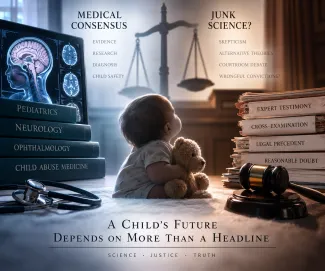
Shaken baby syndrome (SBS) has acquired a new descriptor: “junk science.” The label has migrated from defense briefs and skeptical experts into court opinions, podcasts, headlines, and public debate. But calling a contested diagnosis “junk science” is not the same thing as proving it is—unless you believe the increasing onslaught of media hype and misleading headlines. Either we read that the alleged perpetrator has been convicted of shaking a baby, causing death or serious injury, or that the diagnosis is a sham. In a few cases, the verdict is overturned, or a new trial ordered. But headlines and legal cases calling the diagnosis fraud or “junk science” are proliferating.
SBS, or Abusive Head Trauma (AHT), is defined as “an injury to the skull or intracranial contents of an infant or young child (less than five years of age) due to inflicted blunt impact and/or violent shaking,” commonly manifested by retinal and subdural hemmorhage and cerebral damage (often called the “triad"). Frequently these children also suffer skull fractures and other brain injuries, occurring when the fragile infant brain is repeatedly shaken and internally bangs against the hard skull encasing it, causing a concussion-type injury, then snaps backwards to cause more internal damage at the back of the skull (a contre-coup lesion), before the process repeats itself in a series of shakes.
Despite international medical consensus from at least 15 medical associations validating the diagnosis, a few rogue doctors and some biomechanists have convinced the media (and the courts) that the diagnosis is junk science. Now we all know junk science is bad; however, it's especially harmful in situations where it can impact the most vulnerable. Shaken Baby Syndrome is now a pejorative of the legal lexicon. Prosecutors charged with avenging horrific death or injury that could only result from repeated shaking now must rebut the “junk science” label attached to an SBS diagnosis, even before proving the specific case against the named defendant.
Recently, the highest court of New Jersey entirely eviscerated the SBS diagnosis, sustaining the decision of the appellate court in the Nieves case. The court said the diagnosis doesn't exist as there is no consensus between the medical/pediatric community and expert-witness biomechanists, who are generally paid for their testimony.
As for the evidence these biomechanists rely on, they measure the external force of shaking dolls or animals, then extrapolate the results to infants to show that the external force of a shake is insufficient to cause the injuries. They ignore the impact of internal forces or the cascading and intermingling effects of internal cardiovascular and neurological damage, causing edema and the shearing of nerves as precursors to the syndrome.
Courts have latched onto this SBS debunking fad, claiming a new wave of science has shifted the medical consensus away from treating intracranial and intraocular bleeding along with brain swelling as a presumptive diagnosis of abuse.
Recent attacks on the diagnosis broadcast by the press seem to rely on the premise that “If you repeat a lie often enough, people will believe it." Consider a recent article in last month’s e-journal The Appeal. [1] The story blares the misleading headline “Shaken Baby Syndrome Has Been Largely Debunked. Courts Are Still Catching Up,” presumably written to further imprint that courts should catch up to “new science” rejecting the diagnosis.
The case charged the baby’s mother, who eventually accepted a plea deal which allows her to maintain her innocence. One wonders why the mother was charged, since she was not with the child at the time of the injury. Rather, her housemate was supervising the child. In fact, her defense team accused the housemate of killing the child (a far cry from claiming the child did not suffer SBS). The housemate testified for the prosecution (was some deal concocted?) and accused the mother. Again, no one seems to have contested the diagnosis at trial.
But some additional statements used to bolster the “junk science” appellation are just plain bunk. The article notes that 27 people convicted of causing SBS have been exonerated since 2014. This, the author claims, signifies “that the medical community’s understanding of SBS/AHT has changed significantly” over the last ten years.
Now prosecutors do goof, and so do judges, and cases are occasionally overturned or new trials ordered. However, the fact that SBS cases are overturned says nothing about the diagnosis itself—merely that the prosecution’s case wasn’t strong enough. In fact, multiple cases of all types are reversed each year. So, just how does the reversal rate of SBS cases compare to other criminal cases?
According to the National Center on Shaken Baby Syndrome, roughly 1,300 cases of SBS/AHT are reported annually in the U.S. While we don’t have precise numbers of indictments and convictions for SBS specifically, roughly 40% of reported severe child maltreatment cases result in criminal prosecution, with general conviction rates near 88%. That means some 520 cases a year involving serious child abuse, including SBS, are prosecuted. Less than 5% are overturned or reversed. By comparison, nearly “9 percent of total appeals resulted in reversals of lower court decisions in 2015 and the years preceding.” Comparatively speaking, SBS cases do far better on appeal than other criminal cases.
What do the Biomechanists Have to Say?
To eviscerate the diagnosis, the Nieves case relied extensively on biomechanical evidence evaluating the external force of one shake in dolls and lambs. Significantly, most experiments did not include repeated shaking, and in the lamb experiment, one-third died, though the cause is not described.
At the 2026 World Biomechanics Conference, held in July, hundreds of papers were presented. Save mine, none addressed Shaken Baby Syndrome. At least a half dozen sessions with multiple speakers, however, did address Chronic Brain Trauma (CBT) and the traumatic risk of cerebral damage from repeated concussions in sports, especially football. The biomechanists generally didn't discuss external forces as a potential cause, focusing on internal injuries to tissues, cells, and organs.
Various mechanisms for severe neurological disease from CBT were examined to determine causation: internal damage to the cardiovascular system and internal deformation of the blood-brain barrier, neither of which dolls have, as well as neurodynamics and what happens inside the brain during impact (which also isn’t examined in doll studies).
The absence of a recovery process between impacts has been especially implicated as a precursor to CBT. Vessel softening from repeated concussion-type injuries increases brain vulnerability to subsequent head trauma. For this reason, high school coaches are careful not to let head-injured teens back in the game until they recover. By comparison, in the shaken baby case, the concussions are rapid- with no recovery time, accelerating tissue and cellular damage.
Other mechanisms postulated by supporters of the SBS diagnosis were found in the experimental work presented at the conference, including blood-brain barrier disruption causing brain edema, injury to the microvascular system, and the direction and speed of impact resulting in sheared nerves, all contributing to an internal cascade of events which explain the diagnostic triad found in Shaken Baby cases.
The speakers noted that teens are more susceptible to neurological injury from Chronic Brain Trauma Damage than adults. So, what might you conclude about babies?
Science advances by questioning its assumptions, revising explanations, and incorporating new evidence. Courts face a different problem. They must decide whether the evidence establishes that a particular defendant injured a particular child. Getting that judgment wrong can imprison an innocent person or allow a guilty one to go free. But an erroneous prosecution, an overturned conviction, or legitimate uncertainty about precisely how an infant was injured does not, by itself, invalidate the underlying medical diagnosis.
That is the danger of the “junk science” label. It collapses two very different questions—did abusive head trauma injure this child, and did this defendant cause it?—into one. The courtroom must answer the second beyond a reasonable doubt. Science should be allowed to answer the first with evidence, uncertainty, and continuing inquiry—not headlines.
[1] “The Appeal is a nonprofit news organization that envisions a world in which systems of support and care, not punishment, create public safety.The Appeal’s journalism exposes the harms of a criminal legal system entrenched in centuries of systemic racism…. “
Barbara Pfeffer Billauer JD MA (Occ. Health) PhD
Professor Barbara Pfeffer Billauer is an internationally recognized scholar of public health law, bioethics, and the laws of medical care, focusing on the integration of science and law and its impact on day-to-day policy and legal outcomes. She has lectured and published extensively, in scholarly journals and law reviews, and has written and edited seven books for lay and academic audiences.