She was told she was chasing the impossible. She persisted through poverty, skepticism, and 25,000 failed attempts. In the end, Ada Yonath unlocked one of biology’s most elusive structures: the ribosome, transforming our understanding of how antibiotics work and paving the way for drugs that can overcome antibiotic resistance. Her story is not only one of scientific brilliance, but of extraordinary perseverance.
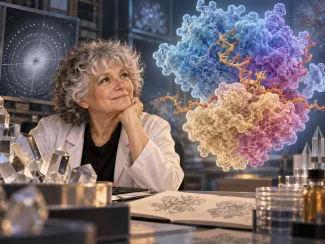
Women have won eight Nobel Prizes in Chemistry; the first went to Marie Curie in 1911, and the second to her daughter, Irene Joliot Curie, in 1935. We waited almost three decades for the 3rd woman Nobel winner in Chemistry, Dorothy Crowfoot Hodgkin, and another 45 years before the 4th award was granted [1]. Like Dorothy Hodgkin, Ada Yonath, who died last month, is relatively unknown. In 2009, she became the first woman from the Middle East to win a Nobel Prize in the sciences for deciphering the structure of ribosomes, the cellular machinery that synthesizes proteins. Until Dr. Yonath mapped its structure, its mysteries remained hidden. The discovery proved crucial to understanding antibiotic resistance and developing new drugs to combat resistant microbes.
The Puzzle Everyone Thought Impossible
It took almost four decades of work for Yonath to crack the “ribosomal code,” beginning her inquiry in the late 1970s. Because of its small size, presumed internal asymmetry, and instability, the conventional means of mapping its structure, X-ray crystallography (refined by previous Great Woman, Rosalind Franklin), the ribosome was considered impossible to crystallize, “and Yonath was considered a dreamer or a fool for trying.” That didn’t stop her, although it took 25,000 attempts before she cracked its structural mysteries.
Because bacterial ribosomes are essential for survival, bacteria have evolved ways to alter or protect themselves, allowing them to proliferate and harm (or kill) the host, human or animal. The adaptations include blocking antibiotics from binding, a phenomenon known as “antibiotic resistance.” As bacteria continue to adapt, infections become increasingly difficult to treat, creating a significant public health threat.
From Ribosomes to Antibiotic Resistance
There is another wrinkle to ribosomal antibiotics. They must affect only bacterial ribosomes, not those of the human host. According to Yonath, even a single nucleotide misarrangement can make a huge difference.
Yonath’s success provided invaluable insight into how bacterial proteins are synthesized, knowledge crucial to creating new antibiotics that target bacterial ribosomes and shut down protein production, killing the bacterial invader. Ribosome inhibitors are among the most successful antimicrobial drugs and make up more than half of all medicines used to treat infections today, all based on Yonath’s pioneering work.
A Curious Mind, Undeterred by Obstacles
Born in Jerusalem in 1939 to poor parents who fled Poland in 1933 shortly after Hitler assumed power, she showed curiosity and ingenuity early on. At five, she tried to measure her family’s balcony height using two tables, a chair, and a stool. The experiment ended when she fell and broke her arm.
Her father’s death after a long illness further compromised the family’s penurious status. Poverty and family circumstances did not prove an obstacle to a stellar education. Her mother enrolled her in the best schools, and Ada helped cover the costs by babysitting, tutoring, and cleaning (even the chemistry lab), while continuing to excel in school in exchange for tuition. To attend the prestigious Tichon Hadash high school, she taught math to students for tuition, then graduated from the Hebrew University of Jerusalem with a bachelor's degree in chemistry in 1962 and a master's degree in biochemistry in 1964. In 1968, she earned her PhD from the Weizmann Institute of Science for X-ray crystallographic studies of collagen structure.
Her education then took her to the U.S., where she did postdocs at Carnegie Mellon University and MIT, began her work in protein crystallography, and then returned to Israel to head its only protein crystallography laboratory for almost a decade. In the late 1970s and 1980s, Yonath collaborated with leaders in crystallography, and after briefly returning to the US as a visiting professor at the University of Chicago, she returned to Weizmann, where she continued her pioneering (and often derided) work in bacterial protein biosynthesis and structural modeling for two decades.
Like Nobelist Barbara McClintock and Albert Einstein, she seemed to have a genius for visualizing the then unknowable. In her case, she visualized the “ribosomal tunnel,” the path taken by nascent proteins, and how bacteria self-regulate. In 2000 and 2001, she determined the high-resolution structures of ribosomal subunits—a feat then considered unachievable. Despite the ribosome’s asymmetry, which made structural modeling difficult, Yonath discovered a region of universal “two-fold” symmetry around its active site, providing a framework for understanding its biochemical activities.
To enable her structural analysis, she developed a novel technique, cryo-bio-crystallography, which blasts X-rays through the ribosome-derived crystals at –185°C to protect their structural integrity. The process is now routine in structural biology, enabling intricate projects that would otherwise be considered formidable.
As if that were not enough, Yonath elucidated the mechanisms of over twenty antibiotics, illuminated the mechanisms of drug resistance, deciphered the structural basis for antibiotic selectivity, and showed how it plays a key role in clinical usefulness and therapeutic effectiveness, paving the way for modern structure-based drug design.
A Scientist First
Yonath said she was inspired by Marie Curie, whose biography sparked her fascination with science. Yet she resisted being defined as a “woman scientist,” and refused to consider Curie as a role model. Instead, Yonath considered herself simply a scientist. Her career unfolded in a world where women could more easily gain access, recognition, and a place at the laboratory bench than in Curie’s time, but challenges still existed. The path was open but not fully cleared, made possible by the women who came before her. Yonath widened it further—not by seeking to become a symbol, but by refusing to let doubt, convention, or repeated failure determine what she could accomplish, driven by a passion “to know” and an irrepressible drive that carried her forward throughout her life.
“The vision to understand the ribosome was an irresistible intellectual stimulus” - Ada Yonath
Challenging Consensus, Changing Science
Ada Yonath’s story reminds us that transformative science does not always begin with certainty—or even with the approval of one’s peers. Sometimes it begins with a question that others consider foolish and the stubborn conviction that it is worth pursuing. Her decades-long pursuit of the ribosome changed structural biology and reshaped the fight against antibiotic resistance. But perhaps her most enduring contribution is less tangible: she showed what can happen when curiosity meets resilience, and persistence outlasts skepticism. In science, as in life, the impossible may simply be a problem that has not yet found its patient enough investigator.
[1] Hodgkin received it for determining the structures of penicillin and vitamin B12. In 2020, Emanuelle Charpentier and Jennifer Doudna shared the award for their work on CRISPR and gene editing.
Category

Barbara Pfeffer Billauer JD MA (Occ. Health) PhD
Professor Barbara Pfeffer Billauer is an internationally recognized scholar of public health law, bioethics, and the laws of medical care, focusing on the integration of science and law and its impact on day-to-day policy and legal outcomes. She has lectured and published extensively, in scholarly journals and law reviews, and has written and edited seven books for lay and academic audiences.