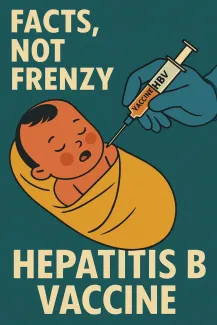
Well, it should come as no surprise that the ACIP has decided that hepatitis B vaccination for newborns is no longer its recommendation. Nor is it surprising that many organizations are breathlessly concerned. Let’s consider the facts and then craft a policy.
For the facts, I am using an article supporting Hepatitis B vaccination (HBV) in the current issue of JAMA Network.
What Hepatitis B Does—and Why Timing Matters
- Hepatitis B virus is highly contagious and can remain infectious on surfaces for about a week. Most serious harm comes from chronic infection, which can lead to cirrhosis and liver cancer.
- Age matters a lot: only about 20–30% of people infected after age 6 develop chronic disease, versus 70–90% infected in early childhood, and about 1 in 4 untreated infants infected at birth die prematurely—making prevention in pregnancy and early childhood a key goal.
- Perinatal (around-birth) hepatitis B infections happen in three main ways. Some pregnant women who test positive (HBsAg-positive) don’t get proper follow-up, others aren’t screened at all, leaving their viral status unknown, and some mothers test negative during pregnancy but are infected at the time of delivery.
- “Today, among all pregnant women in the US, approximately 0.5% test positive for HBsAg and, in 2021, an estimated 17,827 infants were born to such mothers. Under these conditions, hepatitis B vaccine administered at birth reduces perinatal transmission by approximately 70% and, when paired with hepatitis B immune globulin, prevents more than 90% of perinatal infections.”
- The standard hepatitis B vaccine is a well-studied 3-dose series given at birth, 1 month, and 6 months. It contains no thimerosal (done in an abundance of caution to “boost public confidence). The birth dose recommendation is backed by extensive evidence showing it’s both safe and effective when given shortly after delivery. Studies show no higher risk of adverse events when the shot is given at birth versus later.
- Evidence also suggests infant vaccination provides long-lasting protection, with at least ~90% still protected at 17 years.
- The vaccine has been in use for approximately 40 years. Decades of trials and ongoing safety monitoring have consistently confirmed the vaccine’s safety.
In short, hepatitis B is both highly transmissible and highly preventable, especially when protection starts at birth.
How Policy Got to the Birth Dose
The federal guidance for HBV has changed over time. While testing for hepatitis B infections became available in 1969, it took 15 years to make the first recommendation – to administer HBV soon after birth to infants born to women who were hepatitis B positive. This risk-based approach failed to identify HBV infections; as a result, in 1988, both the Centers for Disease Control and Prevention (CDC) and the American College of Obstetricians and Gynecologists recommended universal HBsAg testing in pregnancy. While this reduced cases, there continued to be 50 to 100 acute infections in infants annually. This leakage prompted further recommendations, introduced in 1991, for routine administration of the hepatitis B vaccine to all newborns before hospital discharge. This further reduced but did not eliminate cases.
Those policy shifts weren’t just bureaucratic tinkering; they were attempts to design a system that works despite predictable gaps in testing and follow-up. These nudges and policy changes were, in effect, accommodations to human nature and to the realities of our health-care system—realities that won’t change because of a single ACIP vote. Pregnant people at the highest risk of transmitting hepatitis B to their infants often face barriers to prenatal care, may miss testing, or may struggle with follow-up in fragmented systems. More importantly, the dramatically improved outcomes we’ve seen for children come from the messy real world, not from idealized randomized trials. Universal birth-dose vaccination was designed as a safety net precisely because real-world care rarely matches the textbook version.
The JAMA analysis estimates that under the current standard of care—universal hepatitis B birth-dose vaccination—about 625 perinatal infections occur each year. If the birth dose were eliminated for infants of mothers who test negative, that number would rise to roughly 674, an 8% increase. If the birth dose were limited only to infants of mothers known to be HBsAg-positive, projected perinatal infections jump to about 1,101—a 76% increase over current levels.
An additional potential downstream effect is that commercial insurance companies will no longer provide this vaccination at no cost to their beneficiaries. [1] Of course, being “penny-wise, but dollar-foolish,” may result in greater costs to insurers for those infants who become infected and develop chronic liver disease.
Medical Freedom—or Just Good Defaults?
CBS reports that the panel now emphasizes individual decision-making in consultation with a health-care provider. But that has always been the case: vaccinating a newborn is a medical procedure that requires informed consent from the parents or guardians. Parents already have the right to refuse vaccination; what has changed is the strength and clarity of the public-health nudge toward immunization, not the existence of a mandate.
"Before the birth dose was recommended, 20,000 newborns a year were infected with hepatitis B. Now, it's fewer than 20. Ending the recommendation for newborns makes it more likely the number of cases will begin to increase again. This makes America sicker." – Senator Bill Cassidy
When the Facts Change, I Change My Mind: Here, They Haven’t”
It seems to me that the facts about Hepatitis B vaccination have remained unchanged. Given the safety profile of the vaccine, based on decades of real-world data, I am willing to, “out of an abundance of caution,” possibly overtreat my child. What you determine for your child is up to your calculus, but there has never been a time when you could not refuse. The change is in the application, and the ACIP ignores the real-world experience that moved the target from high-risk only to everyone to minimize the risk to “the children.”
Secretary Kennedy has emphasized that tackling chronic illness requires shifting from “sick-care” to health, realigning incentives to reward wellness, and restoring public trust in health agencies. Whatever one thinks of his broader agenda, ACIP's decision fails to meet any of those goals.
The underlying evidence hasn’t meaningfully changed: HBV remains highly transmissible, the risk of lifelong harm is greatest when infection happens earliest, and the birth dose is a proven, decades-tested safety net against predictable failures in screening, follow-up, and access. If we remove the universal default, we should not be surprised when preventable infections rise. We will simply shift costs from a cheap vaccine to the expensive treatment of chronic liver disease. Informed consent belongs at the bedside, but public-health guidance should be built for the real world, not an idealized one—and the real world is exactly why the birth dose became standard in the first place. That is what the facts, not the frenzy, still point toward.
[1] According to STAT, there will be no change in insurance coverage, including for Medicaid, Children’s Health Insurance Program, and Vaccines for Children – all federal programs. The guidance does not apply to women found to be positive for Hepatitis B.

Chuck Dinerstein, MD, MBA
Director of Medicine
Charles Dinerstein, MD, MBA, is the Medical Director of the American Council on Science and Health. A vascular surgeon with more than 25 years of clinical experience, he brings a physician's understanding of medical decision-making, an appreciation for scientific uncertainty, and a broader perspective on healthcare economics and policy to his writing.