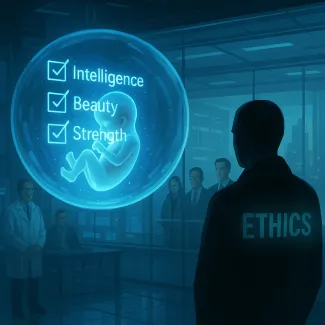
The secrets of our genes can be mined or misused. Our challenge is to sift through the data, utilize the tools, knowledge, and wisdom of what we can handle, and resist the temptation of tangling with the remainder. Otherwise, we risk creating the Sorcerer’s Apprentice, incorporating unintentional tweaks, errors, or mutations capable of reproducing for all eternity, without “the undo” or “never mind” code. This takes courage, willpower, and enforceable international regulations, which as of now go wanting.
To Recap
Somatic cells regulate cellular function; their information is not inherited, and genetic editing of mutated or defective somatic cells can be made without fear that mistakes will be transmitted across generations. By contrast, editing of germ cells has the potential to change cells on a hereditary basis, and therein lies the rub.
Biological concerns of germline editing include the fear of unintended consequences, creating irreversible errors, and knowledge gaps, such as the role of epigenetics. Legal, ethical, and moral questions trigger fears of privacy incursion, unintended use by insurance companies, schools, and employers, as well as a lack of societal buy-in and discourse.
Notwithstanding the dangers, germline engineering has been carried out at least once, to uniform and international (albeit ad hoc) condemnation. The objections were so loud that the perpetrator, Chinese doctor He Jiankui, was jailed. Bans were enacted in the Oviedo Convention in Spain, which legally bound members of the Council of Europe, and regulations were promulgated in Britain and Canada. By comparison, in the US, the sole effective constraint is the unavailability of federal funding. However, little stops the intrepid, wealthy tech-bro from renting an offshore island and setting up shop.
While scientists rant about the lack of regulation, and entrepreneurs are busy renting office space, lawyers, ethicists, influencers, and the public remain generally ignorant of the uses and dangers.
Dangers- What dangers?
To begin, genes often have multiple roles, a property called pleiotropy. In most cases, we don’t know the full extent of a gene’s capacities. Editing one gene may cause off-site effects, and deleting a “bad” gene may inadvertently remove a protective effect for the gene pool. Thus, people with two copies of the HBB gene can develop sickle cell anemia, but that gene also conveys resistance to malaria. Deleting the HBB would prevent sickle cell anemia, but also increase the risk of malaria. On an individual basis, this may be OK. On a population basis, not so much. The CCR gene, hubristically edited by He Jiuankui to prevent HIV/AIDS, is now thought to be related to cognition and dementia. The far-reaching and yet unknown ramifications on future generations are unclear.
A bioethical offshoot of this issue revolves around the impact of permanent changes to the human gene pool – even those currently regarded as beneficial. Genetic editing that favors socially preferred genomic avatars or genetic signatures (e.g., blonde, blue-eyed, buxom, Barbie-like beauties) would limit genetic diversity, a guarantor of a species’ survival. And since financial resources will determine who avails themselves of the technology, we can expect exacerbation of a two-tier society. These issues, in turn, birth the question of who will be empowered to decide which species-permanent changes we make?
Beyond Nature
While some diseases are governed by individual genes, such as Tay-Sachs or Huntington’s disease, and are amenable to genetic repair, most conditions, like diabetes or heart disease, are governed by multiple genes acting in concert. These diseases are not simply a product of genetic programming, which creates our genotype, but require mediation by a constellation of environmental and lifestyle factors to produce a particular effect, our phenotype.
To target the gene groups involved in multifactorial diseases or traits, some companies are producing algorithms to compile a polygenic risk score (PRS).
“Polygenic risk scores (PRSs) summarize genome-wide genotype data into a single variable that measures genetic liability to a disorder or a trait. … summing the number of risk alleles carried by an individual, weighted by the effect size …. The PRS is seductive in its [apparent] simplicity….”
These scores are commercially marketed for individual, clinical use, although verification of their validity for these purposes is non-existent. And while PRS may be useful for public health purposes, the predictive value is limited by the test population’s genetic variations, making generalization to individuals more akin to snake oil than prescriptive care. They ignore considerations of environmental and lifestyle factors influencing the expression or realization of the targeted genotype or traits, meaning you might not even get what you signed up for.
Additionally, new technologies like AI alert us to greater genetic complexities not only in causing diseases, but also for non-disease traits like height, intelligence, and hair color, making genetic editing or relying on PRS even more fraught.
Getting Our Hands Around the Jello
Complicating assessment is the already muddy characterizations of the contents of Pandora’s genetic box, including the sloppy cataloging and conceptualizing of genetic procedures: Roughly six types of interventions are now available or theoretically possible, although in addressing each, legal, ethical, and moral concerns are often lumped together:
- Somatic cell editing to treat or cure individual diseases (in utero or after birth).
- Germline editing to eradicate monogenetic hereditary diseases.
- Embryo screening for IVF parents using PRS to deselect embryos with a genetic signature that may increase disease risks (considered socially acceptable)
- Embryo screening for IVF parents using PRS to select genetic signatures likely to produce favored traits (considered socially unacceptable), raising the specter of what I call “soft-eugenics.”
- Somatic screening based on PRS for susceptibilities to diseases and the effects of certain drugs.
- Genetic germline editing of embryos
These procedures/technologies have different purposes, risks, and benefits, present other dangers to our species, and trigger different social sensitivities. Some techniques will directly or indirectly affect the gene pool forever, highlighting questions over society’s right to informed consent or eugenic concerns.
Playing to Greed and Ego
Latest on the genetic drafting table are socio-economic polygenic scores (PGS). These are touted as being predictive of education, income, occupation, and more. They are erroneously perceived as carrying scientific weight, inviting interest from the legal community, admonishing influencers to maximize benefits while minimizing harms, and giving legitimacy to the scores when unwarranted. Indeed, the scientific fallacies involved in using these scores on a clinical basis are sidestepped, while population use is given credence, even though the scores have yet to be validated. What may be worse is that the biological ramifications to future generations go unrecognized by non-scientifically oriented influencers.
Even without a rigorous social discourse on the ethics of genetic-tampering ventures, which I have previously and repeatedly raised, these products and marketers are increasing.
Last month, Nucleus Genomics boasted new technologies to determine genes for sex, height, hair color, eye color, along with IQ and complex traits like anxiety and ADHD. Another new carrot in the PGS marketing tool-kit includes scores reflecting longevity, ranking embryos by likelihood of diseases impacting lifespan. That expression of these genes (even if all relevant ones could be identified and targeted) involves environmental and lifestyle components outside parental control, is not dwelt on.
Paradigm Shift
Not to be outdone, Brian Armstrong, creator of the cryptocurrency exchange Coinbase, is planning on going beyond embryo-selection and entering the ethically fraught world of embryo-editing. Armstrong intends to implement newer, “safer,” gene-editing techniques, called base-editing, to make “humans resistant” to common conditions like heart disease or Alzheimer’s. Related plans by co-founded company NewLimit, a “life-extension venture,” are exploring ways to reprogram old cells into an embryonic-like state, and pursuing “immortality” research, including uploading human minds to computers.
Like all technologies, genetic tinkering can be used for both good and bad purposes. In this case, however, that dichotomy is muddied by unknowns and unintended consequences, polluted by profit-making matrices, and concocted to tantalize parental desires for better, brighter, brawnier kids. The stakes go beyond prettier and pricier progeny with genius genes. Newly fangled lures include the possibility of genetic intervention to prevent disease and increase longevity, along with raising the specter of eugenic selection, benefiting the rich while penalizing the poor.
The scientific community is not amused. Recently, three organizations representing leaders in reproductive technology [1] demanded a ten-year global moratorium on heritable human genome editing, warning that it remains “far too risky and ethically fraught for clinical use.”
I fear it’s too late:
“What was once controversial is now an everyday practice. The same is true with genetic optimization. The technology is now here and it’s here to stay.”
- Kian Sadeghi, CEO of Nucleus, a company providing “genetic health insights”
[1] Alliance for Regenerative Medicine (ARM), the International Society for Cell and Gene Therapy (ISCT), and the American Society for Gene and Cell Therapy (ASGCT

Barbara Pfeffer Billauer JD MA (Occ. Health) PhD
Professor Barbara Pfeffer Billauer is an internationally recognized scholar of public health law, bioethics, and the laws of medical care, focusing on the integration of science and law and its impact on day-to-day policy and legal outcomes. She has lectured and published extensively, in scholarly journals and law reviews, and has written and edited seven books for lay and academic audiences.