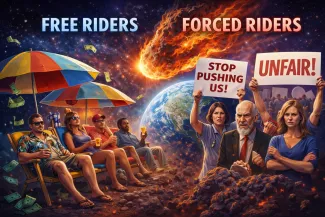
In September 2022, NASA crashed a spacecraft into the asteroid Dimorphos to test whether it was possible to alter an asteroid's course. It was successful and exemplified a public good. The potential benefit of protecting us from a cosmic collision benefited the entire world, not just US taxpayers. However, other public goods are more contentious.
Whenever benefits are broadly shared, individual incentives and collective needs tend to diverge. Roads, disease surveillance, national defense, and clean air protect entire populations, yet the costs must be gathered from specific individuals. If participation is voluntary, some will prefer to rely on others’ contributions, leaving the service underfunded. If participation is compulsory, the system works more reliably, but some participants inevitably feel conscripted into supporting something they might not have chosen. The tension between these two outcomes runs through nearly every debate about public goods.
To understand why these conflicts arise, economists typically begin with two fundamental properties of goods: rivalry and excludability.
The Economics of a Public Good?
Economists classify goods based on two main traits: rivalry and excludability. A good is considered rival if one person’s use decreases the amount available for others—like a pizza slice that only one person can eat. A good is excludable if people who do not pay can be prevented from using it. These traits lead to four main categories of goods. Private goods, such as food or clothing, are both rival and excludable and are usually allocated through markets—the domain of Adam Smith’s “invisible hand.” Common resources, like fisheries or grazing land, are rival but hard to exclude others from using, leading to the classic “tragedy of the commons.”

Modern services sometimes blur these boundaries. Digital platforms and membership services can serve millions of people at minimal extra cost, making them mostly non-rivalrous. However, they remain excludable through subscriptions or membership fees. Costco, Netflix, and Amazon Prime are well-known examples.
Non-rival and non-excludable enterprises include many of our most contentious issues, such as public health initiatives like fluoridation and vaccination, taxpayer-funded education, national dietary choices, and environmental regulation. Therefore, it would be helpful to better understand the driving forces behind these non-rival, non-excludable enterprises.
Contentious Public Goods
Not all public goods are as straightforward as NASA crashing into Dimorphos. Vaccines require manufacturing, distribution, and medical staff to administer them. Sometimes, they can be scarce, making them partially rivalrous. Remember the frenzy around getting an appointment for the first COVID vaccines? Vaccines can also be withheld or limited due to scarcity, pricing, insurance coverage, or eligibility rules. Think back to the earliest days of COVID when everyone was scrambling to be declared “essential,” like GNC, or when we prioritized the earliest vaccinations for certain groups. Vaccines are not perfectly non-excludable.
Another characteristic of contentious public goods is that their benefits are mixed, providing both private and public benefits. For vaccination, individual protection from disease is a private good, while herd immunity is the public good. For fluoride, fewer cavities are the private benefit, whereas downstream benefits like improved dentition, especially for chronic illnesses, are the public benefits.
The “prevention paradox”
Preventive measures often create a paradox. When vaccines or fluoridation work well, the diseases they prevent become rare. As the threat fades from view, the perceived benefit of participation declines and uptake can fall. Economists and public health experts call this the prevention paradox: success reduces the visible incentive to continue participating.Even though individuals gain some personal protection through herd immunity, a public good, some still opt not to vaccinate, citing “medical freedom.” This combination of factors has diminished the public benefit of herd immunity, causing nearly an eight-fold rise in measles cases since 2024 (285 vs 2283 cases).
Without ongoing nudges, voluntary vaccination often remains at suboptimal levels, prompting the government to develop public health policies that counteract these incentives and encourage higher vaccination rates.
The COVID pandemic involved policies that shifted incentives to encourage higher vaccination rates.
- Public procurement to ensure supply – Operation Warp Speed
- Subsidized vaccination through public funding and insurance reimbursement – reduce cost barriers to zero
- Public education – a plethora of news conferences, and advertising of risk
- Public mandates – to prevent free-riding.
However, those mandates introduced another player into the system: forced riders—individuals compelled to participate but who see no personal benefit. All taxpayers without children who pay for public education, as well as those who prefer alternative methods for educating their children, could be considered forced riders. The Great Barrington Declaration was a cry from the forced riders, as were the individual objections of first responders and healthcare workers mandated to be vaccinated. Those who object to fluoride in our water supply are often forced riders.
When it comes to risk mitigation as a public good, we need society to decide how much risk reduction we want, who pays for it, and whether participation should be voluntary with free riders or mandatory with forced riders. Vaccination, like many controversial public goods of risk mitigation such as fluorides or eliminating ultra-processed foods, is at the intersection of individual choice and collective welfare, with shifting incentives.
When Solving Free Riders Creates Forced Riders
Economists have long focused on the free-rider problem, which occurs when a good is non-excludable. When people can't be prevented from benefiting, some will choose not to pay for it. When governments try to address the free-rider problem, often through taxes or mandates, they risk making some people support a public good they don't value or see as necessary.
Environmental regulation provides another example. Policies that cut air pollution generate a public good—clean air is non-rival and mostly non-excludable within a region. However, individuals who see the regulations as costly, unnecessary, or ideologically offensive may feel compelled to oppose a system whose benefits they devalue.
Here's the uncomfortable but unavoidable aspect of public goods: solving the free-rider problem often entails creating forced riders. Debates about vaccination mandates, fluoridated water, or taxpayer-funded education are not just disputes about science or safety. They are about how society balances two inefficiencies: the underproduction of public goods caused by free riders, and increasingly, the resentment or perceived loss of autonomy experienced by forced riders.
Every society implicitly chooses its position on that spectrum. From this perspective, debates over vaccination, fluoride, or pandemic policies are less enigmatic. They are not just disagreements over evidence or ideology but debates about where to set the boundary between voluntary cooperation and collective responsibility. Relying too heavily on choice can weaken safeguards that depend on broad participation; relying too much on enforcement can undermine trust and autonomy. Public policy thus becomes a matter of balancing—crafting institutions that promote shared benefits while avoiding the feeling that participation is forced.
Sources: The Economics of the Asteroid Deflection Problem

Chuck Dinerstein, MD, MBA
Director of Medicine
Charles Dinerstein, MD, MBA, is the Medical Director of the American Council on Science and Health. A vascular surgeon with more than 25 years of clinical experience, he brings a physician's understanding of medical decision-making, an appreciation for scientific uncertainty, and a broader perspective on healthcare economics and policy to his writing.