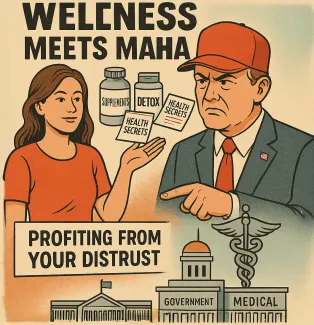
In January, Andrea Love and I co-authored an article on the then-incoming Trump administration’s growing alignment with the Wellness Industry. Since then, these ties have only deepened, and now the Wellness Industry and MAHA are inextricably linked. They both pull from the same playbook, which relies heavily on specific feelings leading you to certain assumptions. The playbook goes something like this:
- Be LOUD: Call attention to a problem that most people have heard about or feel like they know something about. Bonus points if it’s been in the headlines recently. Otherwise, manufacture a problem. Either way, be very loud about it.
- Accusations of malfeasance: Blame said problem on malfeasance, often on the “Bigs,” government agencies, the healthcare system, Pharma, or some combination of these. The more you can accuse and scapegoat, the better.
- Fake empathy: Signal understanding that you’ve been wronged and, as a result, you’re looking for someone who takes your “specific” body and life into account, unlike those pesky medical doctors who know nothing about you.
- Sell solutions: Sell products, plans, and “secrets,” all tailored to make you feel you're making healthy choices and paying your hard-earned dollars to people who actually care about you and have your best interest at heart.
These tactics exploit your emotions, relying on suggesting that the messengers know more about the problems than you do, that the messengers “actually care,” potentially in a way that no one has before, and that the messengers can guide you through the problems to solutions that will really work (their products and services).
The reason this playbook works for both the MAHA movement and the Wellness Industry is simple: both target people who feel disenfranchised and distrustful of established institutions. Whether it's someone who believes the government is corrupt and lying to them about political issues, or someone who feels the medical establishment has failed them, the core emotion is the same—disempowerment. The wellness industry capitalizes on this by presenting itself as a more caring and personalized alternative to the cold, impersonal healthcare system. Similarly, the MAHA movement casts itself as the champion of the "little guy," the only force willing to stand up against a "corrupt" government and corporate greed for your health.
This shared strategy of identifying a common enemy and positioning themselves as the sole, empathetic solution is what makes the playbook so effective for both. However, understanding the playbook by itself is ineffective; we need to be able to identify the playbook in action.
Examples of MAHA Wellness Grifts
MAHA grifts vary, but as I have written:
“They all like to rail about their dislike of the Bigs - Pharma, Food, Agriculture, etc. They speak out against the profit motives of those industries (while their portfolios contain their stock), while turning around and monetizing their outrage through selling supplements, detoxes, bogus health tests, and pushing into Flexible Spending Accounts and Health Spending Accounts.”
Vani Hari: she’s got the ear of RFK Jr., and she uses it to complain about specific chemicals while selling supplements and detoxes, also made of chemicals. For example, her protein powders contain "alkalized cocoa." To make alkalized cocoa, you must use FDA-approved methods involving chemicals like ammonium, potassium, or sodium bicarbonate. While she’s built her following and fortune railing against the use of chemicals, especially those that are difficult to pronounce, the use of these chemicals seems to be acceptable when it serves her own financial interests.
Casey Means: the current nominee for surgeon general, who doesn’t have a license to practice medicine, co-founded a company that sells continuous glucose monitors. There is scant evidence that people without diabetes benefit from the use of these devices. Additionally, tracking every minor shift in your body might become its own unhealthy obsession. In addition to co-founding a wellness company, Means also, like many others in the MAHA movement, endorses supplements, partners with supplement companies, and has written a book.
“She is the medical expert of choice for those who distrust medical expertise…What MAHA says that’s new is largely untrue, and what it says that’s true isn’t new.” – Compact
The Grift Is the Point
When you look past the rhetoric and examine their actions, it becomes immediately apparent why this alliance between MAHA and the Wellness Industry benefits both. The grift is the point.
It was never about making you healthier. It was about making money off of making you think that they wanted you to be healthier. They’ve sold you a specific set of virtues that they alone represent, capitalizing on the fear and frustration that people feel towards various aspects of our systems. They want to keep you good and riled up so you'll continue to spend your money with them. It’s all the more effective because they’ve convinced you that they really care. MAHA branding may be different, but the ultimate goal remains the same: money.
Ultimately, the alliance between the MAHA movement and the Wellness Industry isn't a political anomaly; it's a logical consequence of their shared playbook. As the examples of Vani Hari and Casey Means demonstrate, these figures don't just sell products; they sell an ideology of suspicion and a narrative of personal empowerment that conveniently leads to their own financial gain. The complaints about "Big Pharma" and "corrupt government" are a distraction, as they create new, unregulated industries with the same profit motives they claim to despise.
The true danger is not just the bogus supplements or unproven health devices, but the erosion of trust in established institutions, which allows charlatans to thrive. When the public is convinced that all "Bigs" are malicious, it's easy for a new set of "trusted" messengers to step in and monetize that disillusionment. The grift, as it turns out, was never just a byproduct of their work; it was the entire point.

Katie Suleta, DHSc, MPH
Katie Suleta is a regional director of research in graduate medical education for HCA Healthcare. Her background is in public health, health informatics, and infectious diseases. She has an MPH from DePaul University, an MS in Health Informatics from Boston University, and has completed her Doctorate of Health Sciences at George Washington University.