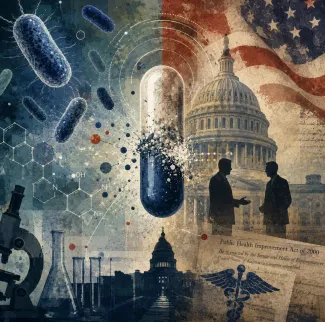
In public policy, the most monumental shifts often begin not with grandstanding, but with quiet, behind-the-scenes relationships. In the late 1990s, while serving as the Vice President of Government Relations for SmithKline Beecham, I witnessed firsthand how a simple act of corporate charity collided with political foresight to fundamentally reshape America's approach to public health.
It began with a request from an old colleague of mine from my days as a Senate staffer in the office of Senator Fritz Hollings in the 1970s. The old friend was now working for Senator Edward M. Kennedy. He reached out with a favor: Would SmithKline Beecham be willing to donate antibiotics to a charitable organization providing critical infectious disease care in the developing world?
After a quick internal review with our leadership, the answer was an easy yes. We were glad to help Sister Mary Teresa and her mission.
Not long after the logistics were finalized, my family and I returned home from dinner to find a message waiting on our voicemail. When I pressed play on the answering machine—the kind that still ran on a small cassette tape—the unmistakable, booming cadence of Ted Kennedy filled the room:
"Hi Burt, Ted Kennedy here. I’m just calling to thank you so much for helping Sister Mary Teresa and the antibiotic donation that SmithKline made, and I just wanted to tell you how much I appreciated it..."
My wife and daughters got a tremendous kick out of hearing that classic Kennedy voice echoing in our kitchen. But the story didn’t end with a thank-you tape.
The Hideaway Lunch
Shortly thereafter, the Senator’s staffer called me back. "We really appreciated what you and SmithKline Beecham did," he said. "Can we return the favor?"
I knew that our Chief Executive Officer, Jan Leschly, was scheduled to travel to Washington, D.C., a month later for a Pharmaceutical Research and Manufacturers of America (PhRMA) board meeting. I proposed a private meeting.
On the day of the visit, I escorted Jan up to the U.S. Capitol and dropped him off near Senator Kennedy’s private "hideaway" office. There, over a couple of simple sandwiches, the head of a global pharmaceutical giant and the lion of the Senate sat down for a quiet, one-on-one lunch.
When I picked Jan up afterward, I asked him how the lunch went. Jan looked at me, thoroughly impressed. "He's a really bright guy," Jan remarked.
Then he shared the core of their conversation. Senator Kennedy had asked Jan a deceptively simple question: "What is the next great public health crisis in America going to be?"
At that time, the late 1990s, the obvious answer on most people’s minds was HIV/AIDS. The epidemic was devastating communities, and while pharmaceutical companies were just beginning to bring early antiretroviral treatments to market, they were not yet overly effective or widely accessible.
But Jan gave a different, prophetic answer: Antibiotic resistance.
The Broken Economics of Medicine
Jan explained the brutal economic reality of anti-infective research to the Senator. Antibiotics, he noted, are unique because they are victims of their own success.
"Antibiotics are incredibly difficult for a business model," Jan told Kennedy. "As a company, we have to invest hundreds of millions of dollars into discovery and development, just like we do for any other drug. Then, when our drug finally gets approved, a patient takes it for a week—and they are cured."
Jan contrasted this with the industry's focus on chronic diseases. "It’s completely unlike a cholesterol-lowering medication or a blood pressure drug, where a patient might take that pill every single day for ten, twenty, or thirty years."
Because of this paradox, the financial incentives for developing new antibiotics were profoundly misaligned compared to chronic therapies. Worse yet, when a powerful new antibiotic was successfully developed, public health officials quite correctly argued it should be kept on the shelf as a "last resort" to prevent bacteria from adapting to it. From a commercial standpoint, companies were being asked to spend billions to create products meant not to be sold.
Senator Kennedy instantly grasped the terrifying public health implications: if the market incentives remained broken, the pipeline of new "miracle antibiotic drugs" could dry up, and humanity would slowly slide back into a pre-antibiotic era where a simple scratch could kill.
Kennedy looked at Jan and said, "Why don’t we work together to see if we can come up with some solutions?"
From a Handshake to Federal Law
That lunch sparked an immediate, collaborative initiative between our office at SmithKline Beecham led by Ellenor Kerr, and Senator Kennedy’s committee staff. We began hammering out policy frameworks that could bridge the gap between private R&D capabilities and urgent public health needs.
This corporate-legislative alliance injected critical momentum into a broader movement. Throughout 1999, Kennedy worked across the aisle with Senator William Frist (R-TN) to elevate antimicrobial resistance (AMR) from an isolated scientific concern to a national security priority.
The policy ideas explored during that era laid the groundwork for the Public Health Improvement Act of 2000. For the first time, federal law established a structured statutory framework to monitor resistant pathogens, fund research networks, and explore market incentives to protect the domestic pipeline of anti-infectives.
In his floor statements during this push for passage of the legislation Kennedy emphasized:
1 The Critical Threat: That antimicrobial resistance was a "silent epidemic" threatening to plunge modern medicine back into the pre-penicillin era.
2 Gratitude to Industry Statesmen: He specifically praised enlightened corporate leadership—singling out Leschly and SmithKline Beecham—for bringing technical genomic expertise to the committee's drafting table instead of playing standard partisan politics.
A Unique Detail: Jan Leschly actually retired as CEO of SmithKline Beecham in April 2000, right in the middle of the final push for this legislation. When Kennedy offered his final floor thanks later that year as the bill headed toward the President's desk, it served as both a legislative acknowledgment and a valedictory nod to a retiring CEO who had chosen to partner with the federal government on an urgent public health crisis
The Crisis Unresolved
Nearly three decades after that sandwich in the Capitol hideaway, the warning Jan Leschly gave to Ted Kennedy has proven entirely accurate.
As recently highlighted by organizations like the American Council on Science and Health (ACSH), antibiotic resistance remains an urgent, escalating global crisis. The pipeline for truly innovative antibacterials is worryingly thin. Decades of market attrition have seen many large pharmaceutical companies exit the anti-infective space entirely, leaving small biotechnology firms to shoulder the burden, many of whom face bankruptcy trying to commercialize vital new drugs in a broken market.
The dual challenge of AMR persists: we must practice strict stewardship to preserve the efficacy of the drugs we have, while simultaneously building robust economic "pull incentives" (such as subscription models or market entry rewards) to make antibiotic development viable.
The conversation that began with a voicemail and a charitable donation reminds us of a timeless legislative truth: solving humanity’s biggest existential threats requires a willingness to listen, an understanding of commercial realities, and a commitment to cross-sector collaboration. Kennedy and SmithKline Beecham built the first blueprint. It is up to modern policymakers to finally finish the structure.

Burt Rosen
Burt Rosen is President of Burt Rosen Strategies and has spent more than four decades developing federal and state government relations strategies for pharmaceutical, consumer products, and medical device companies. He previously served as Director of Government Affairs at Bristol-Myers Squibb and began his public policy career as a legislative aide to U.S. Senator Ernest F. Hollings. Rosen continues to advise pharmaceutical and medical device companies on regulatory and government policy issues.