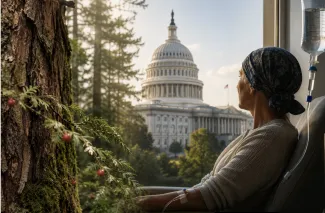
In the annals of medical and political history, few episodes better illustrate the conflict between environmental conservation and medical necessity than the effort to bring Taxol to patients.
Derived from the bark of the Pacific yew tree—one of the slowest-growing trees in the world—Taxol emerged in the late 20th century as a promising new treatment for ovarian and other cancers. However, its path from the old-growth forests of the Pacific Northwest to the patients who desperately needed it required navigating an acute supply crisis, a sudden shift in clinical trial ethics, and an extraordinary legislative rescue mission within the halls of Congress.
A Medical Breakthrough and an Ethical Dilemma
Discovered through a National Cancer Institute (NCI) screening program initiated in the 1960s, Taxol demonstrated a unique mode of action that made it a prototype for an entirely new class of anticancer drugs. By the late 1980s, Phase II clinical trials against advanced ovarian cancer had produced highly encouraging results: the drug caused tumors to shrink in roughly three out of every ten patients, with some studies reporting response rates as high as 60%.
The clinical results were so encouraging that they created an immediate ethical dilemma for regulators. As Taxol’s clinical results became increasingly promising, regulators and researchers faced growing ethical concerns about continuing traditional placebo-controlled trials in patients with terminal cancer. Because the treatment was proving to be remarkably successful, the FDA determined it would be fundamentally unethical to continue giving a placebo to terminal trial patients, thereby denying them a demonstrably effective therapy.
The excitement surrounding the drug quickly spread beyond the clinical trial system, creating intense pressure to expand patient access even before formal approval.
While this decision reflected growing ethical concerns about placebo-controlled trials in terminal cancer patients, it also created an immediate logistical challenge. As demand accelerated ahead of formal FDA approval, Bristol Myers Squibb (BMS), which had licensed the compound from the National Cancer Institute, suddenly faced the problem of producing enough Taxol to meet anticipated patient demand. Although BMS had contracted with Georgia-Pacific to plant two million Pacific yew seedlings, the trees required years to mature, and efforts to develop semi-synthetic production methods were still underway.
The Environmental Lightning Storm
The sudden, desperate demand for Taxol collided head-on with a strict environmental reality. Because the active compound could only be harvested by stripping the bark and killing the tree, the math was devastating: six 100-year-old Pacific yews were required to provide enough Taxol for just one patient. Meeting projected demand for ovarian cancer patients in the United States would require enormous quantities of Taxol, made even more difficult by restrictions on harvesting trees in old-growth forests.
Environmentalists in Oregon and Washington formed the Save the Yew Foundation, successfully turning the tree harvest into a political issue that dovetailed with the fiercely contested logging debates surrounding the endangered spotted owl.
The House Movement: Crafting the Medical Exemption
Because a massive portion of the remaining Pacific yew population stood on federally protected public property, ensuring an adequate supply of the drug required a direct legislative solution. In November 1991, Congressman Jerry Studds (D-MA), alongside 38 cosponsors, introduced H.R. 3836, known as the Pacific Yew Act.
The bill's explicit purpose was to create a landmark legal mechanism: a medical exemption that mandated federal management of public lands to ensure a steady supply of Taxol for cancer patients while balancing long-term conservation. It specifically targeted lands administered by the National Forest System and the Bureau of Land Management (BLM).
The bill was jointly referred to the House Agriculture Committee and the House Merchant Marine and Fisheries Committee. The Agriculture Committee, predominantly Southern and Western members, leaned toward a conservative philosophy that favored providing a life-saving drug over adhering to unyielding environmental restrictions.
To build momentum and ease environmental gridlock, congressional staff and BMS's Government Affairs Director traveled directly to the big-growth forests of Oregon in March 1992. Field observations provided vital ecological context: the Pacific yew did not grow in dense, uniform groves, but was interspersed one or two trees at a time throughout the landscape. Proving that harvesting could be done selectively—requiring only a single worker to cut a tree, strip the bark, and haul it away without clear-cutting the surrounding forest—demonstrated that the disruption would be minimal.
This critical on-the-ground compromise allowed the bill to rapidly advance. Following joint subcommittee hearings, both full committees approved the Pacific Yew Act in May and June of 1992, readying the legislation for a full vote on the House floor.
The Human Element That Accelerated the Senate
With the House version building momentum, the strategic focus shifted to navigating the Senate. The ultimate destination was the Senate Energy and Natural Resources Committee, chaired by Senator Bennett Johnston (D-LA), which was identified as the friendliest forum for federal land exemptions. It was here that abstract public policy became deeply personal.
An appointment was made with a senior attorney in Senator Johnston's office—a former colleague from the early 1970s when the BMS representative worked across the hall in Senator Ernest Hollings’ office. As the pitch for the Pacific yew legislation unfolded, explaining the supply crisis and the desperate need for a federal medical exemption to harvest the trees, she listened quietly.
When the story finished, she looked up and shared a stunning revelation: she had ovarian cancer and was currently enrolled in one of the very Taxol clinical trials that had caused such a stir. She informed him that none of her previous treatments had been successful until she received Taxol, which had successfully shrunk her tumor. She stated simply that she likely would not be alive but for the drug.
The personal impact of the legislation instantly transformed the bureaucratic timeline. The aide immediately mobilized the committee's Chief Counsel and Minority Counsel to slightly modify the draft of the bill, ensuring it was referred directly to the Energy and Natural Resources Committee.
A Lasting Legacy of Governance
With a passionate insider driving the process from within, the legislative gears turned at a speed rarely witnessed in Washington. Introduced in the Senate on June 16, 1992, the companion bill (S. 2851) cleared hearings, won committee approval on July 1st, and was sent to the floor. Meanwhile, the House of Representatives overwhelmingly approved its version on July 7th. The Senate quickly took up the House bill, passing it on July 23rd and clearing it for the White House.
On August 8, 1992, the Pacific Yew Act was officially signed into law. The law successfully secured the medical exemption needed to sustain patient care during a critical historical and scientific window. Ultimately, the law served as a vital bridge; within a few years, alternative semi-synthetic manufacturing methods were successfully developed, rendering the harvest of wild forest trees obsolete [1]. Today, the story stands as a profound example of how governance, when touched by shared human experience and a willingness to compromise, can truly save lives.
NOTE:
[1] The Holton synthesis revolutionized the production of Taxol by using 10-deacetylbaccatin III, a precursor extracted from the needles of the far more abundant European yew, eliminating the need to harvest bark from mature Pacific yew trees. See “Semisynthetic" Is a Real Word—and It Saves Lives: The Taxol Story
Burt Rosen
Burt Rosen is President of Burt Rosen Strategies and has spent more than four decades developing federal and state government relations strategies for pharmaceutical, consumer products, and medical device companies. He previously served as Director of Government Affairs at Bristol-Myers Squibb and began his public policy career as a legislative aide to U.S. Senator Ernest F. Hollings. Rosen continues to advise pharmaceutical and medical device companies on regulatory and government policy issues.