
Bite on a caffeine tablet and be prepared for a number of reactions—all horrible.
Such reactions include, but are not limited to:
- Gagging
- Spewing
- Spewing and gagging
- A reaction resembling the thumbnail pic.
The bitterness is immediate, medicinal, remarkably persistent, and decidedly icky. It clings to the palate long after the tablet is gone, leaving little doubt that caffeine is one of the most intensely bitter compounds most people will ever encounter, at least intentionally. [1]
Which makes coffee rather puzzling.
For math nerds:
- Caffeine molecular weight = 194.19 g/mol
- The authors use a caffeine concentration of 7.5 mmol/L in their experiments.
- This works out to 1.46 g/L
- Under the authors' assumptions, an 8-oz cup (0.237 L) would contain something like 300–350 mg of caffeine.
That's a lot of caffeine; a No-Doz tablet has 200 mg, so one would expect, at the very least, a cat face from a cuppa. Coffee contains enough caffeine to justify such a reaction, yet somehow it doesn't provoke it.
A recent study by Michael Gigl and colleagues at the Technical University of Munich, published in the Journal of Agricultural and Food Chemistry, may explain why. Coffee doesn't taste like a caffeine tablet despite containing plenty of caffeine. Why? Some of that caffeine appears to be interacting with other compounds in the coffee itself.
Regular readers (both of you) may recognize a familiar theme. In a recent article on beer flavor, I discussed how minor components, not just concentration, can play an important role in determining whether drinkers like or dislike certain beers.
The coffee story arrives at a similar conclusion. What matters is not simply how much caffeine is present, but what the surrounding coffee matrix allows that caffeine to do. The challenge, of course, is figuring out which components of that matrix are responsible.
Gigl and colleagues began with one of the leading suspects: chlorogenic acids, a family of compounds naturally abundant in coffee. For decades, researchers have known that caffeine and chlorogenic acids can form molecular complexes, suggesting that these interactions may suppress caffeine's bitterness.
The team confirmed that the complexes do indeed form. NMR experiments showed that caffeine and chlorogenic acid molecules interacted in solution, much as earlier researchers had proposed. Unfortunately, they don't appear to explain very much. Sensory testing [2] showed that caffeine-chlorogenic acid complexes were nearly as bitter as caffeine alone. Bummer.
If chlorogenic acids weren't responsible, something else had to be affecting caffeine's sensory impact.
Next suspect, please.
The researchers turned their attention to melanoidins, the complex brown materials (one reason why coffee is brown) formed during roasting via the Maillard reaction.
Melanoidins are among the least understood components of coffee. They contribute color, body, and antioxidant activity, but because they are chemically complex and difficult to characterize, they have often remained in the background of coffee research.
As was the case with chlorogenic acids, NMR experiments showed that caffeine interacts strongly with the high-molecular-weight melanoidin fraction of coffee (Figure 1).
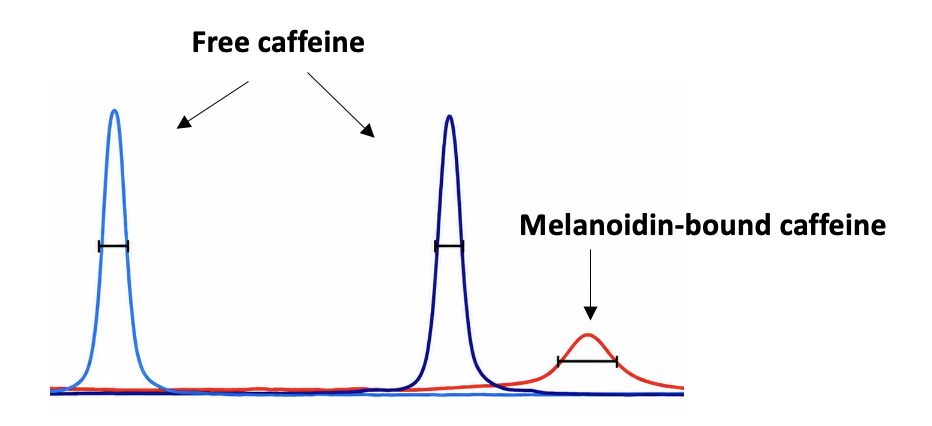
Figure 1. Free caffeine produces sharp NMR signals (blue peaks). Melanoidin-bound caffeine produces a much broader signal (red hump) because it is associated with much larger roasting-derived structures. The reasons NMR does this are complicated and not especially entertaining. The important point is that not all of the caffeine in coffee is freely floating in solution.
Unlike the chlorogenic acid complexes, however, these interactions appeared to affect what people actually tasted.
Bingo.
This time, the NMR experiment did correlate with sensory experiments. When caffeine was combined with melanoidins at concentrations representative of brewed coffee, bitterness was reduced by approximately half.
Suddenly, things began to make sense.
The caffeine had not disappeared. The coffee still contained exactly the same amount of it. Nor had the caffeine been chemically transformed into something less bitter. Instead, a portion of the caffeine appeared to be spending at least some of its time associated with melanoidins.
This distinction is important. What matters to your taste buds is not necessarily how much caffeine is present in the cup. What matters is how much is available to interact with bitter taste receptors.
In other words, the concentration of caffeine hasn't changed. Its behavior has.
Caffeine is present in abundance. Its intrinsic bitterness is undeniable. Yet its sensory contribution cannot be predicted from concentration alone. The roasted coffee matrix itself influences how caffeine behaves and, ultimately, how it is perceived.
In this sense, melanoidins are more than passive roasting products. They appear to function as active participants in flavor expression. Rather than simply surrounding caffeine, they modify its sensory impact through molecular interactions that reduce the intensity of bitterness reaching the drinker.
The broader lesson extends well beyond coffee.
Whether in coffee, beer, tea, wine, or other complex beverages, flavor is rarely determined by individual compounds acting alone. The sensory importance of a molecule depends not only on how much of it is present, but also on what the surrounding matrix allows it to do.
The work of Gigl and colleagues offers a reminder that flavor is not merely a matter of composition. It is also a matter of interaction. Coffee does not taste the way it does because of caffeine alone. It tastes the way it does because caffeine exists within coffee.
Bottom line
It's not often that a problem gets solved this cleanly. The researchers identified a suspect using NMR spectroscopy, rounded up 18 volunteers to conduct the lineup, and caught the culprit. Coffee doesn't taste as bitter as its caffeine content would suggest because some of that caffeine is busy hanging around with melanoidins.
That's pretty cool. Much like iced coffee.
NOTES:
[1] Caffeine is nowhere near the bitterest substance known. That dubious honor belongs to compounds such as denatonium benzoate (Bitrex®), which is added to antifreeze and other household products to discourage accidental ingestion. Nevertheless, caffeine is probably among the most bitter substances most people will ever intentionally encounter. Whether they choose to repeat the experience is another matter.
[2] English translation: The researchers mixed the compounds together and had 18 trained volunteers taste them. Despite convincing NMR evidence that caffeine and chlorogenic acids were interacting, the tasters remained stubbornly unconvinced.

Josh Bloom
Dr. Jonathan (Josh) Bloom, ACSH's Director of Chemical and Pharmaceutical Sciences, earned his Ph.D. at the University of Virginia and completed postdoctoral training at the University of Pennsylvania. During his 20-plus years in drug discovery at Wyeth, his research group discovered the antibiotic Tygacil®, approved in 2005. He holds 25 issued patents and has authored 35 academic papers. Since joining ACSH in 2010, he has written more than 2,000 articles and dozens of op-eds for major newspapers, including The Wall Street Journal and Chicago Tribune.