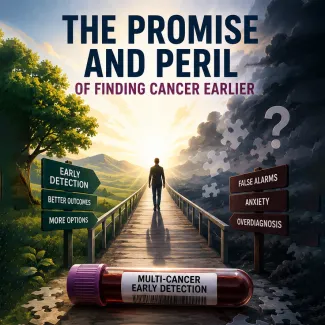
Before answering that question, it helps to understand what cancer screening is meant to do—and why even good screening tests can create difficult trade-offs.
Why earlier is not always simpler
In general, the earlier a cancer is identified, the more likely it can be cured or effectively treated, making it more of a chronic illness than a death sentence. Prostate and breast cancers fall into that category, while pancreatic and ovarian cancers, because their more specific symptoms appear late, are most often diagnosed in later stages, when treatment is far less helpful. For the most part, our screening tests, e.g., mammography, colonoscopy, and prostate-specific antigen (PSA) blood tests, identify individuals with breast, colon, and prostate cancers, respectively, ideally in the earliest stages. However, these screening tests come at a price, both economically and psychologically – with falsely identified cases creating increased worry and falsely missed cases creating unwarranted ease that may later become malpractice litigation. [1]
One way to make screening more useful is to focus it on people most likely to benefit. In clinical terms, this means “enriching” the screening population—testing people whose risk is already higher because of age, lifestyle, genetics, or family history. That is why people with a family history of breast or colon cancer may begin screening earlier, why smokers may be offered lung cancer screening, and why people with BRCA mutations may receive closer surveillance.
The promise of blood-based biomarkers is to add a new layer to that risk picture, detecting clues from the tumor itself before symptoms appear.
Cancer biology offers another possible way to identify risk. Tumors can release small traces of DNA, proteins, or other molecules into the bloodstream before symptoms appear. In theory, those signals could help doctors identify people who need closer evaluation, even when they feel well.
In 2015, as reported in JAMA, a small number of asymptomatic pregnant women were found to have cell-free DNA consistent with an underlying cancer. That finding led to the founding of Grail, a company dedicated to the earlier detection of cancers through these early chemical biomarkers. Grail is a driving force behind what is termed multi-cancer early detection (MCED), with a validated test, Galleri, that can identify a biochemical signature associated with up to 50 cancers. They began a study in the US, Pathfinder, as well as a study in the UK, NHS-Galleri.
Pathfinder I and II
Pathfinder I was designed primarily to measure what happens after Galleri detects a cancer signal: how long it takes, and how much follow-up testing is needed, to reach an answer. More than 6,000 adults aged 50 or older with no cancer symptoms were tested. Galleri detected a signal in 1.4% of them. Among those flagged, cancer was confirmed in 38%, while 62% turned out to be false positives. Getting to an answer often required more testing: additional lab work in 80% of flagged patients and imaging in 90%. It took about two months to confirm cancer, but almost three times as long to clear a false alarm. The test’s strongest performance was its negative predictive value of 99%, meaning that a negative result made cancer very unlikely in the study setting. Its positive predictive value was less reassuring, at about 40%. [2]
Pathfinder II built on this work and included 23,000 cancer-symptom-free individuals at risk for cancer, based on established clinical risk factors such as lifestyle and family history. The results have not yet been peer-reviewed or published, so caution is warranted. Still, the reported findings suggest that testing a higher-risk population increased Galleri’s positive predictive value to 62%, a notable improvement over Pathfinder I and, according to the investigators, stronger than some standard screening benchmarks.
It seems fair to conclude that combining Galleri’s biochemical signature with lifestyle and family history risks improves identification of individuals with “early” asymptomatic cancers. Whether the screening pool is best enriched by evaluating blood work first or only in those clinically at risk remains to be tested and will ultimately be a matter of cost.
That leaves the most important question. After all this improved detection, are we saving lives—or simply making earlier diagnoses?
A Larger Trial - NHS-Galleri
As reported at ASCO, this study evaluated 142,000 cancer-asymptomatic adults aged 50-79, with half receiving annual Galleri testing. In more real-world testing, the positive predictive value was 52%, not quite as useful as Pathfinder II suggested. The goal was to identify cancers earlier, and the results were mixed. It increased the number of cancers identified fourfold compared with the control group receiving standard care. It found more early cancers (16%) and reduced late cancers (14%), defined as having spread distantly (Stage IV). However, there is no information on whether we saved any lives.
Earlier Diagnosis, Better Outcomes?
For some aggressive or hidden cancers, earlier detection might reduce mortality. That is the hope behind MCED screening. But even this large, carefully conducted study does not yet tell us whether Galleri meaningfully improves quality of life or survival, or whether it mainly shifts the timing and stage of cancer diagnosis. That distinction matters. Earlier diagnosis can help, but it can also introduce lead-time bias, overdiagnosis, anxiety, invasive follow-up testing, and cost. For regulators and clinicians, the central question is whether Galleri is ready to become part of routine care or needs further study to demonstrate that its benefits outweigh its financial and psychological harms.
[1] It is estimated that up to 25% of breast cancers identified on mammography can retrospectively be identified on the previous study.
[2] A positive predictive value answers the question, "If my test comes back positive, what is the probability that I actually have cancer?"

Chuck Dinerstein, MD, MBA
Director of Medicine
Charles Dinerstein, MD, MBA, is the Medical Director of the American Council on Science and Health. A vascular surgeon with more than 25 years of clinical experience, he brings a physician's understanding of medical decision-making, an appreciation for scientific uncertainty, and a broader perspective on healthcare economics and policy to his writing.