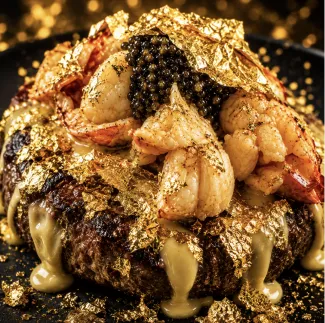
In today's "Are You Kidding Me?" feature, scientists at Stanford reported that they're using AI to create space-age burger recipes. Seriously? (Yes, seriously. My esteemed colleague Chuck "Chuckie D." Dinerstein also wrote about this, albeit in a slightly different style).
Apparently, yes. According to Ellen Kuhl, Professor of Mechanical Engineering, who is quoted in the June 26th Stanford Report:
Most AI systems are trained to predict what already exists. We wanted AI to invent what should exist next.
Ellen Kuhl, Professor of Mechanical Engineering
In these days of barely-pubescent crypto billionaires, you might expect that someone with electrons to burn might create a $666 gold-leaf hamburger, if for no other reason than to "out-ass" his billionaire buddies.
Nope. It's now 14 years too late. The "Douche Burger," a magnificent accomplishment by any measure, made its societal debut back in 2012. Humanity hasn't looked back since. AI may or may not create the tastiest burger, but it's way behind in the race to produce the most pretentious one.
Can you eat gold?
The question, like most of those in the Dreaded Chemistry Lesson From Hell®, is nuanced rather than a simple yes-or-no proposition. Therefore, let's bring in the kings of nuance, Steve and Irving, to host this episode.
Returning from the Knicks' victory parade, Steve (left) and Irving displayed their understated style, à la Spike Lee.
Here is what the average American knows about gold:
- It's pretty
- It costs a lot...
- (For guys only) ...but not as much as alimony, should you forget to purchase a sufficient quantity of the stuff to commemorate various occasions of importance, especially anniversaries.
The above can be represented by a mathematical equation:

There's plenty that you don't know about gold. You can chew it (sometimes), destroy it (although it's not easy), there are a few terrible drugs that contain it, and miners use sodium cyanide to extract it, which isn't exactly marvelous for the environment. But to understand why you can eat gold in the first place, you first have to understand why gold is chemically so unusual. Our first stop in the Chemistry Lesson From Hell® is gold "minerals."
Gold "minerals" are super rare
I put the word "minerals" in quotes because the only metals commonly found on Earth in their elemental (unchanged) state are gold and seven others [1]. Gold and the other noble metals—those that are stable in the presence of oxygen, carbon dioxide, water, and the rest of the environment—are chemically unreactive. In contrast, metals such as magnesium, sodium, potassium, zinc, lithium, and calcium are almost always found as chemical compounds in minerals rather than as the pure metal. Chalk, for example, is calcium carbonate, not metallic calcium. Gold, on the other hand, is commonly found in nature as the pure metal.
There is an exception. Gold combines with tellurium (of all things) to form gold telluride, a mineral. This is seriously weird chemistry, so rather than make an idiot out of myself trying to explain it, I'll just show some pretty pictures.
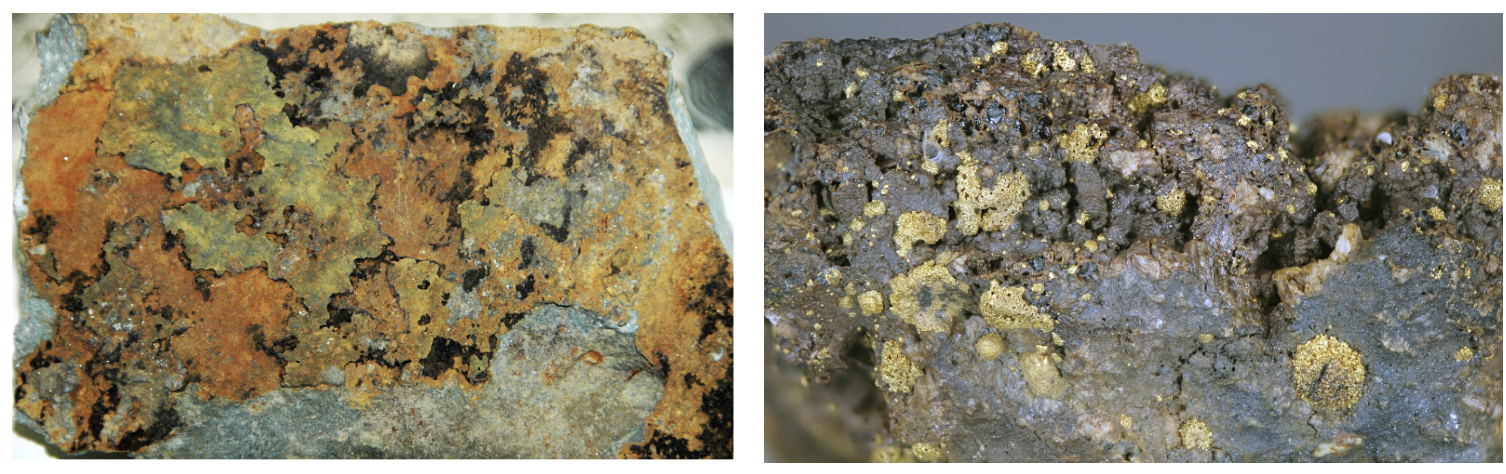
Gold telluride. Pretty pictures. Images: Wikipedia
Gold is practically inert
There are very few things on earth that won't react with nitric acid. It's some powerful ####. But gold does not. You need something even worse called aqua regia ("regal water"), which is made by adding 3 parts of concentrated hydrochloric acid to one part concentrated nitric acid. (Warning - not recommended as eye drops). The reason both acids are required is that they perform different functions in two distinct steps. Nitric acid is a very strong acid, but also a powerful oxidizing reagent. Hydrochloric acid provides Cl-.

The reaction of gold metal with aqua regia. Gold reacts reversibly (and very slowly) with nitric acid to form a little Au3+. Then chloride reacts with the Au3+ to form the stable AuCl4- ion, which is water-soluble. This reaction removes the Au3+ from the solution and drives the equilibrium to complete the reaction.
Pure gold is too soft to make jewelry, so much so that you can chew it.
There are a number of methods used to measure the hardness or softness of metals. (One is called the Rockwell Hardness Scale.) By any measure, gold (24K, 100% pure) is soft. It is rarely used in jewelry because it would bend too easily. There is another measure of metallic hardness called the Mohs Scale, which rates metals from 1-10, with 1 being the softest (1). Gold, zinc, tin, and lead (the softest of the common metals) are on the low end (between 1.5-2.5), while steel and tungsten are on the other end (~7). Your teeth are a 5, so while it is not recommended, if you bite down on pure gold, you will leave a small imprint. If the gold is 24K and thin enough, you could theoretically eat it.
Gold forms coordination complexes. Some of them are drugs.
Gold doesn't react with many chemicals, but it is a transition metal – a group of metals in the center of the periodic table that form "coordination complexes" with the metal in the center surrounded by a number (often 4 or 6) of ligands (2) such as ammonia, cyanide, water, and chloride. These metal-ligand bonds can be quite strong, even irreversible. To envision the difference between a chemical reaction and complexation, a reaction "destroys" the metal while coordination "holds it captive." Here's a notorious coordination complex:
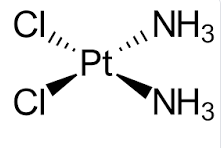
cis-Diamminedichloridoplatinum(II), aka cisplatin, is a coordination complex with two chloride and two ammonia ligands. It is one of the most toxic chemo drugs, causing vomiting in >90% of patients.
If you haven't done research in the arthritis field you might be very surprised to know that there are actually FDA approved drugs containing gold atoms. Gold-containing drugs are immunosuppressive coordination complexes (with sulfur) and are used to treat rheumatoid arthritis. Here are their structures.
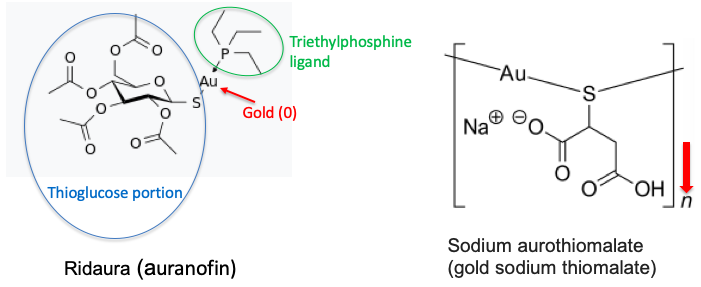
Two gold-containing drugs. Both Ridaura (a complex of acetylated thioglucose and triethylphosphine) and gold thiomalate (a polymeric complex of gold and thiomalic acid) are disease-modifying anti-rheumatic drugs (DMARDs). Both have a long list of side effects and have largely been replaced by newer, more effective drugs such as Enbrel and Humira.
Gold mining isn't so great for the environment
Gold metal also forms coordination complexes with cyanide, which is why cyanide is used for gold mining. In a process called cyanide leaching, crude gold-containing ore is soaked in a solution of sodium cyanide.
Step 1: Gold is reacted with sodium cyanide and oxygen to form sodium dicyanoaurate (complex), which is water-soluble (this is what "aq" means):

Step 2: The gold complex is reacted with powdered zinc, forming zinc cyanide (water-soluble) and gold metal, which precipitates and can be collected by filtration.

The problem is that this can leave a bunch of cyanide lying around. The US has banned the use of cyanide leaching for gold mining. It has yet to ban kale.
The golden hour. Time to quit
Well, time is money, and money is gold. I've spent more than enough time writing this hideous article. Feel free to symbolically balance the equation by sending some gold to ACSH. We won't waste it on $666 hamburgers.
Now, the funniest part. It was a hoax!
If you were a wealthy moron hoping to eat gold, you were out of luck. A New York food truck owner made the whole thing up. The owner, Franz Aliquo, had his reasons:
"[We make it because of] our deep-seated disgust and hatred of all the other douche burgers out there."
Franz Aliquo, 2012. One angry dude, but the quote is pure gold.
NOTE:
[1] The others are silver, copper, platinum, palladium, osmium, iridium, and mercury

Josh Bloom
Dr. Jonathan (Josh) Bloom, ACSH's Director of Chemical and Pharmaceutical Sciences, earned his Ph.D. at the University of Virginia and completed postdoctoral training at the University of Pennsylvania. During his 20-plus years in drug discovery at Wyeth, his research group discovered the antibiotic Tygacil®, approved in 2005. He holds 25 issued patents and has authored 35 academic papers. Since joining ACSH in 2010, he has written more than 2,000 articles and dozens of op-eds for major newspapers, including The Wall Street Journal and Chicago Tribune.