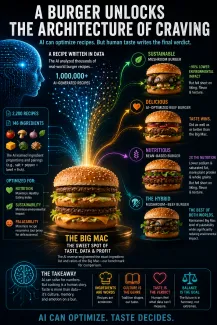
A Recipe Written in Data
The AI of the study used about 2,200 burger recipes found on Food.com, providing it with both the 146 different ingredients and their relative proportions within each recipe. Additionally, they had weightings for which ingredients went together, i.e., salt with pepper was weighted more heavily than beef paired with fish.
The AI generated over one million burger recipes that were optimized for nutritional quality based on the Healthy Eating Index [1], environmental impact [2], and palatability. Of course, an AI has no taste buds; the researchers needed a proxy for pleasure. They used recurrence: if certain ingredient combinations repeated in the model’s output, that suggested the model was gravitating toward combinations that were common, familiar, or statistically favored in human burger recipes. In other words, the most repeated combinations were treated not as proof of deliciousness, but as likely candidates for a high-probability sweet spot in burger tradition.
The most frequent combination in each of those three optimizations was translated by a trained chef into meals that were served to roughly 100 human participants in a blinded restaurant setting, where they rated the flavor, texture, and overall “liking.”
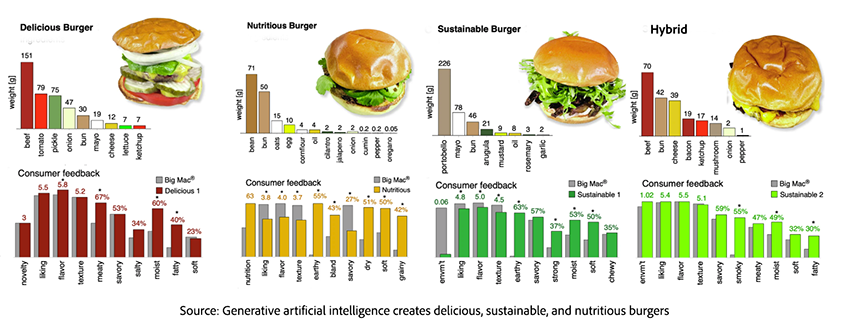
- The AI, without prompting, successfully reverse-engineered the exact ingredient list and ratios of the Big Mac – the fast-food icon does indeed occupy both a mathematically optimized and profitable region of our collective taste. It served as the study benchmark.
- When optimized for palatability, AI-generated “Delicious Burgers” did as well or better than the Big Mac
- Optimized for sustainability, a mushroom-based burger reduced the environmental impact by an order of magnitude, but failed to come close to a Big Mac in terms of liking, flavor, or texture
- Optimized for nutrition, a bean-based burger doubled the HEI, reducing sodium and saturated fats while packing in plant proteins and whole grains. It, too, failed to come close to Big Mac in all three categories.
- A mushroom-beef hybrid burger maintained Big Mac’s palatability and enjoyment while still reining in its environmental impact.
The AI could solve for selected measures of planetary and personal health. But when those solutions reached the plate, human taste buds pushed back. The study’s real interest begins where the numbers stop: in the space between an optimized recipe and a satisfying meal.
The Grammar of Craving
Samin Nosrat’s Salt, Fat, Acid, Heat argues that all good cooking relies on balancing these core elements in creating a range of flavors and textures. She is not the only cook to make that argument. So, it would not be surprising that an AI tuned to language would uncover an underlying culinary grammar, where ingredients are words, recipes are sentences, and cultural choices are genres.
The Big Mac even comes with its own familiar sentence:
“Two all-beef patties, special sauce, lettuce, cheese, pickles, and onions on a sesame seed bun.”
To extend the metaphor, the Big Mac is not Shakespeare because it is refined, but because it is canonical: instantly recognizable, endlessly repeated, and structurally balanced. Its fat, from beef, cheese, and sauce, is sharpened by pickles and onions, then softened and textured by lettuce and a sesame-seed bun.
That helps explain why the healthier and more sustainable burgers struggled. On paper, their culinary “sentences” were grammatically plausible. On the tongue, participants found them bland, dry, earthy, or grainy. By reducing fat and salt while emphasizing beans, mushrooms, grains, or other plant-forward ingredients, the recipes gained nutritional or environmental advantages but lost some of the sensory punctuation that makes a burger feel like a reward.
Still, the AI’s achievement should not be dismissed. By scanning thousands of crowdsourced recipes, it mapped patterns of culinary harmony that are rarely written down as rules. Much of that knowledge usually travels through habit, culture, family cooking, restaurant practice, and the accumulated instincts of cooks.
The tension between what the model could map and what diners want points to the deeper problem with optimization.
Grammatically Correct, but Artfully Dead
An algorithm maximizes data points, aligns variables, and produces a result that is irrefutable on paper. Yet, when exposed to actual human experience, these optimized constructions frequently collapse under the weight of their mathematical underpinnings. The model successfully met the task’s mechanical requirements: it doubled the Healthy Eating Index with a bean-based formulation and slashed environmental impact by an order of magnitude using portobello mushrooms. It is a series of sentences that contains no errors yet inspires no joy.
This is the danger of optimization when it is separated from sensory intuition. If a system treats human indulgence as noise to be reduced, it may strip away the textures that make food compelling in the first place. In comfort food, fat, smoke, salt, and softness are not merely parameters to minimize or balance. They are emphasis, punctuation, and narrative hook—the emotional syntax that pulls the eater in.
Participants found the optimized versions bland, dry, earthy, or grainy, not because the AI misunderstood nutrition or sustainability, but because it misunderstood the emotional genre of the burger. A burger is not merely a delivery system for protein, fiber, sodium, saturated fat, and carbon footprint. It is a compact architecture of craving. The AI could identify combinations that were probable, nutritionally defensible, and environmentally attractive. But probability is not pleasure, and compliance with a rule set is not the same as satisfying a craving.
The study shows what AI can reveal about the patterns beneath ordinary appetite.
What AI Really Discovered
In this study, novelty mostly emerged through recombination. The model worked within a landscape of existing burger recipes, mapping what people had already made and then sampling new possibilities from the edges of that terrain. That may not be creativity in the human sense, but it is still powerful, revealing patterns in what we have already liked and recombining them at a scale no individual cook could manage.
Human cooking, conversely, thrives on serendipity. Where the AI sees an anomalous data point to be filtered out, the human mind can turn accident into insight. Burnt butter is not merely an improbable deviation from a recipe; its unexpected nuttiness becomes beurre noisette, something to be applied to savory or sweet as conditions warrant. A chef can deliberately break the established rules of culinary grammar, creating an entirely original dialect.
The model’s real achievement was not that it invented the future of food. It showed that human craving has patterns. Ingredients behaved like words, recipes like sentences, and cultural choices like genres—structured enough for a machine to detect, but still difficult to translate into pleasure.
It uncovered the grammar of the burger well enough to reverse-engineer the Big Mac and produce a palatable hybrid that retained much of the pleasure while reducing environmental impact. It did not discover healthier foods people automatically want. It discovered that our preferences are patterned, legible, and therefore optimizable.
That discovery is both useful and unsettling, because the ability to map craving can be used to improve food, or to make existing cravings even harder to resist.
The Public-Health Problem Hidden in the Burger
By treating culinary grammar as a high-dimensional pattern to be searched, AI can help unlock the syntax of human craving. That power matters most at scale. A chef cooking for a table can respond to mood, season, smell, memory, and what looks good in the market that morning. A company feeding millions needs a script that can be repeated with minimal variation. AI is well-suited to that second world: it can search a million possibilities for the burger that offends the fewest palates. The risk is that such food begins to speak in homogenized prose—efficient, broadly acceptable, and less connected to the intimacy of cooking for particular people.
When an optimization tool enters a market-driven food system, its most obvious use is to improve efficiency. If the target is nutrition, it can raise the Healthy Eating Index. If the target is sustainability, it can reduce environmental impact. If the target is desire, it can recreate the architecture of the Big Mac. The ethical question is not whether AI can optimize food, but who sets the target.
The public-health challenge is that those goals do not naturally converge. The AI revealed the conflict with unusual clarity. Healthier and more sustainable foods may succeed on paper yet fail on the tongue because craving is sensory, emotional, cultural, and learned. The harder task is not teaching AI to optimize food. It is teaching it to help create better food that people want to eat. Unless we are careful about what we ask it to optimize, it may become very good at giving us exactly what we already want, rather than helping us want something better.
Source: Generative artificial intelligence creates delicious, sustainable, and nutritious burgers Nature NPJ Science of Food DOI: 10.1038/s41538-026-00953-x

Chuck Dinerstein, MD, MBA
Director of Medicine
Charles Dinerstein, MD, MBA, is the Medical Director of the American Council on Science and Health. A vascular surgeon with more than 25 years of clinical experience, he brings a physician's understanding of medical decision-making, an appreciation for scientific uncertainty, and a broader perspective on healthcare economics and policy to his writing.