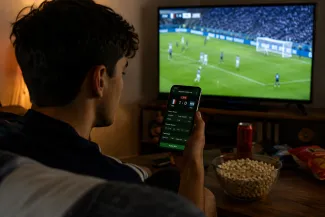
Geuvânio was ecstatic. He had just bet 100 reais ($20) on an Algerian victory over Austria, a bold call given that many pundits expected a draw and both teams would advance. He trusted his hunch and focused on the potential reward: an Algerian win would return about 415 reais ($80).
With every minute, his emotions swung between euphoria and despair. Austria scored, Algeria equalized, Austria pulled ahead, and Algeria fought back. Then, in stoppage time, an Algerian winger broke free and scored, making it 3–2. But just before the final whistle, an Austrian header made it 3–3. In little more than 90 minutes, Geuvânio had gone from hell to heaven and back again. He cursed the referee, the Algerian players, and the entire Austrian squad. In the end, his boldness had not beaten the odds; it had merely confirmed them. Having learned from past experience, he knew the worst decision would be to chase his losses. Instead, he simply turned off the TV.
Geuvânio does not exist, but his emotions certainly do. According to a BBCreport, the 2026 World Cup could become the largest betting event ever, with more than $50 billion expected to be wagered throughout the tournament. In regulated markets, bookmakers typically retain 5% to 10% of all wagers, known as the "house edge," meaning they would keep around $2.5 billion once the tournament ends.
Behind these figures, however, are stories far less optimistic than Geuvânio's. While some gamble for entertainment, others gamble away their savings, hoping for financial relief. Still others struggle with Gambling Disorder, recognized by the latest Diagnostic and Statistical Manual of Mental Disorders (DSM-5) and classified under substance-related and addictive disorders, which affects roughly 74 million adults worldwide. The situation is growing more alarming because content creators now promote gambling to millions of followers, and technology has removed a long-standing barrier: people no longer need to travel to a casino. They simply open an app.
The Human Cost of a Bet
Aleksei Ivanovich spent day and night gambling; he won thousands and lost millions. He barely slept or ate, and although he seemed interested in other matters, roulette was his only true obsession. He claimed he wanted only to recover what he had lost, but deep down he knew it was a lie: he became ensnared in a vicious cycle. Published in 1866, The Gambler remains one of the most striking portrayals of compulsive gambling.
More than a century later, much of what Dostoevsky described appears in the DSM's diagnostic criteria. Gambling Disorder is marked by a persistent pattern of behavior that disrupts personal, family, and professional life. The diagnosis requires at least four criteria, including lying to family members about gambling, losing relationships or opportunities because of it, gambling to relieve stress or frustration, and chasing losses.
As might be expected, the disorder rarely occurs in isolation. National studies in the United States report high rates of comorbidity with other mental disorders.
A 2023 meta-analysis published by the American Psychological Association found that suicidal ideation and suicide attempts are common among people with gambling problems. Compared with those without the disorder, they were twice as likely to report suicidal ideation and nearly three times as likely to have attempted suicide during their lifetime.
When Addiction Turns Deadly
For some, gambling ceases to be entertainment and becomes part of a web of psychological, financial, and social problems with potentially severe consequences. Raquel Maria, the widow of Military Police Lieutenant Danilo Lopes Negrão, described how her husband began betting during the 2022 World Cup, developed an addiction, accumulated nearly one million reais ($192,000) in debt, and committed suicide seven months later. His story drew thousands of comments from people sharing similar experiences, showing how gambling harm can extend beyond the individual and into families and communities.
This is especially concerning because, while stories like Raquel Maria's reach only part of the public, millions encounter the opposite message: that betting is simply another form of entertainment. Few factors have done more to normalize that perception than digital influencers and the betting industry's advertising machine.
How Sports Became a Betting Platform
During CazéTV's broadcast of the South Korea–Mexico match, which drew about two million viewers, a QR code invited the audience to place a specific bet on shots on target and goals scored. The announcer asked the commentator for her opinion. She replied, "There's a strong chance of that happening." The problem was not the incorrect prediction.
In seconds, her remarks shifted the World Cup from a sporting spectacle to a consumer opportunity, with announcers serving as salespeople. This was not an isolated case. During Canada vs. Qatar, the same channel promoted halftime odds of 4.20-to-1 that both teams would score. Canada was leading 3–0; Qatar had ten men. The match ended 6–0.
The incident drew the attention of Brazil's National Consumer Secretariat, which investigated irregular betting advertisements during World Cup broadcasts. Brazilian TV, however, is not the exception. According to the Gaming Trust Index, produced by PR agency 5WPR, the US betting industry invested roughly $3.9 billion in marketing in 2025 alone, most of it on television, digital advertising, and athlete partnerships. As psychiatrist Timothy Fong of UCLA’s Gambling Studies Program put it: "ESPN has practically turned into a 24-hour casino advertisement."
Scientific evidence supports that observation. A systematic review found that betting companies accumulate hundreds of thousands of social media followers and post multiple times daily, consistently framing gambling as glamorous while minimizing losses, messaging aimed primarily at young men. A GambleAware survey found that 66% of people aged 11–24 in the UK had seen gambling advertisements on social media in the previous month, and those already at higher risk of Gambling Disorder report stronger urges to bet after exposure to such content.
The New Sales Force
The influence of influencers has drawn particular scrutiny. A study using focus groups in which participants discussed real advertising images found that young people consider influencers more persuasive than traditional celebrities because they feel relatable, fostering a sense of belonging and the false impression that betting is simply part of their lifestyle.
The evidence is consistent: betting companies do not gamble (pardon the pun) on long shots. They invest billions because advertising, celebrities, and influencers work. The greatest irony is that even this does not fully explain the sector's explosive growth. Gambling advertisements have existed for decades, but one barrier that once limited impulsive behavior, having to travel to gamble, no longer exists. It is available in your pocket, and that is why the crisis is accelerating.
The Pocket Casino
There is a large science behind the design of casinos, from the lack of windows and clocks to the constant barrage of sounds and lights. While casinos still beckon, today, you can simply open an app.
One might expect online gambling to cause less harm without those sensory cues. The evidence points in the opposite direction. A review in the British Journal of Psychology found that smartphones transform gambling by combining constant availability, personalized promotions, and real-time rewards, a combination that physical casinos provide to their high roller “whales.” Beyond staying within reach almost all the time, smartphones integrate notifications, location data, and sensors in ways that make betting faster, more private, and more immersive than on any desktop. Unlike computers, which typically confine betting to the home or office, phones accompany their owners everywhere, shifting betting from a planned activity to one that quietly competes for every idle minute. Add in-play betting, with odds that shift continuously during a match, and the result is a cycle of reinforcement that strengthens habits and makes them harder to break.
Interviews with 33 young Australian bettors, published in the International Journal of Mental Health and Addiction, revealed a consistent pattern: most used computers to research odds before matches but reached for their phones the moment they were ready to bet. Phones were always within reach.
"Wherever I go, I have my cell phone... I can check the results and follow my bets. You don't always have access to a computer... but my cell phone is always with me."
Most participants acknowledged that what they valued as convenience had increased the frequency of their gambling, making it part of their daily routine.
Advertising may trigger the urge to bet. But the smartphone ensures the urge can be satisfied immediately — no queues, travel, or closing time. Between the impulse and the bet, there is often nothing more than the time it takes to unlock a screen.
Beyond Personal Responsibility
In October 2024, The Lancet Public Health published findings from a multidisciplinary commission on gambling. Its core recommendations:
● Reduce exposure by restricting access, marketing, and sponsorship
● Guarantee universal support and treatment
● De-normalize gambling by dismantling the perception of betting as harmless entertainment
● Establish independent regulators with a public health mandate, shielded from commercial influence.
They all share a common premise that gambling is not solely a problem of “self-control” but an ecosystem of advertising, apps, and influencers that must be addressed. Otherwise, it is no more adequate than blaming smokers while leaving the tobacco industry unrestrained.
Messages such as "gamble responsibly" are insufficient on their own. A 2024 systematic review found no evidence that these messages change behavior. Messages that make social consequences explicit, such as isolation, family breakdown, and debt, appear more credible and potentially more effective. The evidence is still limited, but the direction it points to is clear.
I believe governments should prohibit or severely restrict the use of influencers in gambling campaigns. These campaigns create a distorted view of gambling, particularly for young people who look to influencers as role models for behavior.
None of these changes will come easily. Yet as long as every sporting event doubles as a betting marketplace, every influencer can become a bookmaker's salesperson, and every smartphone serves as a casino carried in our pockets, gambling will remain less a matter of isolated personal choice than of constant, engineered opportunity. Every day, another Geuvânio will keep losing money he cannot afford to lose. Until public policy catches up with that reality, the odds will continue to favor the house.

Mauro Proença
Mauro Proença is a nutrition graduate student with a postgraduate degree in Clinical Nutrition from the University of São Paulo (USP), Brazil.