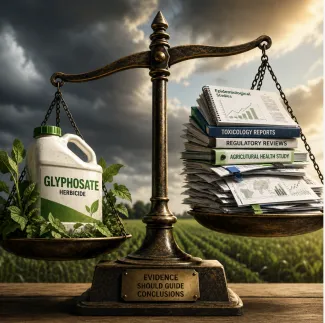
The recent decision by the U.S. Supreme Court in Monsanto v. Durnell has only added to the already profound public confusion regarding the safety of glyphosate, the active ingredient in the weedkiller Roundup. In a 7-2 decision, the Court ruled that federal law supersedes a state’s responsibility to warn its residents regarding a potential threat from Roundup. In this case, federal law is represented by the U.S. EPA’s 2020 determination that glyphosate is not carcinogenic at levels to which most people are exposed.
Many people have interpreted the decision as a declaration that glyphosate is safe. This is incorrect. Instead, the Court relied on the EPA's determination that glyphosate is not carcinogenic at ordinary exposure levels; it did not independently decide whether glyphosate causes cancer.
In reading articles leading up to, and following, the SCOTUS ruling, I came across a commentary that Yale neurologist and contributor to Science-Based Medicine Steven Novella posted in February. He explained that he was updating an earlier post because glyphosate was “back in the news.” I was curious to understand what underlay the title of his new piece, “Glyphosate remains controversial.”
Novella is a neurologist at Yale University and a founder of Science-Based Medicine. He is also the host of the popular podcast, the Skeptics’ Guide to the Universe. His article is worth examining because he is trying to present an even-handed, impartial overview of this fraught and highly controversial question.
Novella largely views the available evidence as indicating that glyphosate, the most widely used pesticide worldwide and in the United States, appears to be safe. However, he clearly wants to take seriously the possibility that we may be missing something, and he bends over backward to consider the possibility that glyphosate poses a threat.
His article starts out, “Glyphosate is the most used herbicide in the world, with farmers applying about 750 million kg per year. … The chemical is popular among industrial farmers because it is safe and effective, and yet it also remains highly controversial. It is also back in the news, and so an update on the science of the safety of glyphosate is in order."
Novella makes important points that are often ignored — e.g., about the margin of safety set by the regulators based on toxicology and about the impracticality of pesticides used in organic agriculture.
He has apparently delved into the literature, focusing on review articles, a meta-analysis, and several agency reports. But his reading of the literature appears spotty, and he has not worked through what to make of various publications he cites.
In approaching his central concern, Novella writes, “But there is also a legitimate scientific controversy fueling the public controversy, and it mainly revolves around how best to approach the question of toxicity. As I have discussed previously, we can frame this as a difference between hazard and risk.”
He goes on to explain the difference between hazard and risk. But, in doing so, he shows no awareness that the hazard-risk distinction does not provide an adequate explanation — or exculpation — of the International Agency for Research on Cancer’s (IARC’s) 2015 determination that glyphosate is a “probable carcinogen.” I have addressed this issue at length recently (here and here). In short, IARC’s determination regarding glyphosate hinged on 1) its Working Group’s erroneous conclusion that the rodent studies showed evidence of carcinogenicity (here and here) and 2) the involvement of Christopher Portier, who signed contracts to help in lawsuits against Monsanto within two weeks of IARC’s reporting the glyphosate classification (here).
Further evidence that there is more to understanding IARC’s glyphosate determination than to cite the agency’s focus on “hazard” is the fact that the European Chemicals Agency, which has carried out its own evaluation of glyphosate in concert with the European Food Safety Authority and found the chemical to not be carcinogenic, focuses on hazard as well.
Toward the end of his post, Novella tells us that, “Where the scientific controversy remains heated is over the question of an association with non-Hodgkin lymphoma (NHL), especially for workers with the highest exposure.” And he goes on to cite two “reviews” that “come to the conclusion that there is a persistent signal [emphasis added – GK] in the research for an association between high levels of glyphosate exposure and non-Hodgkin lymphoma.” The first of these is a meta-analysis by Zhang et al. This paper received an enormous amount of publicity when it came out in 2019 due to the fact that its abstract proclaimed that workers with heavy exposure to glyphosate had a 41-percent increased risk of non-Hodgkin’s lymphoma. The paper was highly tendentious, and suffers from combining poor-quality case-control studies with the much higher-quality and much larger prospective Agricultural Health Study.
Zhang et al.’s conclusion was based on selecting one of five models used in an analysis of the Agricultural Health Study data. The EPA review noted that the highest-quality data included in the meta-analysis (i.e., the AHS) failed to support Zhang et al.’s a priori hypothesis that NHL risk was increased at higher glyphosate exposure levels. Furthermore, there was no evidence of a dose-response relationship in any of the 5 analyses carried out by the National Cancer Institute in its analysis of the AHS data. Finally, in the analysis preferred by Zhang et al., the relative risks for the first quartile and the second quartile were larger than the fourth quartile, contrary to their hypothesis that the risk increased with increasing exposure.
(I have written about the Zhang et al. meta-analysis here, here, here, and here).
The second “review” is by Dennis Weisenburger. Both Zhang and Weisenburger are paid plaintiff experts, and Acquavella, whose review Novella also mentions, once worked for Monsanto. Novella makes no mention of possible bias in any of these articles.
In addition, Novella fails to cite two other meta-analyses, by Paolo Boffetta (here) and by Kabat (here). Both of these meta-analyses found no evidence of an association of glyphosate exposure with risk of non-Hodgkin’s lymphoma.
If Novella had considered all three meta-analyses and, in addition, given greater attention to the results of the Agricultural Health Study of 54,251 pesticide applicators followed for 17 years, he would have found further support for his own stated impression that glyphosate plays a valuable role in agriculture and is relatively safe and not carcinogenic at the levels to which most people are exposed, rather than his headline that “glyphosate remains controversial.”
This just shows how easy it is even for highly accomplished scholars to draw poorly-founded conclusions from an uncritical and incomplete reading of the relevant evidence.
Geoffrey Kabat is a cancer epidemiologist and the author of Getting Risk Right: Understanding the Science of Elusive Health Risks. His articles can be found here.

Geoffrey Kabat
Geoffrey Kabat earned a Ph.D. in Russian and Comparative Literature from Columbia University. He then switched to public health and epidemiology, obtaining an M.S. and ABD from the Columbia School of Public Health in 1984. He has done primary research in cancer epidemiology at the American Health Foundation, Stony Brook University School of Medicine, and the Albert Einstein College of Medicine. He has published 155 peer-reviewed scientific papers on topics ranging from smoking and diet to pesticides, air pollution, electromagnetic fields, sleep, and clinical factors, including obesity, height, and blood type.
In the 1990s, he became aware that often the message conveyed to the public about research on environmental exposures was badly skewed and that, in the words of an air pollution researcher in California, “it is in our interest to have people be afraid.” This led him to adopt a dual perspective on epidemiologic research. In the early 2000s, he started writing articles attempting to clarify various purported health risks, including electromagnetic fields, cell phones, pesticides, bisphenol-A, radon, passive smoking, and “endocrine disruption” in Forbes, Slate, the Genetic Literacy Project, Quillette, and elsewhere. He has published two books regarding health risks: Hyping Health Risks: Environmental Hazards in Daily Life and the Science of Epidemiology (2008) and Getting Risk Right: Understanding the Science of Elusive Health Risks (2016).