With the Northwest and parts of Europe in flames from wildfires, smoke from those fires continues to drift east and bring Air Quality Alert Days to areas not directly in the fire’s path. Wildfire smoke is a complex, dynamic aerosol produced by the incomplete combustion of everything in the fire’s path. While it is predominantly water vapor and carbon dioxide, it also contains particulates, including the environmental villain PM2.5. A new study examining prenatal exposure suggests that, when it comes to wildfire PM2.5, every silver cloud may have a gray lining.
Let’s lay a bit of groundwork. The researchers note that wildfire PM2.5 can account for up to 40% of ambient PM2.5 during wildfire season and that periods of elevated exposure are associated with increased morbidity and mortality. Who is actually at risk during these intervals remains unclear. Risk is not distributed evenly: susceptibility varies with age, health, exposure, and other factors. My recent post on healthspan suggests that poor air quality may be more impactful on our growing population of frail than on our well. But I digress. In this study, the population of interest is pregnant women and their developing fetuses.
What components of wildfire smoke might cause harm, and how accurately can researchers measure a pregnant woman’s exposure?
When the Measure Isn’t the Exposure
The researchers point out that PM2.5 is associated with preterm birth, low birth weight, and other consequences of these conditions. They then discuss another of air pollution's bad actors, polycyclic aromatic hydrocarbons (PAHs), and their biologically plausible role in inflammation and adverse birth outcomes. Here, the less expert reader would be misled. PAH is not PM2.5; it is a fellow traveler. The typical percentages of these volatiles, now bound to the carbon within the PM2.5 range from 0.03% to 0.5%, an order of magnitude, depending on the wildfire measured. PM2.5 is an exposure metric, now used as a biomarker of possible harm. That distinction introduces uncertainty when moving from measured particle concentrations to claims about biological mechanisms.
Because no study has “comprehensively evaluated how prenatal exposure to PM2.5among live-born infants has changed over time and space,” the researcher took on the task. They used county-level PM2.5 data, a “state-of-the-art chemical transport” model, and national birth certificate data to derive their results and conclusions. In general, PM2.5 data do not estimate individual exposure. Modeled pollution at the county level is not the same thing as an individual pregnant woman’s actual exposure. Where she lived and worked, how much time she spent outdoors, indoor filtration, and local variation can all matter, introducing additional uncertainty. Models, no matter how up-to-the-minute, remain representations, not ground truth about reality. These factors add to the uncertainty of the researcher’s PM2.5 biomarker [1], so the results require less conviction than the numbers suggest. But let’s go with the flow and posit that the calculations are a reasonable approximation, in the ballpark of PM2.5’s impact.
The Good News in the Data
The study’s central result is easier to see than to describe. The figure below tracks total prenatal PM2.5 exposure alongside non-wildfire PM2.5 from 2003 to 2019. Both fall substantially; the difference between those trends captures the growing contribution from wildfire smoke.
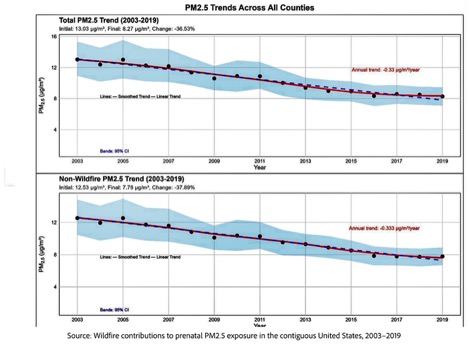
During the interval, average daily prenatal PM2.5 exposure declined by 34%. Non-wildfire PM2.5—the pollution we have deliberately targeted through cleaner fuels, vehicles, power generation, and other measures—fell slightly more, by 37%. There is the silver cloud: prenatal exposure to fine-particle pollution declined substantially. The gray lining is that the decline could have been somewhat larger. As the researchers put it, “a portion of the gains from anthropogenic emission reductions were offset by increasing wildfire activity.” Both conclusions can be true at once; however, the researchers' discussion and synthesis suggest we were able to snatch defeat from the jaws of environmental victory.
To be fair, the researchers did note the improvement in possible exposure for pregnant women before rapidly pivoting to indicate that “gains would have been even larger without increasing wildfire contributions.” How much larger? Somewhere between 2% and 5%.I say we take the victory lap and move to another question: how much wildfire risk is actually within our control?
Answering that question takes us beyond the prenatal-exposure study itself and into a separate body of evidence about how wildfires start, spread, and can sometimes be mitigated.
From Measuring Smoke to Managing Fire
Human activity—including equipment, power lines, campfires, debris burning, and occasionally arson—accounts for a large majority of wildfire ignitions in the United States, while lightning causes many of the remainder. Using a combination of satellite remote sensing, fuel moisture monitoring, and yes, those meteorological models, can help identify landscapes where fire risk is elevated and where fires may spread. Prescribed burns and on-the-ground mechanical thinning of 10 to 20% of forest landscape fuels can reduce high-risk areas by 50% or more. So why isn’t more of it done?
The majority of our wildfire appropriations are directed at extinguishing those fires, leaving little for prevention. Proactive fuel management is hindered by the need for favorable atmospheric conditions necessary to prevent a fire from escaping. [2] As with any preventive mitigation, there is a NIMBY chorus opposed to the real, temporary inconvenience against a possible greater, generally unimaginable loss. Drought and increasing heat narrow the window of favorable days. Regulatory requirements add another layer of complexity.
Fuel-reduction projects on public lands can require environmental review, adding substantial time before treatment begins. Air-quality regulators also restrict prescribed burning when smoke would push local pollution beyond acceptable levels. Those safeguards address real environmental and public-health risks, but they can create a difficult trade-off in protecting “the public health”: Do we accept a limited amount of planned smoke under controlled conditions to reduce the risk of far greater smoke exposure from an uncontrolled wildfire later?
That trade-off brings us back to the study’s larger lesson: environmental progress and emerging environmental risks do not have to cancel each other out.
Two Things Can Be True
Framing the rise of wildfire smoke as a fatal erosion of our environmental progress, rather than as a distinct challenge for forest management, illustrates a larger tendency to obscure genuine public health triumphs beneath a cloud of hand-wringing. Cutting anthropogenic PM2.5 by over a third nationwide is a monumental, hard-won policy and engineering victory that has certainly improved baseline air quality for millions of expectant mothers. If we genuinely wish to protect vulnerable populations from atmospheric hazards, give forest managers the regulatory clearance to burn off the fuel beds before nature does it for us on far worse terms.
Environmental progress is real. So is the wildfire challenge. Acknowledging one does not require minimizing the other.
[1] If PM2.5 is so flawed, why use it? Because it can and has been measured.
[2] While less than 1% of prescribed burns get out of control, the liability is great, creating a perverse incentive to procrastinate.
Source: Wildfire contributions to prenatal PM2.5 exposure in the contiguous United States, 2003–2019 Frontiers in Environmental Health DOI: 10.3389/fenvh.2026.1838836

Chuck Dinerstein, MD, MBA
Director of Medicine
Charles Dinerstein, MD, MBA, is the Medical Director of the American Council on Science and Health. A vascular surgeon with more than 25 years of clinical experience, he brings a physician's understanding of medical decision-making, an appreciation for scientific uncertainty, and a broader perspective on healthcare economics and policy to his writing.