
September is National Vascular Disease Awareness Month. I would be remiss as a lapsed vascular surgeon not to speak about the disease afflicting the patients I have cared for over 30 years. However, it would not be the work of the American Council on Science and Health to focus on the already well-known vascular risk factors involving smoking, BAD cholesterol, and high blood pressure. Instead, consider a high-profile study of a risk factor that captures the public’s imagination: micro- and nanoplastics (MNP).
The Finding That Made Headlines
The opening clinical salvo arrived in March 2024, when a landmark study in thein the New England Journal of Medicine examined plaque removed from 257 patients undergoing carotid endarterectomy, a vascular surgical procedure. [1] The researchers used a combination of imaging and electron microscopy to identify submicrometer plastic particles lodged inside cells (macrophages) in the removed plaque, and chromatography to identify the substances within the plaque. They found that 58.4% of the patients had detectable levels of polyethylene (PE) in their excised plaque, and 12.1% had polyvinyl chloride (PVC). Unsurprisingly, these plastic-containing plaques exhibited significantly higher inflammatory expression. Most concerning, patients with these plastic-laden plaques had a 4.5-fold higher risk of suffering a heart attack, stroke, or death over roughly the next 3 years compared to those without MNPs.
As with any study that upends our understanding of cardiovascular risk, this strong observational signal quickly met scientific pushback. After all, even when grounded in physical pathological specimens and hard clinical outcomes, correlation does not equal causation.
Are We Really Measuring Plastic?
The first concern was methodological: the use of Pyrolysis-Gas Chromatography-Mass Spectrometry (Py-GC/MS) to determine the levels of polyethylene and polyvinyl chloride levels in the specimens. Py-GC/MS heats a specimen in an oxygen-poor environment, breaking plastic polymers into smaller, characteristic molecules and then analyzing those fragments. It is particularly useful for microplastics, because the original plastic particle may be too small or too chemically altered for straightforward identification.
Unfortunately, the natural lipids and fats in our arterial wall and in those plaques share identical hydrocarbon building blocks with microplastics, especially polyethylene, the microplastic found in the highest concentrations in the NEJM study. Because they look chemically quite similar, they create a false polyethylene signal. A study about a year later concluded that Py-GC/MS
“is currently not a suitable analysis method for PE and PVC in biological matrices due to the presence of interferences and nonspecific pyrolysis products.”
When Smoking Enters the Picture
But the skepticism does not stop at chemical measurement error; it extends to the clinical context itself. This summer, a study published in the 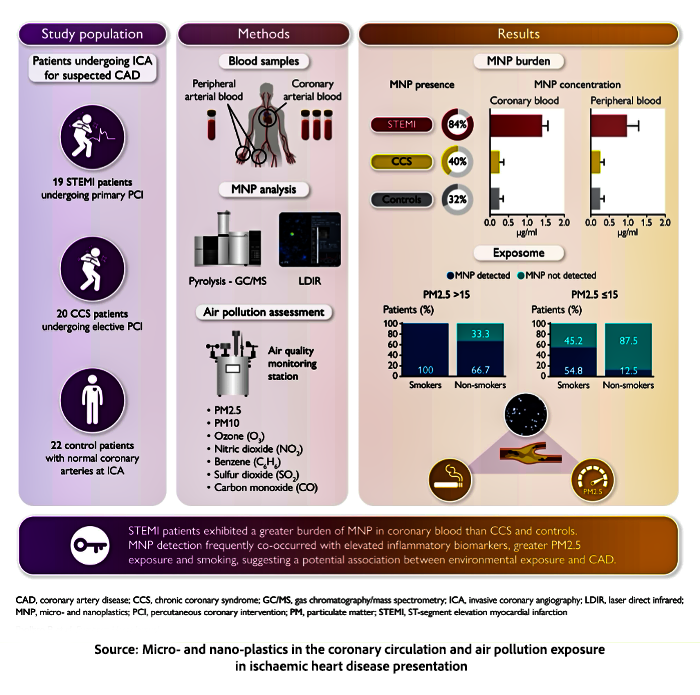 European Heart Journal identified two additional confounders. The study measured MNPs in the coronary artery circulation of patients treated for an acute heart attack, as well as in those with stable coronary artery disease or normal coronary arteries. Patients with acute heart attacks had the highest concentrations of MNPs – polyethylene accounted for 97% of the detected polymers. As the graphic depicts, Py-GC/MS was again used to measure plastic concentrations.
The first concern raised was that individuals being treated for an acute heart attack are more exposed to shed plastics in the intravenous lines and drug “bags,” providing acute medical infusions. Perhaps those higher levels reflected greater acute exposure to medical care and had nothing to do with a potential “causal chain.”
The second confounder appeared after statistical adjustment: smoking was the only independent predictor of the presence of blood-borne MNPs, suggesting that “plastic risk” is more a biomarker of its fellow traveler, smoking. If plastic is indeed the passenger rather than the driver, it forces us to re-examine what other clinical factors are riding along.
The Risk Factor Hiding in Plain Sight
This brings us back to a set of 'hidden' data from the original NEJM study—hidden, perhaps, only because the media chose not to look. While the media hyper-focused on the 4.5-fold greater risk from microplastics, the careful reader examined the additional data on the study’s fully adjusted risk model found in the supplements. As it turns out, while MNPs accounted for a 4.5-fold greater risk, another fellow traveler in vascular disease, diabetes, accounted for a 4.7-fold greater risk. [2] This statistical reality raises a profound question: Is our obsession with environmental novelties blinding us to our ongoing failure to manage metabolic disease?
This irony deepens when we realize that for patients with diabetes, metabolic and environmental risks may collide. While the public primarily ingests or inhales plastics, individuals who rely on daily subcutaneous insulin injections, a group like smokers, are at greater risk for atherosclerosis, including plaques in the carotid, and MNPs can enter through injection. A study of 50 patients using injectable insulin compared to 50 healthy controls found twice as many MNPs in those with diabetes.
The Shiny New Threat and the Familiar Foe
It is not surprising that the news led with microplastics, even though diabetes carried a higher hazard ratio. We click and obsess over the novel, especially an environmental threat to us all, like microplastics. At the same time, a well-established metabolic risk struggles to be visible, surfacing only around price rather than clinical outcome. The lesson here is not that we should ignore microplastics, but that we must maintain our clinical perspective.
The role, if any, of microplastics in the development and outcomes of atherosclerosis and its many manifestations is unknown. Science, especially when applied to our health, is not a collection of absolute truths, but a continuous, self-correcting refinement. In this instance, measurement remains challenging, and the techniques at hand may cast more shadow than light. It is rational to investigate microplastics, but we cannot let the latest shiny object distract us from the foundational pillars of vascular medicine. We have made fantastic progress in smoking cessation, but the metabolic dysfunction of lipids and sugars remains key treatable risk factors.
[1] Carotid endarterectomy involves opening the main blood supply to the brain in the neck and removing plaque from its midportion, which is thought to cause strokes involving occlusion or embolization of brain arteries.
[2] The NEJM study did note fewer patients with diabetes in the group with PMNs; however, it does not indicate insulin use, a key concern because of the plastics involved in injections.
Source: Microplastics and Nanoplastics in Atheromas and Cardiovascular Events NEJM DOI: 10.1056/NEJMoa2309822

Chuck Dinerstein, MD, MBA
Director of Medicine
Charles Dinerstein, MD, MBA, is the Medical Director of the American Council on Science and Health. A vascular surgeon with more than 25 years of clinical experience, he brings a physician's understanding of medical decision-making, an appreciation for scientific uncertainty, and a broader perspective on healthcare economics and policy to his writing.