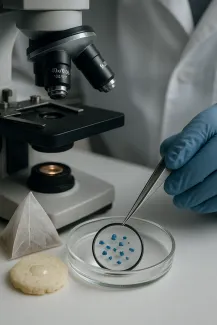
Rethinking Microplastic Risks
Micro- and nanoplastics (MNPs) are tiny solid fragments formed when larger plastics break down through wear, aging, or chemical reactions. They differ from additives or chemical residues, which are separate, regulated substances. Over the past decade, scientists have investigated whether everyday packaging, utensils, and containers—known as food contact materials (FCMs)—release MNPs into food or drink. The question matters because it touches directly on what we eat and how we trust the materials around it. The European Food Safety Agency (EFSA) undertook that necessary review.
The European Food Safety Agency is the EU’s scientific agency for food-chain safety. It is generally regarded as one of the more stringent and transparent food-safety agencies globally. By comparison, our Food and Drug Administration often allows some substances through a faster “Generally Recognized as Safe” pathway without a full review. Like all regulatory bodies in this space, it is not immune to scrutiny over conflicts of interest. However, the EFSA is widely trusted for its scientific assessments within Europe and by many international partners.
In June 2016, EFSA published a statement saying that micro- and nanoplastics were an “emerging issue” and that existing data on occurrence, toxicity, and fate were insufficient for a complete risk assessment. A structured literature review was commissioned to inform EU risk managers and the packaging industry about the evidence for MNP release from FCMs during use and the characteristics of the released particles. That review forms the basis of the latest evidence—so what exactly did it find?
How Scientists Test Everyday Plastics for Microplastic Release
Researchers reviewed 81 studies covering 101 types of food-contact materials, including everyday consumer products. The most frequently tested items were bottles and closures, featured in more than a third of the studies, followed by food containers, cups, and tea bags. In practical terms, most experiments aimed to simulate everyday use, such as heating containers or applying repeated mechanical stress. Overall, the body of research was considered “broad and representative” of the main plastics used in food packaging and preparation across Europe.
Why Detecting Microplastics Is Harder Than It Sounds
Detecting and identifying MNPs is a demanding task. The analytical methods vary widely—each with strengths and weaknesses that limit how confident scientists can be in their results. Some methods are highly specific, allowing clear identification of polymer types and visualization of shapes and structures. Yet detection limits differ, and optical techniques often miss the smallest particles. Many studies also lacked proper validation or standardized procedures, creating inconsistent results and possible over- or underestimates. Cross-contamination was common, especially during filtering or heating, as non-plastic residues sometimes mimicked plastic particles. Consequently, while many papers report microplastics of different sizes and shapes, their credibility varies greatly. The most frequently identified polymers match those in standard packaging materials, lending some internal consistency—but the overall quantitative precision remains uncertain, and data on nanoplastics are still scarce.
Are We Seeing Real Plastics or False Positives?
Determining whether detected particles originate from food contact materials or from external contamination is a significant challenge in assessing MNP release. Particles may appear through normal wear, abrasion, or degradation, but they can also form earlier, during manufacturing, packaging, or handling, before the material ever touches food. Environmental dust and lab contamination can introduce false positives, further complicating the interpretation of results.
Because risk assessments depend on knowing the actual source, researchers compare the chemical composition, color, and shape of detected particles with those of the original FCM. Despite these efforts, the evidence remains inconclusive. Even so, the evidence remains inconclusive: only 44% of studies found particles matching the FCM polymer, while 11% found mismatches, and the rest lacked data. Many reported microplastics could therefore stem from contamination or analytical artefacts rather than genuine release.
Non-Plastics Masquerade as Microplastics
Many so-called microplastic particles detected in food contact materials are actually mimics—such as fatty acids, oligomers, or additives—that precipitate during cooling after hot-water testing. These residues can mimic the appearance and spectra of plastics, leading to significant overestimates of micro- and nanoplastic release. Improved temperature control, solvent cleaning, and cross-method validation are essential to distinguish real plastics from these false positives.
What Really Causes Plastics to Shed Microfragments
The review concludes that micro- or nanoplastics do not migrate by “diffusion” through plastic—an idea sometimes suggested in earlier studies. Instead, plastics form solid matrices that trap particles. The main mechanisms of release are mechanical: everyday abrasion, twisting, cutting, or friction during normal use, especially in items like bottle caps, plastic bags, or tea bags made from woven fibers. As materials age and become more brittle, these effects can worsen. Evidence from recycled plastics remains too limited for firm conclusions, but overall, mechanical stress—not chemical diffusion—is the key driver of microplastic release.
How Much Microplastic Release Actually Happens
The review found consistent evidence that microplastics can be released from food contact materials during everyday use, mainly through mechanical stress such as abrasion, friction, or surface wear, and from materials with fibrous or open structures, such as tea bags. As the report concludes,
“There is evidence of microplastics released during the uses of FCM… this release is due to mechanical stress, such as abrasion and friction, or due to materials with open or fibrous structures… [but] the extent of the actual particle release is much lower than the results presented in many of the reviewed publications.”
This highlights that while microplastic release occurs, earlier studies may have significantly overestimated its magnitude due to methodological artefacts and contamination.
Data on nanoplastics, however, remain essentially absent, as current analytical techniques lack the sensitivity to detect these smaller particles. As the review notes,
“Most available results concern microplastics, whereas data on nanoplastics are almost entirely lacking… there is no sufficient basis at this stage to estimate MNP exposure from FCM during their uses.”
Consequently, despite significant research activity, the evidence base remains too limited and uncertain to conclude real-world exposure through food packaging or containers.
Keeping Perspective: The Evidence for Public Concern
Public concern about microplastics has grown rapidly—often outpacing the evidence. The European Food Safety Agency’s comprehensive review shows that while microplastics can indeed be released from food contact materials, the quantities are far lower than many early studies suggested, and most data on nanoplastics are still unreliable or missing altogether. Much of the apparent risk has been amplified by inconsistent testing methods, contamination, and the misidentification of non-plastic residues as plastic particles.
This does not mean we should dismiss the issue. It means we should keep it in proportion. The science to date tells us that microplastic release from everyday packaging is a real but limited phenomenon, not a looming public health crisis. Until we have robust, reproducible data on real-world exposure and toxicity, caution, not alarm, and curiosity, rather than misplaced confidence, should guide both policy and public perception.
Source: Literature review on micro- and nanoplastic release from food contact materials during their use EFSA Supporting Documents DOI: 10.2903/sp.efsa.2025.EN-9733

Chuck Dinerstein, MD, MBA
Director of Medicine
Charles Dinerstein, MD, MBA, is the Medical Director of the American Council on Science and Health. A vascular surgeon with more than 25 years of clinical experience, he brings a physician's understanding of medical decision-making, an appreciation for scientific uncertainty, and a broader perspective on healthcare economics and policy to his writing.