Finding the causes of autism is proving far more difficult than finding factors associated with it. A new study of maternal health and autism reveals how the same medical diagnosis can represent different biological, environmental, and social circumstances. As federal initiatives search for preventable causes, the challenge may be distinguishing genuine risks from the fellow travelers that accompany them.

The Trouble with Finding a Cause
Autism spectrum disorder (ASD) is now diagnosed in approximately 1 in 31 American children, with diagnoses rising especially among girls and racial and ethnic minority populations. Researchers have identified numerous maternal health conditions associated with autism that reflect an underlying biological condition, environmental exposures, differences in access to medical care, or a combination of these factors. Separating their individual contributions is particularly difficult when those influences overlap.
Race and ethnicity introduce another layer of complexity because of the inherent differences they entail. As a result, the same diagnosis does not necessarily reflect the same underlying exposure or biological risk across populations.
Previous research that found associations between maternal health conditions and autism statistically adjusted for race and ethnicity; a new study flips the script by examining whether some maternal conditions are associated with autism differently across these populations. The goal is not to establish race as a biological cause but to determine whether differences in social determinants of health might help explain why the same maternal condition is linked to varying levels of autism risk.
Looking for Differences, Not Just Associations
The researchers conducted a retrospective observational study using electronic health records of 224,353 children born between 2010 and 2017 in Kaiser Permanente Northern California, a large, integrated health care system. They examined 25 maternal health conditions previously associated with autism. Children were followed from birth, and 85% of those diagnosed with autism were evaluated at specialized autism assessment centers.
The study included roughly 224,000 children, of whom 2.4% received an autism spectrum disorder (ASD) diagnosis during follow-up. Children were followed for a median of 3.7 years, and the median age at ASD diagnosis was 3 years.
When the Same Diagnosis Tells a Different Story
Autism diagnoses varied by maternal race and ethnicity:
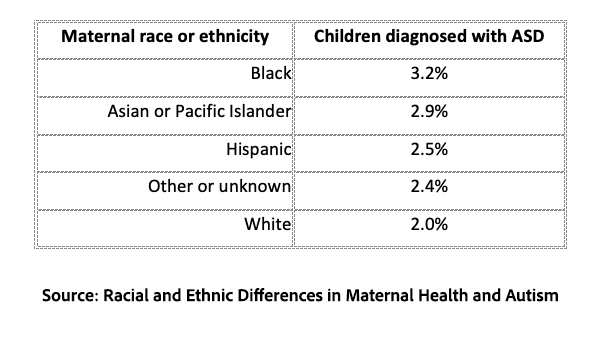
However, these differences describe diagnosed autism within the study population, not necessarily differences in underlying biological susceptibility.
Previous research identified multiple maternal medical conditions associated with autism in offspring. Of these, 25 occurred frequently enough across racial and ethnic groups to allow meaningful statistical comparisons. In many cases, these conditions overlapped; most mothers had at least two conditions, and 10% had five or more, highlighting the difficulty of attributing an observed association to any single maternal condition.
While most associations were broadly consistent across racial and ethnic groups, the preponderance (84%) showed no statistically significant difference in the strength of association across groups. Four conditions showed statistically significant differences between groups: overweight or obesity, depressive episodes, asthma, and other maternal diseases complicating pregnancy. For all four, the estimated associations with autism were stronger among White mothers than among Black, Hispanic, and Asian or Pacific Islander mothers.
Adding adjustments for maternal age, insurance, health care utilization, and the child's sex and birth year did not substantially change the estimated associations.
Despite measurable racial and ethnic disparities in autism diagnoses, most maternal health conditions showed broadly similar associations with offspring autism. It remains unclear whether the exceptions reflect genuine differences in biological risk or differences in how maternal conditions are diagnosed, treated, and recorded, along with other genetic, environmental, and social factors that accompany those conditions.
The Problem of Fellow Travelers
This study gives us a reasonable “snapshot” of the prevalence of ASD in our national population; roughly 1 in 3 children are being diagnosed along the ASD spectrum, and this metric is driving the urgency of new federal ASD initiatives. Although the study was not designed to evaluate the new federal ASD initiatives, its findings illustrate a problem those initiatives will inevitably confront: separating potentially causal exposures from the many biological, environmental, and social circumstances that accompany them and that are difficult to disentangle.
As the researchers note:
- We are often not measuring the same condition — obesity may be diagnosed differently among White and Black women even at comparable BMI and comorbidity levels. Similar diagnostic differences may apply to psychiatric conditions. What appears to be a difference in autism risk could partly reflect who receives a diagnosis and at what threshold.
- Are we measuring the condition or its management, and are those relevant exposures? Two pregnant women with asthma may have very different experiences depending on disease severity, medications, treatment effectiveness, and access to continuing care. The researchers point out that medications may introduce potential fetal exposures, while effective treatment may mitigate the consequences of maternal illness. The same diagnosis can therefore represent substantially different biological circumstances.
- What accompanies a diagnosis — For example, maternal asthma may accompany exposure to air pollution, poor housing conditions, inadequate ventilation, or occupational hazards. Similarly, a psychiatric diagnosis may occur alongside other maternal health conditions, environmental stresses, or differences in care. Some of these fellow travelers may be genuine confounders; others may be intermediaries, risk modifiers, or sources of measurement error. They are not interchangeable and can complicate causal interpretation.
The authors could not identify a clear mechanism by which diagnostic disparities alone explained the observed associations. Their findings raise a more fundamental problem for initiatives seeking to identify and reduce environmental, pharmaceutical, or maternal contributors to autism: distinguishing genuinely causal exposures from the circumstances that accompany them.
Removing an exposure that merely accompanies the true cause may change nothing about autism risk, even as it creates the appearance of decisive public health action. Yet demanding absolute causal certainty before acting could delay interventions that offer genuine benefits, regardless of their effects on autism.
Ultimately, the question is not simply whether an exposure is associated with autism, but whether changing that exposure would change the outcome. Finding autism's fellow travelers may be relatively easy. Determining which ones are actually driving the journey is the far greater challenge.
Source: Racial and Ethnic Differences in Maternal Health and Autism JAMA Network Open DOI: 10.1001/jamanetworkopen.2026.37501
Category

Chuck Dinerstein, MD, MBA
Director of Medicine
Charles Dinerstein, MD, MBA, is the Medical Director of the American Council on Science and Health. A vascular surgeon with more than 25 years of clinical experience, he brings a physician's understanding of medical decision-making, an appreciation for scientific uncertainty, and a broader perspective on healthcare economics and policy to his writing.