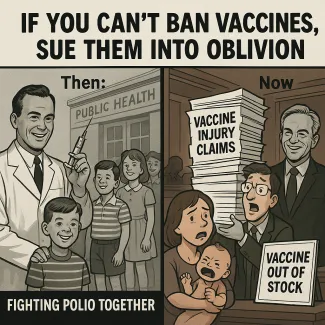
Imagine that you want to decrease vaccine use, but you can’t outright say so. What can you do? How about increasing lawsuits against manufacturers, which might, if history is any guide, create a vaccine shortage? Last week, Health and Human Services Secretary Kennedy proposed a novel initiative: transferring COVID-19 vaccine injury lawsuits into the National Vaccine Injury Compensation Program. Big deal or not?
Undone in a Flash
For more than two hundred years (even before the germ theory of disease was known), vaccination has been embraced as a social good and public health necessity. The 1904 decision of Jacobson v. Massachusetts documents the history of vaccine efficacy and international acceptance beginning in the late 1700s. This consensus was reflected in the global scientific community's support for governmental mandates worldwide, which required vaccination for smallpox in multiple countries.
In the 1947 smallpox epidemic, 6,000,000 NYC residents snaked around long city streets waiting to be vaccinated; the mission was accomplished in weeks due to the calm exhortations of the City’s Mayor and head of the Board of Health. During the polio epidemic of the 1950s and 1960s, parents clamored for their children to be vaccinated, even in the face of adulterated vaccines.
Let’s recall that the vast international scientific consensus (based on decades of data, lab tests, and epidemiology) supporting smallpox and polio vaccination is not something with which Secretary Kennedy agrees, his protestations to the contrary notwithstanding. Consider this exchange just two years ago with lawyer, Alan Dershowitz, where he touts that vaccination effectiveness is a religious belief, not a fact:
“The proposition and the theology that smallpox and polio were abolished due to vaccination is controversial. That is not a proposition that is universally accepted.” - Robert F. Kennedy Jr.
Yet, because of vaccines, children no longer choke to death from diphtheria or suffocate from whooping cough (pertussis). Prior to vaccines, about 200,000 cases of whooping cough infected American children annually, killing 9000 of them. In 2023, with vaccination, 5,000 cases were reported with no deaths. For diphtheria, prior to vaccines, we saw about 100,000 to 200,000 cases, with 13,000 to 15,000 deaths annually; post vaccination in 2023, two cases and no deaths.
But the vaccination trajectory wasn’t always rosy, and the alarming history of vaccine litigation led to severe vaccine shortages not too long ago:
- By 1984, vaccine manufacturers for DTP (Diphtheria, pertussis, and tetanus) faced difficulties in obtaining liability insurance. By year-end, only one remained in the market.
- That year, two of the three American manufacturers had stopped or restricted the sale of the DTP vaccine; one halted production due to rising litigation costs, while the other was unable to secure affordable liability insurance.
- In the early 2000s, specific manufacturers also ceased production of DTaP vaccines, further impacting supply.
The 1984 shortage was so dire that the CDC was forced to advise against vaccinating all but the most susceptible on an interim basis, until more vaccine became available. The situation demonstrated that encouraging both vaccine use and production is crucial and requires careful balancing and planning.
Vaccine Lawsuits vs. Public Health: Congress Makes a Deal
To incentivize vaccine production by manufacturers fearful of bankruptcy from the exuberant litigation that brought about the vaccine shortage, and in exchange for the public service vaccine production provides, Congress enacted the (National) Vaccine Injury Compensation Program (VICP) in 1986. In a no-fault system akin to Workers’ Compensation, both injured claimants and manufacturers benefit. In exchange for relinquishing the benefits of traditional tort litigation (with substantial awards), those injured by vaccination receive compensation under the VICP.
The NVICP
“was created in the 1980s, after lawsuits against vaccine companies and health care providers threatened to cause vaccine shortages and reduce U.S. vaccination rates, which could have caused a resurgence of vaccine-preventable diseases.”
While compensation under the VICP generally means a lower award, recovery is quicker and more likely. That’s because the plaintiffs don’t need to prove negligence or malfeasance as in a conventional tort or malpractice case. All that’s necessary is proof that the claimed injury was caused by the vaccine, with causation standards being more lenient than the typical tort suit.
Because the lawyer time involved is less, legal fees are reduced, saving everyone money. Even lawyers aren’t dissatisfied. Both awards and legal fees are covered by a special fund generated via excise taxes (a classic example of risk-spreading). And because there is no contingency fee (the legal costs are covered on an hourly basis), lawyers get paid, win or lose, without reducing the award the claimant receives.
There are, however, some limitations to acceptable claims; most pointedly, they must be significant and not transitory: The injury must have
- Lasted for more than six months after the vaccination; or
- Resulted in inpatient hospitalization and surgical intervention; or
- Resulted in death.
These caveats streamline the system, weeding out nuisance claims.
Secretary Kennedy’s Change of Heart
In the past, Secretary Kennedy Jr. maligned the vaccine compensation system: Consider this exchange between Mr. Kennedy and Attorney Alan Dershowitz:
“DERSHOWITZ: Certainly, anybody who runs a pharmaceutical company cares deeply about not killing people.
KENNEDY: You can’t sue them. There’s no discovery, there’s nothing. They never get caught. Now …. four companies make all of our vaccines. All 72 of the vaccine shots that are now mandated for our children. Every one of them is a convicted serial felon. Glaxo, Sanofi, Pfizer, Merck.”
Now, however, the Secretary wants to enlarge the vaccine compensation program. Last week, he unveiled a rather cryptic initiative, seeking to broaden the VICP to include COVID-vaccine-related claims, although the specifics were undisclosed.
“We’re looking at ways to enlarge the program so COVID vaccine-injured people can be compensated”
- RFK Jr.
Contrary to the insinuation in the Secretary’s remarks, COVID-vaccine injured people are compensated, although under a different program, the Countermeasures Injury Compensation Program (CICP) enacted in the wake of the 2005 anthrax and bioterrorism concerns.
“The Countermeasures Injury Compensation Program (CICP) provides compensation for covered serious injuries or deaths that occur as the result of the administration or use of certain countermeasures. Compensation may include unreimbursed medical expenses (expenses that health insurance did not cover), lost employment income, and the survivor death benefit.”
The CICP addresses public health and national security threats under the Public Readiness and Emergency Preparedness Act (PREP Act). Because of the national security exigencies, this system has more limited payouts and stricter standards, including a one-year statute of limitations (compared to a three-year statute of limitations for the NVIC). This program does not cover attorneys’ fees.
In actuality, the shorter statute mandated by CICP shouldn’t impact many potential claimants (except perhaps for autism, which, per data and scientific consensus, is unrelated to vaccines and wouldn’t be compensable, the Secretary’s rhetoric notwithstanding), as injuries covered under either Act typically surface shortly or immediately after vaccination. The likelihood of a vaccine-related and compensable claim arising more than a year after vaccination is remote.
The longer statute complicates actuarial planning, increases required reserves, and raises excise taxes to cover the awards and administrative resolution fees, ultimately increasing vaccine costs. When maximum vaccine uptake is crucial, as in cases involving national security, maximizing claims and claimants can frustrate the very purposes of the legislation: incentivizing vaccine production and encouraging vaccination.
QUI BONO? (Who Benefits)
To accomplish his plan, Secretary Kennedy reportedly hired (with $150,000 of tax dollars) the law firm of Brueckner Spitler Shelts for its “expertise” on the National Vaccine Injury Compensation. The decision has raised eyebrows, since any changes to the compensation scheme would need to come from Congress.
It is true that criticism has been levied against the CICP for some time. But why is the Secretary intent on making these changes now? Who benefits? Certainly, the lawyers. [1] For one thing, under CICP, awards are lower and more limited, and recovery is more challenging and takes longer. For another, attorneys’ fees aren’t covered under CICP.
"The core question isn’t whether vaccine injuries should be fairly compensated—they should. It’s whether the method chosen enhances or undermines the public trust, legal clarity, and medical supply chain we all rely on." - Robert F. Kennedy Jr.
Expanding vaccine injury compensation deserves thoughtful debate, not vague proposals or moves that could destabilize a system built to protect both public health and legitimate claimants. If history teaches us anything, it’s that maintaining vaccine access requires striking a balance between accountability and stability. When that balance is lost, it’s not just manufacturers who suffer—it’s all of us.
[1] Reportedly, he already stands to gain as much as $2.5 million in referral fees from association with a firm involved in anti-vaccine litigation. However, the cases involved do not include the US as a defendant.

Barbara Pfeffer Billauer JD MA (Occ. Health) PhD
Professor Barbara Pfeffer Billauer is an internationally recognized scholar of public health law, bioethics, and the laws of medical care, focusing on the integration of science and law and its impact on day-to-day policy and legal outcomes. She has lectured and published extensively, in scholarly journals and law reviews, and has written and edited seven books for lay and academic audiences.