I began my career in public health by working in HIV/AIDS education and prevention efforts. I worked in Chicago, Denver, and Kenya. At various times, my job came via funding from the President's Emergency Plan for AIDS Relief (PEPFAR), the CDC, or an NIH grant.
Devoting the beginning of my career to HIV/AIDS research and prevention meant that I was connected to public health infrastructure that was designed to study the pandemic and to prevent more people from becoming infected. I was, and remain, very passionate about this work. It's literally what drew me to public health -- the opportunity to impact thousands of lives around the world through working on a disease that has taken so much from us.
In October 2013, the U.S. government shut down over fights about the budget. Grants were disrupted and I lost my job in Kenya. It was my first time seeing the direct impact of funding withdrawals on the world of HIV/AIDS prevention and research. I was, of course, devastated to lose my job. But what I felt sick to my stomach over was while the work suddenly stopped, the dire need persisted. Everything that I and so many others had devoted our lives to working towards was suddenly in danger of being destroyed. That was terrifying to me.
Government Cuts
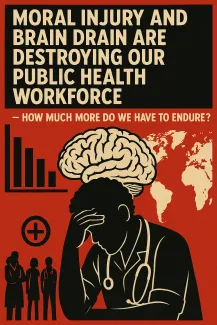
The devastating cuts to science and health research funding have gutted our research infrastructure. While those cuts have very real consequences – in the number of people that have been laid off and the number of labs and studies abandoned – there are other less-tangible consequences. Often ignored is what it does to the morale and mental health of our public health workforce.
According to the Veterans Affairs (VA) National Center for PTSD, moral injury "can occur when someone engages in, fails to prevent, or witnesses acts that conflict with their values or beliefs." Examples include witnessing decisions that go against your beliefs and experiencing betrayal, among others.
The VA goes on to discuss moral injury as it relates to healthcare workers and how it may occur in times of heightened stress, such as a pandemic (e.g., COVID-19 still looms large in the back of everyone's minds). However, the VA adds, "although health care workers are prepared to see patients suffer or even die, witnessing a great deal more suffering and death than what is normally expected may create moral distress."
What often draws people into the field of public health is the desire to impact health and well-being on large scales. Public health warriors rarely work at the individual level. Instead, we work on systems that impact the masses. As a result, we know better than anyone the consequences when those systems break down or are gutted.
Given how I began my career, I know a lot of people who have been laid off during the first half of 2025. They're not doing well. Again, losing your job is very difficult, but what's worse is watching your life's work be destroyed. These people dedicated their lives to preventing deaths, only to watch as the specific protections they worked so hard to establish were cut away. They intimately understand the impact these policies have, and that understanding has caused irreparable damage to our public health workforce.
Brain Drain
Naturally, when people are left without job prospects and/or when they feel like their work isn't valued, they will seek opportunities elsewhere. This could lead to people leaving public health to work in a different field. This could also lead to people leaving the country. Either way, public health will experience a brain drain.
The number of unemployed public health workers has grown since the administration began slashing federal budgets and grants. Seasoned professionals were unexpectedly thrown back into the workforce and are now competing with new graduates for jobs.
Competing with people who are mid- or late-career for the same jobs is not what new graduates were planning on. We'll lose our new graduates and aspiring public health workforce, possibly to other countries, like France, that have started wooing American health science researchers and public health workers. We could lose the future workforce to overseas opportunities for both schooling and work.
This brain drain will set us back years, if not decades. We were a world leader in health sciences and public health research and infrastructure, if not the leader. The brain drain from slashing workforce, grants, and budgets is breaking us. The moral injury that we've inflicted upon our workforce is breaking us.
So much of what keeps us healthy day to day comes directly from our public health workforce. What the Trump administration has done to our budgets, grants, and workforce is diametrically opposed to what Robert F. Kennedy Jr. and members of the Make America Healthy Again (MAHA) movement claim to want. If MAHA actually cares about our health, investing in our public health workforce is the best way to show that. Severe damage has been done, but it's not too late to change course.
I've lost sleep over the dismantling of the U.S. Agency for International Development (USAID). I know many others that have similarly lost sleep over what's happened with the Advisory Committee on Immunization Practices (ACIP) and vaccines. Even more over the cuts to Medicaid. Water fluoridation. The list goes on and on.
Our public health workforce knows that millions of people are now at risk of contracting illnesses that I and so many others worked tirelessly to keep at bay. People will die. People have already died. Logically understanding this is a lot, but for those of us who have worked in it and feel passionately about the work, it's gut-wrenching. How much more will we ask our public health workforce, and the world, to endure?
This is a reprint of an article by Katie Suleta that first appeared on MedPage Today. The original article can be found here.
Katie Suleta, DHSc, MPH
Katie Suleta is a regional director of research in graduate medical education for HCA Healthcare. Her background is in public health, health informatics, and infectious diseases. She has an MPH from DePaul University, an MS in Health Informatics from Boston University, and has completed her Doctorate of Health Sciences at George Washington University.