As we adjusted to this new geometry of safety, we also argued over rules, risks, and responsibilities. Yet beneath those debates lies a simple truth: the shape of our networks, both social and spatial, profoundly influences how disease spreads. That same principle plays out underground, where ants face their own invisible epidemics.
Other social creatures attempt to mitigate infectious disease. Ants often self-isolate when ill, and in some instances are terminated by their healthy nest-mates. In short, social insects “have evolved a large suite of collective mechanisms for disease defense that confer “social immunity.” A study reported in Science examines changes in the nest-building behavior of ants when exposed to a pathogen, offering insight into “Mother Nature’s” approach to pandemics.
Briefly, researchers allowed 180 worker ants to excavate a new nest. After a day, they introduced 20 more ants — some exposed to a deadly fungus, others untreated controls. The pathogen spreads through touch, killing about 90% of directly infected ants and tripling mortality among their nestmates. Over six days, the team tracked how the colonies built and behaved.
Treated ants left the nest building area at significantly higher rates than their uninfected nestmates, suggesting to the researchers a degree of self-isolation seen in other ant societies
- Pathogen‐exposed colonies dug faster, extending tunnels more quickly, so the nest grew larger and ant density inside dropped.
- They spread entrances farther apart on the surface, easing crowding where ants meet.
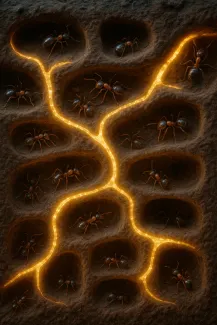
- The underground network became longer and sparser, resulting in decreased efficiency and link density, which meant ants had to travel farther through the maze.
- Modularity increased, carving the nest into more clearly separated compartments that limit cross-traffic.
- Individual chambers were placed in less central positions and had fewer direct chamber-to-chamber links, lowering each chamber’s influence on the whole system.
Together, these structural shifts create a roomier, more compartmentalized, and pathogen-resistant nest layout.
“We found that the combined effects of pathogen-induced architectural changes and self-isolation in pathogen-exposed nests resulted in much stronger inhibition of disease transmission compared with architecture alone.”
Computer simulations confirmed the finding. The altered nest layouts reduced spore load and lethal infections — effectively flattening the curve. When combined with the ants’ behavioral self-isolation, disease transmission dropped even faster, showing how architecture and behavior reinforced one another in a kind of evolutionary synergy.
The timing and participants in the architectural changes provide additional insight. The early structural changes appeared within 24 hours, before the fungus fully took hold, pointing to proactive rather than reactive defense. And because the exposed ants were self-isolating and therefore less active, the extra excavation and design was steered by their uninfected nestmates.
Can the behavior of ants shed light on our own responses to COVID? Like them, we redrew the spaces between us, thinned our daily networks, and created semi-sealed pods. We reduced first contact with floor arrows and one-way aisles, mimicking the ants’ distanced entrances. We limited shortcuts through stay-at-home orders and remote work, just as ants built longer, less efficient tunnels that slowed pathogen travel. We compartmentalized into pandemic “bubbles,” much like ants carved their nests into modular chambers. And we self-isolated — testing, quarantining, and recovering apart from the group.
We applied the same epidemic arithmetic as the ants: lower contact probability, cut network ties, and add compartments. And we used changes in our behavior and built environment to improve our prospects synergistically. However, we differ from our colleagues in two critical ways. First, ants, for unclear reasons, sense “pathogen pressure” through immediate contact cues; humans require more “facts,” which come from slower, noisier epidemiological data. Second, ants rely on decentralized, collaborative behavior, mediated by evolution and pheromones; humans mix top-down mandates with individual choice and politics.
From ants to humans, architecture becomes a kind of immune system — not made of cells, but of design. The ants’ seamless coordination contrasts with our often-divided debates. Yet, their success offers a humbling reminder: resilience against disease arises not from walls alone, but from the harmony between structure and behavior. Our own “architectural immunity” may depend on learning to build and act, with the same unity of purpose.
Source: Architectural Immunity: Ants Alter Their Nest Networks To Prevent Epidemics Science DOI: 10.1126/science.ads5930

Chuck Dinerstein, MD, MBA
Director of Medicine
Charles Dinerstein, MD, MBA, is the Medical Director of the American Council on Science and Health. A vascular surgeon with more than 25 years of clinical experience, he brings a physician's understanding of medical decision-making, an appreciation for scientific uncertainty, and a broader perspective on healthcare economics and policy to his writing.