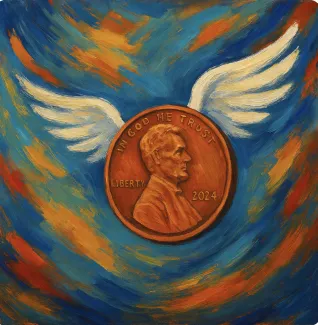
Pennies — now about as useful as a can of sardines in a typhoon — will no longer be minted. Finally.
Just before he hit the button yesterday to mint the last penny, U.S. Treasurer Brandon Beach said:
God bless America, and we’re going to save the taxpayers $56 million
The move was long overdue. Fiscally, the mint didn’t have a logical choice. It was costing about 4 cents to mint a single penny, and that’s mostly due to production costs, not because the price of copper has soared. Since 1982, there has been precious little copper in a penny (2.5%), the rest being zinc, which has always been less valuable than copper (Figure 1).
By comparison, Canada, Mexico, Australia, and much of the EU no longer mint 1- and 2-cent coins, rounding to the nearest 5 cents. Some countries, like New Zealand, now round purchases up or down to 10. Good for them.
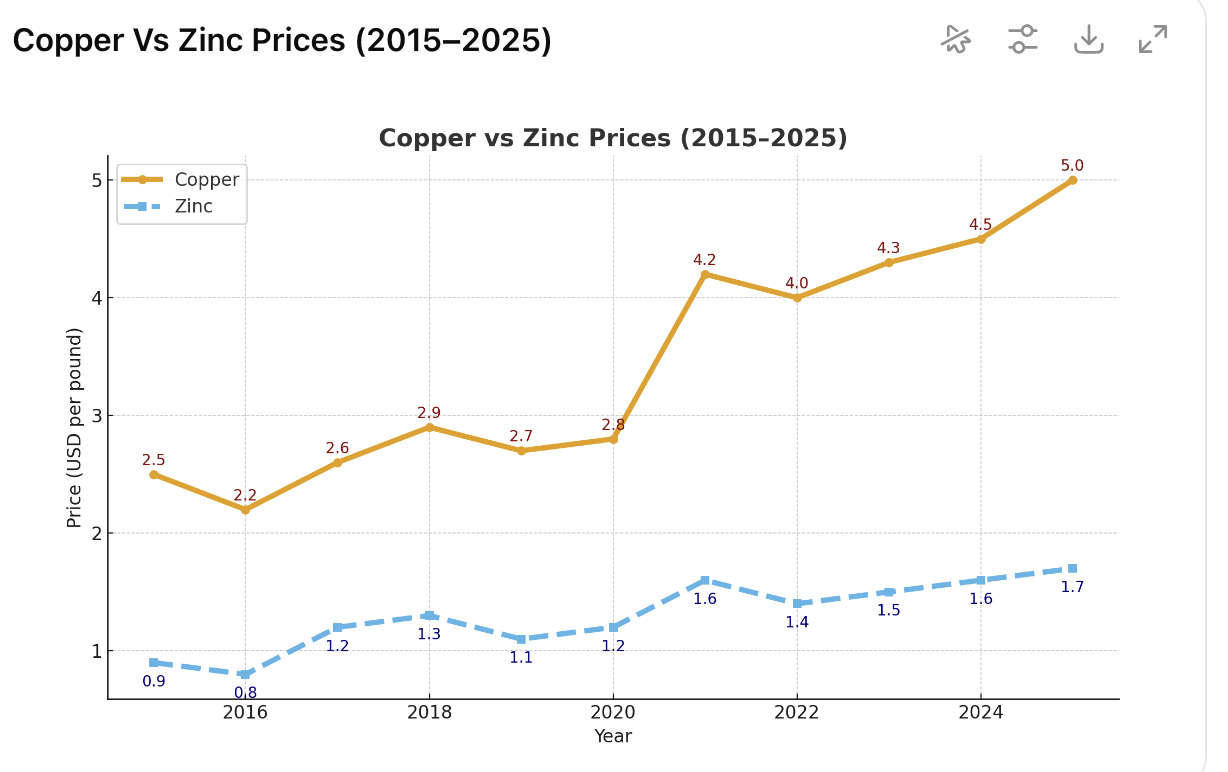
Figure 1. Copper and zinc prices (2015–2025). Calculated from publicly reported historical values using standard unit conversions, with reference data drawn from Trading Economics, the USGS, the World Bank Pink Sheet, and IMF commodity price databases, and all values and the graph were generated by ChatGPT.
This issue is largely irrelevant anyhow, because it's been 42 years since the last minted penny was actually made of copper [1]. The composition of the newer, considerably lighter ones is quite different – 97.5% zinc with 2.5% copper (the coating).
Copper and Zinc are Quite Different. In Several Ways.
Zinc reacts like a madman (video) when dropped into a beaker of hydrochloric acid, while copper does not; it just sits there looking stupid. What about a copper-coated zinc penny? This video shows you what you'd expect – the zinc interior is completely dissolved, leaving the copper shell.
Stability in hydrochloric acid is not necessarily a measure of the value of a metal, but when talking about coins, it certainly is. More stable metals tend to be more valuable (Figure 2).
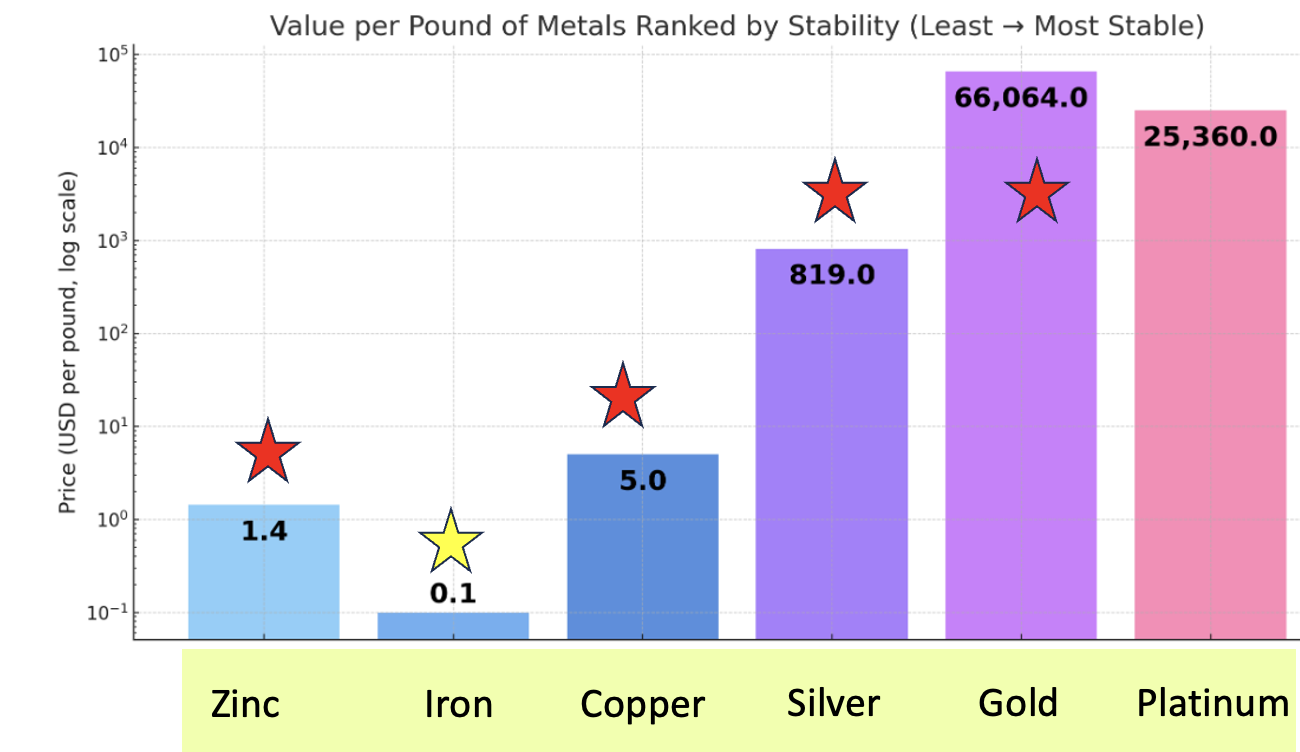
Figure 2. Prices per pound for selected metals arranged by chemical stability (least → most stable). Values (log scale) were calculated from publicly reported spot prices using standard unit conversions, with reference data drawn from Trading Economics, Kitco, USGS, and other commodity databases; ChatGPT generated all values and the graph. A logarithmic scale is used to show the wide range of metal values. All metals used in US coins have a star. The yellow star for iron indicates a one-time use.
As shown in Figure 2, the four metals, now or ever, used in coins increase in value with stability.
Quiz #1: Platinum used to be more valuable than gold. What happened?
Quiz #2: What the hell is iron doing on that list? Iron coins?
(Answers below)
So are Copper and Silver, and Gold.
Only 18 years earlier (1965), the mint switched to a cheapo version of the coins: silver dimes, quarters, half dollars, and dollars [2]. More or less the same reason. The metal value of silver coins (90% silver), aka "the melt value" [3] of the coin, was more than the coin itself. This is why you'll never see a pre-1965 dime, quarter, half, or silver dollar – in circulation today [4]
And the same thing happened 30 years before that with gold coins [5].
Miscellaneous
- It's time to change the old aphorism, "Find a penny, pick it up. All day long, you'll have good luck." Pennies haven't been worth picking up for decades. How about: "Find a penny, let it be. You're a dope, but don't blame me."
- Being penniless (a word we use frequently at ACSH) will be environmentally beneficial. The zinc must be mined, shipped to the mint, minted (with copper) into coins, and distributed to banks and stores that probably don't want them. All of this requires a whole bunch of fuel.
- Since 1982, 327 billion pennies have been minted. That's a lot of zinc.
- About two-thirds of pennies don't even circulate. They are either thrown out or sitting around in jars.
Enough already.
Fading into History
The penny is the most recent coin to be discontinued, but many beautiful and exotic coins preceded it. Here are some of them.
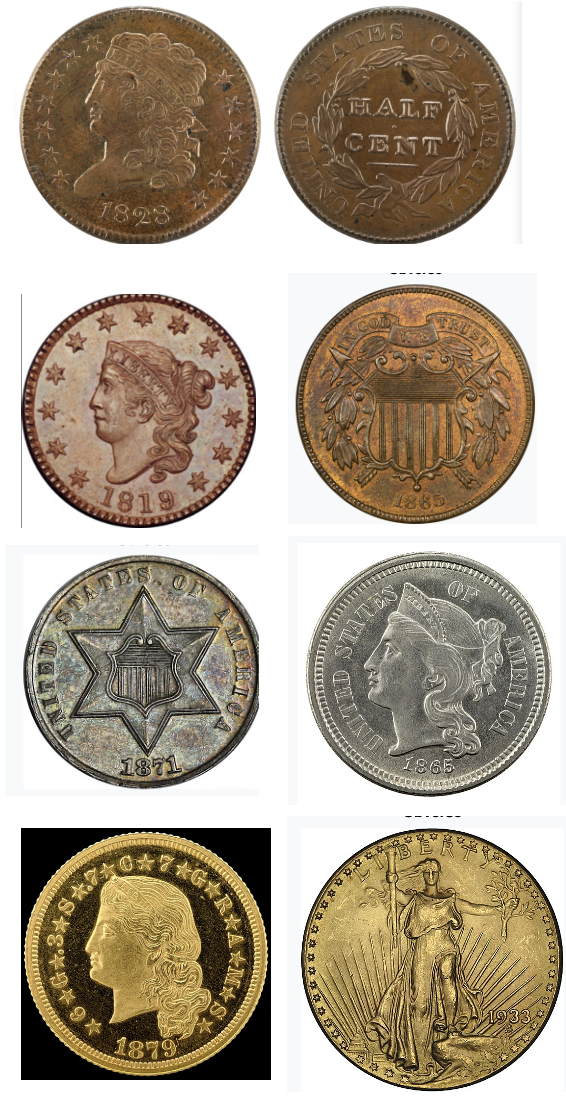
Top: Half-cent, obverse and reverse
Second line: (Left) a large cent. (Right) a Two-cent piece.
Third line: Three-cent coins, silver, and nickel
Bottom: (Left) $4 gold coin (very rare, can be worth $1+ million), $20 gold piece (often thought to be the most beautiful American coin ever made.
NOTES
[1] Copper pennies were 95% copper and 5% zinc.
[2] For any of you numismatists out there, the real silver dollar ended in 1935.
[3] It is illegal to melt US coins for profit, but OK for jewelry etc. There are other variations in the law.
[4] A 1964 quarter is now worth about $10 on eBay.
[5] Gold coins once circulated widely in the United States, but their role as everyday money ended when the country abandoned the domestic gold standard in 1933. The final link between the dollar and gold was severed in 1971, leaving U.S. currency entirely fiat rather than backed by precious metal.
Quiz answer #1: 2008 happened, and gold was safe.
Quiz answer #2: Because of a wartime copper shortage, 1943 pennies were made of steel.

Josh Bloom
Dr. Jonathan (Josh) Bloom, ACSH's Director of Chemical and Pharmaceutical Sciences, earned his Ph.D. at the University of Virginia and completed postdoctoral training at the University of Pennsylvania. During his 20-plus years in drug discovery at Wyeth, his research group discovered the antibiotic Tygacil®, approved in 2005. He holds 25 issued patents and has authored 35 academic papers. Since joining ACSH in 2010, he has written more than 2,000 articles and dozens of op-eds for major newspapers, including The Wall Street Journal and Chicago Tribune.