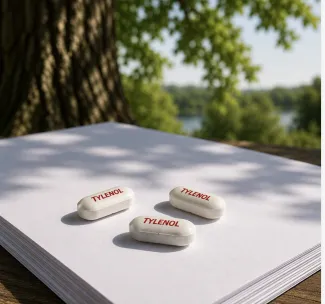
Q: What do wood and Tylenol have in common?
A: Two things.
First, if you get hit over the head with a piece of wood, you'll probably get a headache that Tylenol won't do much for.
Second, the chemistry used to turn wood into paper has some things in common with the chemistry that makes Tylenol's reactive metabolite toxic.
The second answer requires considerably more explanation than the first.
The Longview, Washington accident
Before getting to the chemistry, it's worth remembering why the subject came up in the first place. The recent paper mill disaster in Longview, Washington, claimed the lives of 11 workers and injured others. One of the chemicals involved was "white liquor," a highly alkaline and corrosive mixture (pH > 12) used in the Kraft process [1], the primary method for converting wood into paper and cardboard. If the term sounds innocuous, don't be fooled. White liquor is chemically similar to industrial drain opener (lye) and is not something you would want on your skin. [2]
Paper chemistry 101
Paper is made from cellulose fibers, a long linear polymer of glucose that is closely related to (but behaves very differently from) starch [3]. The reason is simple: cellulose consists of long, tough fibers that can be separated, pressed together, and formed into strong sheets. The problem is that trees are not composed solely of cellulose. The fibers are embedded in lignin, a complex aromatic polymer (contains benzene rings) that serves as both glue and structural support for trees.
Before wood can be converted into paper, the lignin must be removed, but the cellulose must remain. White liquor makes that possible. The challenge is one of selectivity. How do you remove one polymer from a tangled mixture of two without destroying the one you want to keep?
The key to the Kraft process is not brute force but selectivity. The sulfide in white liquor helps steer lignin chemistry toward breakdown rather than a variety of undesired side reactions, while largely sparing the cellulose fibers needed to make paper.
That selectivity depends in part on sulfur-containing molecules intercepting highly reactive intermediates before they can participate in less desirable chemistry. Organic chemists familiar with drug metabolism may find that idea oddly familiar.
Tylenol's Reactive Metabolite
Regular readers know that I've written extensively about Tylenol toxicity over the years. In a Tylenol overdose, a fraction of the drug is converted into a highly reactive metabolite called NAPQI. Under normal circumstances, NAPQI is rapidly neutralized by glutathione, a sulfur-containing molecule that reacts with the metabolite before it can damage liver cells. When glutathione stores become depleted, however, NAPQI begins reacting with liver proteins, forming stable covalent bonds that can ultimately lead to liver injury (Figure 1). The importance of glutathione lies in its ability to intercept NAPQI before the metabolite can participate in more damaging chemistry.
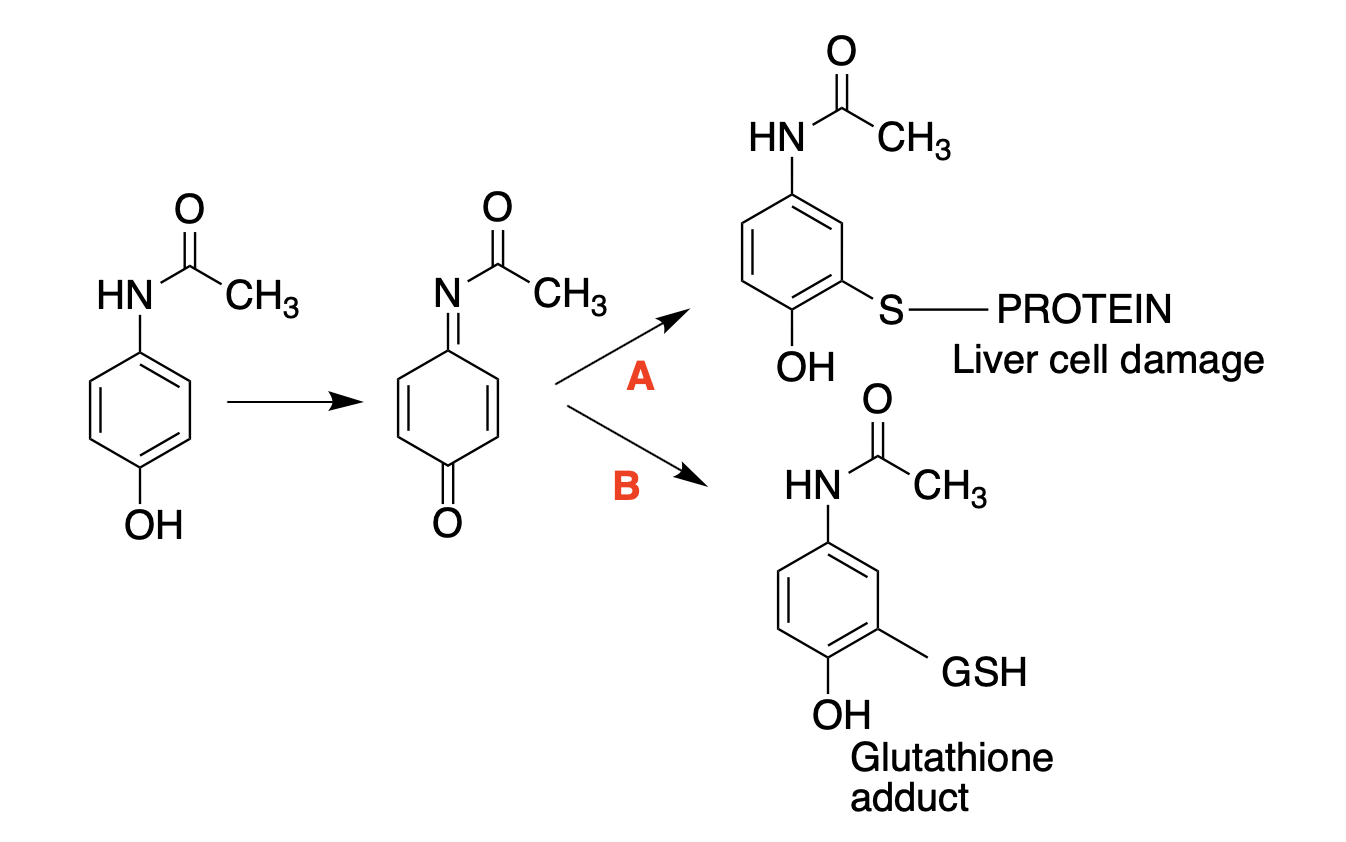
Figure 1. When excess Tylenol is consumed, some of it is converted to NAPQI, a highly reactive intermediate. Route A: NAPQI reacts with sulfur-containing groups on liver proteins, forming covalent adducts that contribute to liver injury. Route B: Under normal conditions, NAPQI is neutralized by glutathione, preventing it from reacting with liver proteins.
A Similar Story in Paper Mills
The chemistry in a paper mill is very different, but there is an intriguing mechanistic resemblance.
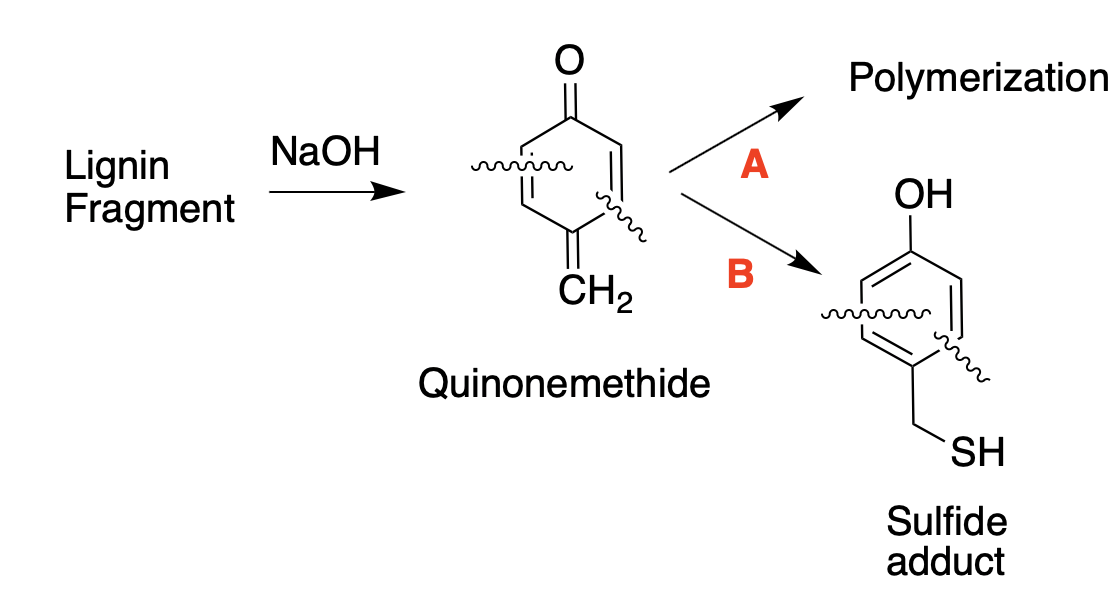
Figure 2. Under strongly alkaline conditions, lignin forms reactive quinone-methide intermediates (chemistry not shown). As is the case with NAPQI, there are two primary outcomes. Route A: The quinone methide reacts with other lignin fragments, causing repolymerization and formation of more resistant lignin structures. Route B: Sulfide intercepts the quinone-methide intermediate, preventing repolymerization and promoting lignin breakdown while preserving cellulose. The squiggly lines indicate that these are fragments of much larger lignin molecules.
The role of sulfide in the Kraft process goes beyond simply accelerating lignin degradation. Quinone-methide intermediates can follow multiple reaction pathways. Some lead to fragmentation of the polymer, but others allow lignin fragments to recombine, producing condensed structures that are even more difficult to remove. Sulfide ions help by rapidly reacting with these intermediates, effectively "mopping them up" before they can undergo unwanted side reactions. In doing so, sulfide steers the chemistry toward lignin breakdown rather than lignin reassembly.
That is the connection to Tylenol toxicity. In the liver, the reactive metabolite NAPQI is intercepted by glutathione before it can react with liver proteins. No, paper mills are not using Tylenol chemistry. But the same broad principle appears in both places: sulfur-containing molecules help control the fate of highly reactive intermediates.
As usual, organic chemistry is bizarre. White liquor contains no liquor, and the chemistry that helps turn wood into paper turns out to have something in common with Tylenol poisoning. How do people ever learn this stuff?
[1] The Kraft process is the world's dominant papermaking technology. Wood chips are cooked with a mixture of sodium hydroxide and sodium sulfide ("white liquor"), which separates cellulose fibers from lignin. The word Kraft is German for "strength."
[2] Despite its innocuous name, white liquor is a strongly alkaline solution containing primarily sodium hydroxide (lye) and sodium sulfide. Typical pH values exceed 12, making it comparable in corrosiveness to industrial drain cleaners.
[3] Cellulose and starch are both polymers of glucose. The difference lies in how the glucose molecules are connected. Starch contains α-linkages that humans can digest, whereas cellulose contains β-linkages that form strong, fibrous structures resistant to digestion. Thus, potatoes provide calories, while paper does not.

Josh Bloom
Director of Chemical and Pharmaceutical Science
Dr. Josh Bloom, the Director of Chemical and Pharmaceutical Science, comes from the world of drug discovery, where he did research for more than 20 years. He holds a Ph.D. in chemistry.