The Good News
In 1978, the first test-tube baby, Louise Brown, was born. Since then, In Vitro Fertilization (IVF) has led to millions of babies born via IVF. This year, we surpassed 100,000 IVF births in the US. In the 1990s, advanced techniques perfected cryopreservation, freezing gametes (eggs and sperm) and the product of their union, the embryo. Gamete cryopreservation is now medically indicated for individuals about to undergo medical care, e.g., chemotherapy, that might impair their ability to produce sperm or eggs. Once an iffy technique, cryopreservation today allows frozen embryos to survive, ready to be thawed, even decades after fertilization. That’s the good news.
And The Bad
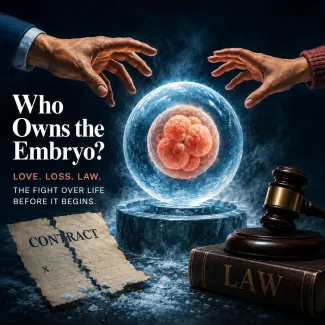
The bad news concerns sperm, eggs, or embryos that are later abandoned or rejected, or where ownership is contested – as in divorce. Who owns the embryo, then? Usually, this is governed by contracts entered into before the procedure begins. But divorce rattles prior commitments and convictions, and parties renege or change their minds. And while the parties ruminate or litigate, the embryos remain on ice. Expert opinion varies on the number of abandoned embryos, but one clinic reports an abandonment rate of 21%, numbering in the millions.
Statistics belie the emotional toll. One recently reported case depicts the heart-wrenching story of 47-year-old Erin Millender and her quest for a child. On the cusp of menopause, extinguishing any hopes of fertility, Ms. Millender relied on IVF with her then-husband, Adam Rubin, to have a child. The process produced two viable embryos. But as their marriage deteriorated, Mr. Rubin revoked his consent to implantation, almost dooming a multi-year quest for motherhood.
Generally, parties have three options for the disposition of the embryo in the event of divorce, most frequently decided when the parties retain the IVF facility and its services:
- Implantation at the behest of either party
- Donation for research or to would-be parents (embryo-adoption)
- Destruction
But it’s not only the parental parties who have an interest. IVF facilities fear being sued, worried that allowing abrogation of contractual decisions puts them at risk.
Erin and Adam initially opted for implantation, but as their marriage deteriorated, Adam withdrew his consent and sought enforcement in the courts. The lower court rejected Adam’s contention that the embryo should be donated and awarded Erin “custody” under the contract. Adam appealed. Before the appeal could be heard, Erin had implanted the embryo and was pregnant.
“I did not endure the I.V.F. process, assist with medical appointments and injections,” with the intention of being reduced to an anonymous donor.”
- Adam Rubin
Generally, American courts don’t compel the birth of an embryo, a position Mr. Rubin relied on, arguing that he didn’t want to father a child who would never know its father. The lower court rejected the argument, a position typical of many lower courts but not of appellate courts.
Courts in a Quandary
Courts have taken split approaches, with some favoring the party seeking a child and others favoring those opposed to its birth, depending on the court's perspective and the parties' arguments, and in some cases inviting legislative intervention. Bioethicists and religious predilections have contributed different views, which may also influence the outcome. Varying legal outcomes depend on whether constitutional law or property law is applied, and on whether the court chooses to:
- Enforce the contract between the parties.
- Use a “balance test” to balance the right to procreate versus the right not to procreate.
- Apply a “contemporaneous mutual consent” approach, requiring mutual consent by both parties for the disposition of the embryos, often resulting in the embryos remaining frozen until an agreement is reached between the parties.
While courts often rely on contractual provisions, some scholars argue that courts should void such contracts because they involve family relationships and therefore violate public policy. [1] Others claim that it is impossible to contract in advance about something as vital as the decision to destroy an embryo.
Allowing a party to renege after signing a contract also introduces uncertainty into the IVF business, which facilities (and insurers) seek to avoid because it affects their bottom line. Some states further increase uncertainty and cost by requiring human embryos to be implanted or stored (indefinitely) until they are “adopted.” Because judicial interventions have been so unpredictable, some states have turned to the legislature for direction.
In tandem with the Dobbs decision, which conferred on States the power to decide abortion access, the nation is becoming more “pro-natalist,” a stance reflected in recent IVF legislation and legal decisions and echoing the prevailing sentiment in other pro-natalist countries. Upending prior decisions enacted in the “Roe v. Wade era,” most recent American legal opinions now favor the parent who seeks to procreate, with many scholars claiming that merely agreeing to enter into IVF waives any right to deny the other spouse the right to bring that pre-embryo to term later on – especially if reproduction is otherwise foreclosed due to age or medical status.
We can expect that shifting political and cultural winds will continue to wreak havoc on contractual decisions, upending the certainty business craves and the wishes of the contracting parties at the time they embarked on the momentous journey of baby-making.
The fate of frozen embryos now sits at the intersection of medicine, contract law, constitutional shifts, politics, and deeply personal hopes for parenthood. As technology advances faster than legal or ethical consensus, courts and legislatures struggle with questions that blur the lines between potential life, property, autonomy, and obligation. The current legal patchwork offers little predictability for families or fertility providers. Until lawmakers craft coherent guidance that respects reproductive freedom and the realities of IVF, embryos will remain suspended not only in liquid nitrogen but also in legal uncertainty. As for the age-old question, What’s Love Got to Do with It – it appears not much.
[1] In contract law, an agreement "void as against public policy" is invalid and completely unenforceable from the beginning because its subject matter undermines society's core legal or moral standards.

Barbara Pfeffer Billauer JD MA (Occ. Health) PhD
Professor Barbara Pfeffer Billauer is an internationally recognized scholar of public health law, bioethics, and the laws of medical care, focusing on the integration of science and law and its impact on day-to-day policy and legal outcomes. She has lectured and published extensively, in scholarly journals and law reviews, and has written and edited seven books for lay and academic audiences.