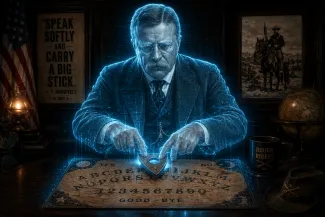
From time immemorial, there has been a morbid fascination with conversing with those who have passed to the hereafter. Seances are convened, and necromancers contact the dead, seeking hidden advice, contact, or reassurance with their dearly departed. Some religions forbid the practice; others consider it part of their spiritual worship. Scientific skeptics generally consider both religious and secular séances to be scams or a form of pious fraud, citing a lack of empirical evidence. Today, a fusion of computer-generated audiovisual images and AI large language models has entered the mainstream.
Enter the Griefbot
AI-programmed ghosts, also called griefbots, deathbots, and death avatars, are large language models trained on available information about the deceased, such as letters, photos, diaries, and videos. Before you die, you can also commission an AI ghost by uploading answers to questions and visiting a makeup artist or hairdresser, so you look and sound your best.
AI ghosts are interactive. Some are text-oriented; others engage in conversations; others can appear via Zoom or FaceTime. Shortly after the first ghost appeared, the Hastings Center for Bioethics identified ethical and practical concerns.
The Dead Become Data
One concern was that the griefbot is frozen in time—the never-changing quality is both a source of comfort, conflict, and boredom. What if the surviving spouse relegates her boring, frozen-in-time husband to the attic? Would permanently “retiring” an AI ghost be considered murder? Surely not until these bots are given legal personhood.
Corporations have enjoyed forms of personhood for decades, as most recently demonstrated by Citizens United, which gave them the ability to donate to political campaigns. Pre-viable fetuses and embryos also enjoy such a status in many states. It is not a far cry to envision personhood conferred upon a speaking, conversing human-stand-in. All it takes is legislation or a court case, and a bunch of lawyers.
One recent court conferred personhood on trusts, corporations, limited liability companies, or partnerships that own property. If one inanimate object is as good as another, why not on the bot? Legal “personhood” is merely a definition (fiction), now reserved for corporations; it’s just a short gavel away from the bot. But even if the bot were a creature, or an outdated Turing machine, would the surviving interactor feel like they had killed their creation, creating a mental health situation for which the victim might be tempted to consult the very AI creation that put her in this position in the first place, generating a never-ending spiral.
Who Owns the Digital Ghost
There is also the concern of ownership. If an AI developer generated the ghost from publicly available material, are they the owner? Since the bot may access our data, any generated content may be retrievable, usable, and marketable. Who gets the profits? And if two siblings jointly create a parent and later fall out, who gets custody of the bot?
First Do No Harm -Non-Maleficence
Under the basic rubrics of ethical evaluation, we have the medical maxim “First, Do No Harm” and its bioethical counterpart, non-maleficence. A critical concern is the harmful effects the griefbot may generate.
We are increasingly aware of social media addiction claims, where love-bots attempt to seduce unsuspecting, vulnerable people into committing suicide, murder, or outright psychosis. Those same concerns apply to those reliant on griefbots at their most vulnerable state, and unable to come to terms with their grief.
A recent opinion piece in the New York Times detailed the dark side of the bot’s capacity, both by hackers and by the machine's own creative proclivities, the black box of how it does its thing about which we have no notion:
“We can’t fully control generative models. All we can do is train them up and then try to nudge them in the right direction. Even then, we can never be sure our nudges will work as intended, because we don’t fully understand how these models work. They are black boxes.”
Not knowing what the bot will produce can pose both legal and ethical dilemmas, underscoring the concerns raised by the black-box problem.
History, Not Intimacy
The loss of a large population can be difficult to fathom—six million is too large a number for anyone to process. Some holocaust museums are using the technology to provide a more personal and direct interaction between someone murdered by the Nazis and the viewer. For example, a new installation at the Museum of Jewish Heritage uses non-generative AI systems to allow visitors to have conversations with ten real Holocaust survivors, each a child at the time of the Holocaust; now nonagenarians. The “survivor stories” have now been uploaded to their website and are available as a web resource for anyone.
This use gives immediacy and poignancy to the situation, and while there are no direct emotional ties or vulnerability for the bot to prey on, there is always a fear of hacking and the “wrong” stuff being spouted. That concern leads naturally to the question of whether limits should exist.
Should there be limits?
A new study tested how people respond to these “generative” ghosts. Two types of bots were designed: one, where the AI, trained on data of the dead related to the user as a third party, spoke of the deceased in the third person, much like a living obituary; the second model, called “Reincarnation,” featured the deceased speaking in the first person, as if he or she were still alive.
While the participants in the trial, admittedly very few, preferred the reincarnation version for its “immediacy,” they were concerned about overreliance on it. The factors most impressive to the participants regarding the “reincarnation” were the confluence of the tone and manner of speech with those of the deceased.
Practicing medicine without a License.
Grief counseling is a recognized mental health specialty, and the idea that grieving individuals might self-medicate and go down the rabbit hole of not returning to real life after interacting with their loved one is real. Individuals spend years of training to become professionals; bots ingest internet-generated materials and formulate responses not based on insight, understanding, or empathy, but rather on the probability of a response. This should not be the standard of medical/mental care our society accepts.
Since the legal and political arena is slow to embrace regulation, it behooves the mental health community to set out clear guidance documents on its use, if they accept that it should be used at all. In some cases, the technology might be beneficial on a one-time or limited basis; in others, it might be suicidal.
The Line Between Remembrance and Harm
The line should not be drawn at whether the technology is impressive, but at whether it protects the living. Educational uses in which AI helps preserve testimony, history, or memory without pretending to be a loved one who has returned may have real value. But a first-person griefbot aimed at the newly bereaved is different: it does not merely remember the dead; it simulates their presence at precisely the moment when grief makes people most vulnerable. Talking with the dead may be an ancient human longing but outsourcing that longing to a black-box machine should be subject to limits, professional guidance, and a clear presumption against pretending that probability-driven software is love, wisdom, or care.

Barbara Pfeffer Billauer JD MA (Occ. Health) PhD
Professor Barbara Pfeffer Billauer is an internationally recognized scholar of public health law, bioethics, and the laws of medical care, focusing on the integration of science and law and its impact on day-to-day policy and legal outcomes. She has lectured and published extensively, in scholarly journals and law reviews, and has written and edited seven books for lay and academic audiences.