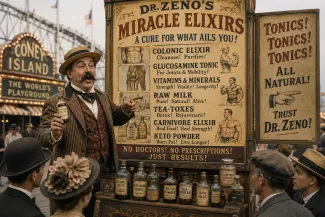
This month’s American Journal of Bioethics featured a Guest Editorial by the preeminent bioethicist, Professor Arthur Caplan. Professor Caplan’s roughly 1500-word rant takes on the purveyors of “raw milk, tea-toxes, colonics, carnivore diets,” and other balms, brews, and baloney. Sadly, the article’s unfortunate perspective seems to be the high cost (per Caplan, the market is projected to reach more than $6000 per American annually by 2029) and selective marketing (to the rich, obviously). It is a persnickety poke at capitalism, cravings, and other protected American liberties, rather than protecting public health or addressing the duping of the scientifically ignorant into procuring potentially risky snake oils, expensive or not.
Caplan admits his disdain for the wellness industry. While he calls out “staggeringly profitable” companies like Gwyneth Paltrow’s Goop, he sidesteps the dangers of the products and the practice. Instead, he complains about proselytizers touting gluten-free meals while he enjoys munching gluten-laden treats at dinner parties. Along with snarking at proponents of the nutritional value of lard and the latest Pilates trend, he makes no secret that his real concern is his lack of patience, exasperation, and generalized grouchiness.
There is also the kick at “autonomy-crazed America,” which he blames not so much for consuming foods and tonics marketed for their health effects, but for ignoring social determinants of health, such as living near a petrochemical plant or a busy airport flight path. Exposures to these insults, he claims, “make staying healthy by jogging a mile every day and avoiding binge drinking far less impactful,” implicitly criticizing the lack of environmental regulation.
The Dangers of Walden Pond
Having not lived in the pristine wilderness (although I did live directly under the JFK Flight path), I can’t vouch for its health and wellness benefits, other than noting the risks of ticks and Lyme disease. However, Caplan’s piece is a missed opportunity to remind us of the dangers of products and practices touting colonics and keto diets and of eschewing evidence-based medicine for the cure and treatment of diseases. While the FDA does provide limited regulation for wellness potions and supplements (mostly related to adulteration and branding), glossy tabloids and photo ops convey a subliminal sense of wellness that can overtake logical decision-making. For the impact of influencers, there is no legal remedy. And while individuals are free to pick their own poison, the lure of supplements and longevity-hacks whose harm taxes the health system affects us all.
Glucosamine
"Glucosamine is one of the most widely used supplements in the U.S., with roughly 40 million users overall.” - Ramon Sun, PhD, of the University of Florida
Glucosamine is a dietary supplement not requiring a prescription and one of the fastest-growing supplements on the market, as people worry about joints and mobility issues. Many people take it for osteoarthritis, but researchers question its effectiveness; the American College of Rheumatology doesn’t recommend it, and the FDA hasn’t reviewed its efficacy.
Excess dose or off-label affects can be gruesome, including upset stomach or increased blood sugar levels, but there may be something more sinister — dementia.
A recent study involved some 24,000 patients with Alzheimer's or related dementias and 41,000 patients with mild cognitive impairment, in a population of roughly half million people studied. One year’s consumption of glucosamine was linked with a 25% higher likelihood of mild cognitive impairment progressing to dementia and a 25% greater mortality over 5 years. Epidemiological findings were substantiated by biological mechanisms, including its ability to bypass the blood-brain barrier, prompting the authors to call for a clinical study. Frankly, this is not one study, you’d catch me volunteering for
“While the results are preliminary and require validation in a human clinical trial, they provide yet another piece of a much bigger mechanistic picture involving metabolic dysregulation and neurodegeneration, according to the study published today in Nature Metabolism.”
On the other hand, evidence is in flux, so consume at your peril
Vitamins and Minerals
While many take carton loads of vitamin and mineral capsules or gum up on gummies touted for better hair, skin, nails, vitality, longevity, etc., studies show they don’t work – unless there is an underlying deficiency. In other words, more isn’t better — just more expensive. Many are harmless and fall smack into Professor Caplan’s riff. But even vitamins and minerals long espoused by the medical profession as beneficial, such as Vitamin D and calcium, which are prescribed to older adults or athletes for stronger bones, have recently been shown to offer little protection against fractures. And excess consumption of these supplements is not harmless; Vitamin D, a fat-soluble vitamin, builds up and is stored in the body, and excess calcium (called hypercalcemia) can be a deadly condition that messes up your mind and your electrolytes.
Vitamin A May Put Others At Risk
While older Americans or jumping gymnasts may choose to improve their knee joints however they wish, including putting themselves at risk, those who choose to bypass vaccines jeopardize the rest of us. Not surprisingly, as vaccine uptake wanes, measles outbreaks are proliferating, with the country on track for the worst record in 34 years.
“Studies have found that vitamin A can dramatically reduce measles mortality.”
– HHS Secretary Robert F. Kennedy Jr
The anti-vax and vaccine-hesitant community has been following the lead of the Secretary of Health and other influencers in seeking out alternative cure-alls to evidence-based (pharmaceutically mediated) medicine, often focusing on products promoted by the wellness industry, including good old-fashioned vitamins, now repurposed as a measles elixir.
Among wellness remedies exemplifying wholesomeness and ripe for vaccine substitution are Vitamin A and Cod Liver Oil, championed by Secretary Kennedy as a means to prevent measles mortality. Even the now-untrusted CDC has warily echoed the recommendation writing
“may be administered to infants and children in the United States with measles under the supervision of a healthcare provider as part of supportive management.”
Kennedy expands on the “up-to-date guidance,” touting its role in “mild, moderate, and severe infection.” Has vaccine disdain and championing the A Vitamin contributed to vaccine resistance by providing “a health and wellness” alternative?
Vitamin A is essential to our health. Deficiencies can exacerbate various illnesses, including measles. However, too much can lead to Vitamin A toxicity. Like Vitamin D, Vitamin A is fat-soluble and stored in the body. When consumed in excess, it can damage the bones and liver. It is also a teratogen, causing birth defects if consumed during pregnancy.
“Vitamin A is not a substitute for vaccination,”
- Dr. Megan Ranney, dean of the Yale School of Public Health.
It is not too far a stretch to surmise that Vitamin A was used as a home remedy by the vaccine-averse last year. While its use as a vaccine substitute and the consequent increase in measles cases are mere suppositions, recent data from the American Poison Center show a 38.7% increase in Vitamin A overdoses between January and March 2025, coinciding with the measles outbreak in 45 US jurisdictions (along with increased related internet searches). The finding was sufficiently concerning to the American Medical Association that a research letter hypothesized that the excess exposure to Vitamin A was caused by the spread of misinformation regarding its role, augmented by the media, “prominent figures in public office,” influencers, and podcasters.
At the end of the bottle, the wellness industry is not merely a marketplace of balms, brews, and baloney. It is an ecosystem of influencers, entrepreneurs, and opportunists who monetize distrust of expertise while marketing confidence as a substitute for evidence, and, in the process, foment disease.

Barbara Pfeffer Billauer JD MA (Occ. Health) PhD
Professor Barbara Pfeffer Billauer is an internationally recognized scholar of public health law, bioethics, and the laws of medical care, focusing on the integration of science and law and its impact on day-to-day policy and legal outcomes. She has lectured and published extensively, in scholarly journals and law reviews, and has written and edited seven books for lay and academic audiences.