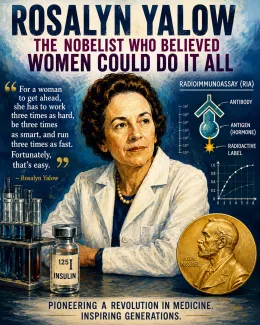
Medical diagnosis was revolutionized in the late 1950s when Dr. Rosalyn Yalow and her collaborator, Dr. Sol Berson, developed the radioimmunoassay technique [1] to measure minute amounts of hormones, enzymes, and other bodily substances. For this discovery, Dr. Yalow won the Nobel Prize in 1977 [2].
I was privileged to interview Dr. Yalow in 1985, when she was 74. Life got in the way of preparing my notes for publication, and they lay dormant until now. Here, under the publication umbrella of ACSH, are my unreported observations of this remarkable woman.
The first thing I noticed upon entering Dr. Yalow’s Bronx VA office – the same office she occupied for over four decades before her death – was a large placard on the wall:
“For a woman to get ahead, she has to work three times as hard, be three times as smart, and run three times as fast. Fortunately, that’s easy.”
The aristocratic woman sat beneath a portrait painted twenty-five years earlier; her face had changed little over time. The years, however, left their mark in hobbled arthritic hands and on her mobility, yet energy and passion lit her eyes. Like the five women scientists awarded the Nobel Prize in Physiology or Medicine before her, she was the first American-born woman to receive the prize, married with children, and had overcome great odds in revolutionizing the practice of science in the process.
The Saga Begins With Rejection
The scene unfolds in 1955, with medical physicist Yalow and collaborator, physician-researcher Benson, submitting their seminal article to the Journal of Clinical Investigation (JCI). The article described what would become their award-winning radioisotope technique for detecting soluble antigen-antibody complexes of small molecules, known as radioimmunoassay (RIA). It was rejected.
It was resubmitted and accepted in JCI a year later, under the title “Immunoassay of endogenous plasma insulin in man,” and became one of the most cited articles published in the Journal. Along with pioneering RIA, their work clarified our understanding of diabetes and laid the groundwork for discoveries in fields ranging from immunology to obesity research, paving the way for today’s diabetes medications, now co-opted for obesity treatment, the GLP-1s.
The key obstacle to Benson and Yalow’s initial submission was that they had classified insulin as an antibody, which ran counter to the prevailing wisdom of the day. Their insight that insulin could have both hormonal and autoimmune properties was novel and crucial for distinguishing between type 1 “juvenile diabetes,” in which autoimmune reactions destroy insulin production, and type 2, adult-onset diabetes, in which patients have sufficient insulin but their bodies exhibit a “resistant” response.
In the beginning
By the time Berson and Yalow began collaborating in 1950, three other male-female teams, all husband-and-wife pairs, had won the Nobel [3]. None prompted the intense speculation and disparaging remarks leveled against Rosalyn, who wasn’t married to her “professional husband,” Sol Berson. To the oft-repeated claim that she is not as brilliant as her co-worker Berson, she shrugs and says, “Sol was brilliant.” But Ros, as she was known, didn’t allow her laser-like focus to be distracted by these inanities.
With equal pride, she might have said she had “professional” children as well - students and junior scientists whom she mentored and nurtured, many of whom ultimately made indelible marks on their own, building on the Yalow-Berson collaboration or following Ros’s footsteps as a role model and mentor.
She wore her convictions in her science and her belief in herself like armor, rarely yielding, perhaps out of the need to prove she was as dauntless as her male peers, perhaps, as her son, Ben, explained, because she was mostly right. This self-assurance appears in her character even as a youngster and becomes a trademark of sorts.
“By the time I was 8, my idea of what my grown-up life would be that I’d be a working scientist… I also knew that I’d be married and I’d have children. I always knew I could have everything. That’s all.”
A child of immigrant parents who barely finished high school, she credits her high school and college science teachers for encouraging her to pursue a career in science. Originally a chemistry major at Hunter College, like many women written about in this column, she found that the only job available and remotely suitable was as a secretary to a Columbia University biochemist. Rather than railing about the injustice, she says, “They needed me…. I had this unwavering belief it would all work out.”
From there, she was offered a post as a teaching assistant in physics at the University of Illinois Urbana-Champaign, in no small measure to replace the male ranks depleted by World War II and to avoid the school being shut down. She was the only woman among the faculty’s 400 members and the first since 1917. There she would later earn a PhD.
Following graduation in 1945, she returned to Hunter College to teach physics before beginning her long association with the Veterans Administration, first becoming a consultant to the Bronx VA Hospital and then creating its first radioisotope laboratory, furthering her passion for transforming the horrors of atomic weapons' radioactivity into peaceful purposes.
A Meeting of the Professional Minds
By 1950, Yalow decided to devote herself to full-time research and began collaborating with Berson. Both thought the other was brilliant and eagerly embraced the notion of teaming up: if Berson provided the genius, Yalow provided the grounding. While his reputation lent gravitas and protection in a male-chauvinist world, she anchored him, shielding his gullible nature from the turmoil of institutional politics.
Her demeanor, regarded as aggressive, smug, even belligerent, generated unpopularity that some say delayed her Nobel award. Nevertheless, the Dr. Yalow I met was quite sensitive, very aware of and pained by the ignominies her husband, Aaron, a physicist who contentedly played second fiddle to his flamboyantly famous wife, was forced to suffer on her account. She recounted two illustrative stories:
It was a week before their marriage when Aaron took his doctoral comprehensives.
“The head of the Department had it in for me, and the attitude spilled over to Aaron. He was made to suffer—just for being engaged to me. In fact, he was made to provide an answer to a question 12 different ways. It was one of the longest doctoral exams ever given. …
When I took my doctorate exams, the guy was stupid enough to try the same thing on me. And my answer was that Goldhaber and Nye taught it to me this way, and if there is anything wrong, you better talk to them about it. The guy walked right out of my exam and didn’t come back, so I had one of the shortest [exams] a doctoral student ever had. I knew I was right and wasn’t going to be troubled by that guy. When a guy who was an authority told Aaron he was wrong, Aaron worried maybe he could have been.”
Although not religious herself, Aaron was, and Dr. Yalow tells me that she was proud to accede to his desire to keep a Kosher home and observe the Sabbath (when she was home). She ran her home like the rest of her life—as a drill sergeant, taking immense pride in overachieving, almost boasting that she “spent as much time with her family as women generally do,” going to school plays and being “there whenever she was needed.” Daughter Elanna, however, remembered this somewhat differently, acknowledging that her mother was home in the early years, but by the time she was in high school, Ros was hardly around.
Eventually, Elanna, who earned a PhD in educational psychology, came to recognize the importance of her mother’s influence in her life. Ros considered her son, Ben, even more brilliant than she was, but he opted not to compete with Mom – eschewing advanced academic credentials and dedicating his life to the science fiction community as an impresario.
When asked for a message to impart to the next generation of women, Dr. Yalow said:
“You don’t have to choose. I would like to encourage professional women to get married and have kids, not like the last three [female] Nobel Prize winners in science.”
Rosalyn Yalow’s story is not only one of scientific triumph but also of temperament: the confidence to be right before others were ready to agree, the stamina to work within institutions that underestimated her, and the conviction that women need not choose between intellect, ambition, marriage, and motherhood.
Her legacy lives on in every laboratory test that depends on accurately detecting the nearly undetectable, and in the example she left for generations of women scientists: do the work, trust the evidence, and never apologize for wanting the whole life.
[1] It works by labeling a known substance using a mixture of antibodies and a small amount of radioactivity to determine how much of the substance is in the unknown sample being tested.
[2] Dr. Berson had predeceased her and was, by the rules of the Nobel Committee, ineligible for the award.
[3] : Marie and Pierre Curie, Irene and Frederic Joliot-Curie, and Gerti and Carl Cori.
Additional Source: Rosalyn Yalow: Her Life and Work in Medicine by Eugene Strauss
Barbara Pfeffer Billauer JD MA (Occ. Health) PhD
Professor Barbara Pfeffer Billauer is an internationally recognized scholar of public health law, bioethics, and the laws of medical care, focusing on the integration of science and law and its impact on day-to-day policy and legal outcomes. She has lectured and published extensively, in scholarly journals and law reviews, and has written and edited seven books for lay and academic audiences.