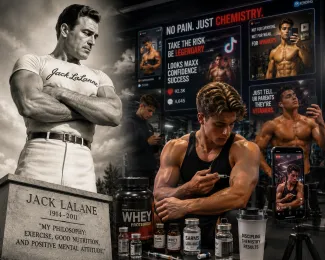
Recently, the bodybuilding world mourned the loss of twenty-two-year-old bodybuilder Gabriel Ganley. For those unfamiliar, Ganley was a Brazilian phenomenon. Charismatic and ambitious, he amassed more than two million followers and embodied something the sport had not seen in years: a young athlete who built his audience as a natural bodybuilder before, less than a year ago, deciding to begin using hormones in pursuit of a professional career.
According to an autopsy report cited by G1, a Brazilian news portal, hypertrophic cardiomyopathy caused his death. The disease thickens the heart muscle and often has a genetic component. Abnormal muscle growth makes it harder for the heart to pump and supply itself with oxygen, leading to abnormal heart rhythms. Whether it alone explains his death is impossible to know.
What is difficult to ignore, however, is the well-established association between anabolic steroids and cardiovascular damage. Long-term cohort studies have found substantially higher, threefold rates of cardiovascular disease and mortality among anabolic steroid users, raising uncomfortable questions about the extent to which these substances may have contributed to Ganley’s death.
Yet the most troubling aspect of this story is not the exact role that genetics, steroids, or other factors played. It is what happened before his death.
“Looksmaxxing:” When the Perfect Body Becomes a Public Performance
For years, social media users, sponsors, coaches, influencers, and fans celebrated the pursuit of increasingly extreme physiques, often treating the transition from natural bodybuilding to pharmacological enhancement not as a dangerous decision but as an expected step toward success. Yet when tragedy strikes, the same environment that helped normalize these choices expresses grief while rarely questioning its role in shaping them.
Ganley's death is not an isolated case. Dallas McCarver, whom Gabriel cited as an inspiration, died at 26 from a heart attack in 2017. Similar cases include Juan Sebastián Anzola Quintero, who died at 26 while training, and Wang Kun, a Chinese bodybuilder who died at 30 in 2025 amid reports of heart disease.
More concerning is the growing number of young people who, influenced by the ideal of a “perfect physique,” follow the same path without fully understanding the consequences.
A CBS News report illustrates this phenomenon well. Journalist Adam Yamaguchi interviewed Zaid Laila, a 16-year-old content creator documenting his physical transformation, diet, training, and anabolic steroid use for hundreds of thousands of followers.
Despite knowing the risks, he argues that it is “worth it” because achieving the same results naturally would take years. His final statement is especially revealing: “If I have a heart attack at 30, I have a heart attack.”
His interview highlights a broader problem: the growing trivialization of anabolic steroids on social media, where many now see them as a shortcut to status, success, and validation.
Risky Behavior: The Young Brain Meets the Online Body Ideal
Social media appears to play a central role, exposing young people to messages promising rapid gains in strength, status, wealth, and popularity through substances portrayed as relatively harmless. Reducing anabolic steroid use to a matter of individual choice or medical freedom ignores a substantial body of evidence showing that adolescents are particularly vulnerable to risk-taking and social influence. Some groups, including individuals with ADHD, may be especially susceptible to these influences.
Research by the National Academy of Sciences suggests that, compared with adults, adolescents are more likely to:
- underestimate risks
- overestimate benefits
- rely more heavily on emotions and peer influence
- place greater value on immediate rewards.
A family environment characterized by supervision, clear rules, and strong emotional bonds is protective, whereas family stress, dysfunction, and substance use increase vulnerability.
Likes and Influencers Turning Risk into Reach
Social media amplifies many of these influences through likes, comments, and shares, facilitating the spread of content that minimizes the risks associated with anabolic steroids and similar substances.
A report from the Center for Countering Digital Hate found that anabolic steroids and related substances — including SARMs [1] and peptides — are widely promoted on TikTok. In the United States alone, related content has accumulated up to 587 million views, primarily from users under 24. Researchers identified content targeting teenagers, including messages such as “just tell your parents they are vitamins” and “take the risk.” They also found websites using regulatory-evasion strategies, marketing products as “research chemicals” or “not for human consumption” while prominently displaying highly muscular physiques.
These findings directly contradict TikTok's policies prohibiting the promotion and sale of such substances.
Rather than marketing products directly, many companies rely on bodybuilding influencers. A study published in Drugs: Education, Prevention and Policy found that steroid promotion on Instagram, TikTok, and Facebook is driven primarily by suppliers and influencers.
These influencers often embody the ideal of an online male, using muscularity as social capital. Even when they do not explicitly promote anabolic steroids, their content can normalize steroid use and steer users toward suppliers.
Suppliers openly market products through private messages, comments, and messaging apps, often without screening. Influencers, meanwhile, combine training advice, diet content, and supplement promotion with intermediary roles for third-party sellers.
Taken together, these practices increase the availability of anabolic steroids and their perceived desirability and normalization. The evidence consistently shows that social media platforms facilitate circumventing existing moderation systems.
Given these findings, it is necessary to ask why and how many young people choose to use these substances.
Prevalence: From Exposure to Intention
Available evidence suggests that anabolic steroid use is already present among a meaningful proportion of adolescents, with prevalence estimates ranging from about 2–3% in some school-based surveys to nearly 6% among boys.
Among the studies on intention, two from the same research group, using data from The Study of Boys and Men, an online survey examining body image among boys and men in Canada and the United States, are especially relevant.
The first study investigated whether having anabolic steroid users in one's social network was associated with stronger intentions to use these substances. Although overall intentions remained relatively low among 1,515 males aged 15 to 35, exposure to steroid users was consistently associated with stronger intentions to use anabolic steroids and greater interest in learning about them.
The second study examined social media exposure to muscular bodies, muscle-building supplements, and drugs (collectively termed muscularity) and its association with intentions to use anabolic steroids. Greater exposure to muscularity-related content, along with increased addictive-like engagement with social media, was linked to stronger intentions to use anabolic steroids. The strongest associations involved exposure to muscular, lean, and athletic physiques, as well as advertisements for anabolic steroids and SARMs.
Additional evidence comes from a study published in The Journal of School Health that included more than 38,000 high school students and found that steroid use was more common among boys, older students, and certain racial minority groups. Greater parental rule-setting, stricter school policies, and stronger disciplinary measures regarding drug use were associated with lower prevalence, suggesting that anabolic steroid use is influenced by demographic, family, and school factors.
Similar findings were reported in a Swedish study published in the European Journal of Public Health, which found that steroid use was more common among boys. Low self-esteem and the use of other drugs were significant correlates, suggesting that steroid use shares risk factors with other forms of substance use and is also motivated by concerns about appearance and athletic performance.
Although the literature remains limited, findings consistently indicate that anabolic steroid use is shaped by social, psychological, familial, and environmental factors.
Beyond Muscle Growth: The Risks of Anabolic Steroids
The risks associated with anabolic steroids are well known, including hormonal dysfunction (gynecomastia in men and virilization in women) and an increased risk of cardiovascular, hepatic, and neuropsychiatric illness (“roid’ rage”). The scientific literature supports these concerns, noting that nonmedical steroid use can affect nearly every organ system.
A study of Danish men published in the Journal of Internal Medicine found that steroid users had about three times the mortality risk of nonusers, along with higher rates of hospitalization and other adverse outcomes. A Swedish national cohort study provided additional evidence of cardiovascular harm. Researchers found that anabolic steroid exposure was associated with roughly double the risk of cardiovascular events and mortality. Importantly, a substantial proportion of deaths resulted from intentional causes, such as suicide or homicide.
While these studies examined steroid users in general, an article in the European Heart Journal followed more than 20,000 male bodybuilding athletes over 16 years.
Researchers documented substantially elevated rates of premature mortality and sudden cardiac death, and available autopsies frequently revealed structural cardiac abnormalities, including left ventricular hypertrophy, cardiomegaly, and coronary artery disease. Again, deaths from suicide, overdose, and homicide were also documented, suggesting that psychosocial and behavioral factors may contribute to the observed mortality patterns.
At this point, the conclusion seems inescapable. Anabolic steroids may increase muscle mass, improve performance, and enhance physical appearance, but these benefits come at a high cost. In milder cases, users may develop acne or gynecomastia; in more severe cases, they face elevated risks of cardiovascular disease, neuropsychiatric complications, suicide, and premature death.
Steroid Use as a Public-Health Problem
Would stricter regulation be sufficient? I do not know.
Stronger oversight of social media platforms and broader educational efforts are reasonable measures. Yet none is likely to solve the problem on its own. The growing use of anabolic steroids among young people reflects a broader environment in which these substances have become increasingly visible, accessible, and normalized.
Gabriel Ganley was not the first. Different names, faces, and circumstances, yet increasingly similar trajectories. Young people are drawn by promises of a stronger body, greater recognition, and a more desirable appearance. Over time, individual stories blur, and what remains is the pattern itself.
Unless we are willing to confront the forces that normalize anabolic steroid use and make these substances increasingly accessible to young people, similar stories will continue to unfold as long as anabolic steroid use among young people is treated primarily as an individual choice rather than a public-health issue.
[1] Selective androgen receptor modulators (SARMs) are a class of drug compounds that bind to androgen receptors and have anabolic effects similar to anabolic steroids. They are not approved for general medical use and are associated with potential health risks.

Mauro Proença
Mauro Proença is a nutrition graduate student with a postgraduate degree in Clinical Nutrition from the University of São Paulo (USP), Brazil.