A new article in JAMA isn't going to make either knee specialists or their patients very happy. And that "cortisone shot" you're scheduled to get? Might want to reschedule that until... never, thanks to this article: "Effect of Intra-articular Triamcinolone vs. Saline on Knee Cartilage Volume and Pain in Patients With Knee Osteoarthritis A Randomized Clinical Trial." The paper pretty much closes the door on the controversy that has surrounded steroid injections. Not only did they not help, but they may have even made arthritis worse.
In a two-year randomized control trial, patients with osteoarthritis of the knee were given injections of either triamcinolone—an anti-inflammatory steroid, or a saline placebo. In contrast to previous trials, which were poorly designed and/or underpowered, this one was set up to give a real answer. Only, it wasn't the answer that people were hoping for. The placebo performed just as well as the steroid shot. That hurts.
During the study, conducted at Tufts Medical Center, participants who had diagnosed osteoarthritis of the knee (and inflammation of the synovial membrane) received injections of either triamcinolone or saline every three months. Timothy E. McAlindon, MD, and colleagues were looking at a number of defined outcomes: pain, loss of cartilage, structural damage, and knee function.
As is the case with good studies, neither the patient nor the clinician who was administering the injection knew what was in the syringe (double blinded). The treatment and placebo groups were randomized (Table 1).
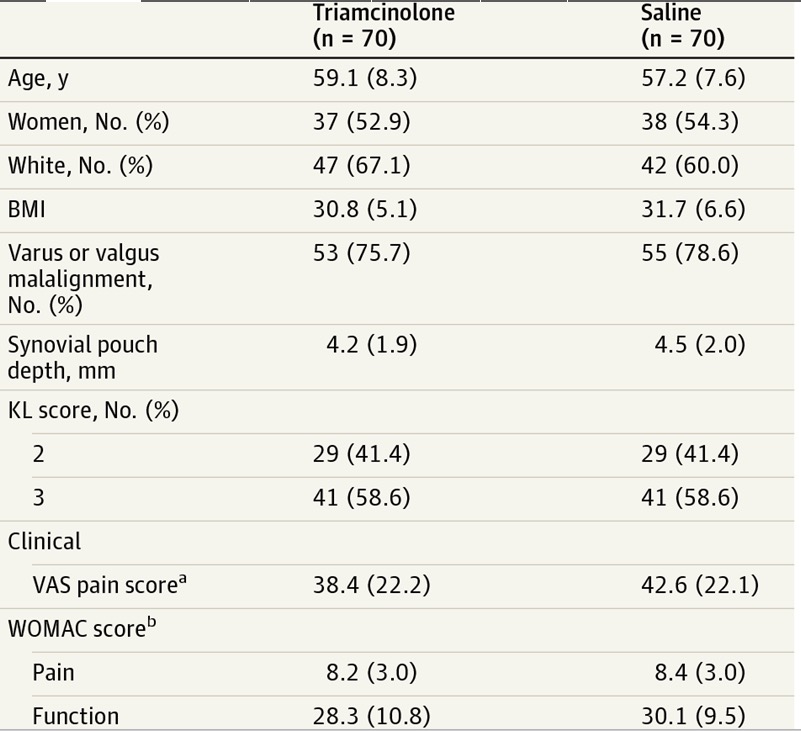
Some fundamental characteristics of the treated (left) and control (right) groups. Note the close match. This minimizes experimental error. Source: JAMA. 2017;317(19):1967-1975. Other parameters not shown.
Methods for evaluating patients' condition were Knee Joint Ultrasonography, MRI, a known measure of bone marrow damage, and WOMAC (Western Ontario and McMaster Universities Osteoarthritis Index) - a questionnaire to assess pain. There was plenty of pain (Figure 1):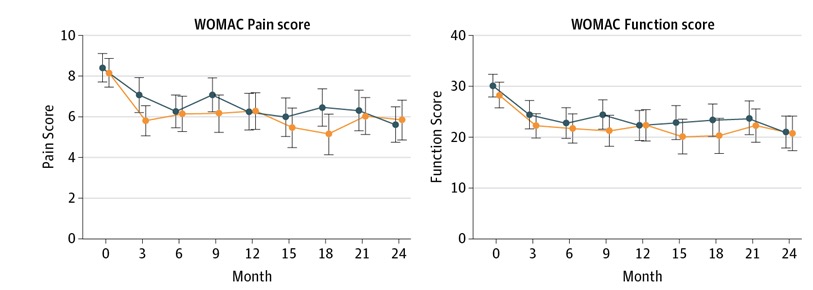
(Figure 1: The two-year results of pain (left) and knee function (right). Absolutely no difference between treated (yellow) and control (black) groups.
Other graphs show much of the same—no effect from the steroid. It would be difficult even to imagine a trial that bombed worse than this.
The Mayo clinic doesn't offer any great alternatives. Its website mentions steroid injections (so much for that) and anti-inflammatory drugs (hard to believe that these will work when injected steroids failed), and a variety of surgical procedure, none of which look like a whole lot of fun.
These results are not radically different from those from a 2014 study that concluded that spinal injections of steroids were not of much use. (See: Injections For Spinal Stenosis Symptoms May Not Need The Steroid Component).

Josh Bloom
Dr. Jonathan (Josh) Bloom, ACSH's Director of Chemical and Pharmaceutical Sciences, earned his Ph.D. at the University of Virginia and completed postdoctoral training at the University of Pennsylvania. During his 20-plus years in drug discovery at Wyeth, his research group discovered the antibiotic Tygacil®, approved in 2005. He holds 25 issued patents and has authored 35 academic papers. Since joining ACSH in 2010, he has written more than 2,000 articles and dozens of op-eds for major newspapers, including The Wall Street Journal and Chicago Tribune.