
In case you are "nova" to this site, here's what to expect: Some terrible puns and juvenile humor, a little about drug pollution in water, and a smear of chemistry in the form of drug metabolism. Don the life jackets. It's time to sink or swim. Upstream.
Drugs in wastewater
What happens to the drugs that people take?
While some are eliminated unchanged, most are metabolized—primarily by the liver—and then excreted, usually in the urine. Although I haven't been measuring urinary metabolites in sewers recently, I'm fairly confident that much of the drug-related mass down there is in the form of metabolites, many of which are no longer pharmaceutically active. [1]
But not always. If you roll up a hundred-dollar bill and donate it to ACSH, I'll explain.
One drug that retains its oomph even after metabolism is cocaine. As if the stuff doesn't cause enough problems up the nose, a pharmaceutically active form of coke can, at least in theory, cause trouble up the gills, perhaps getting the stone crabs stoned and the amberjacks jacked up.
But today's fish special is salmon, and there is some evidence that a cocaine metabolite called benzoylecgonine can impact its behavior, according to an article in Current Biology.
Smoked Salmon
At first glance, the behavior looks familiar: the exposed fish are more active, covering more ground, and generally refusing to settle down, start families, and get fixed-rate mortgages. It’s tempting to call this a cocaine buzz, but that’s probably the wrong way to think about it.
The study doesn’t show that fish are “getting high” in any human sense. What it does show is that exposure to cocaine—and even more so to its metabolite benzoylecgonine (Figure 1)—changes how fish move through their environment.
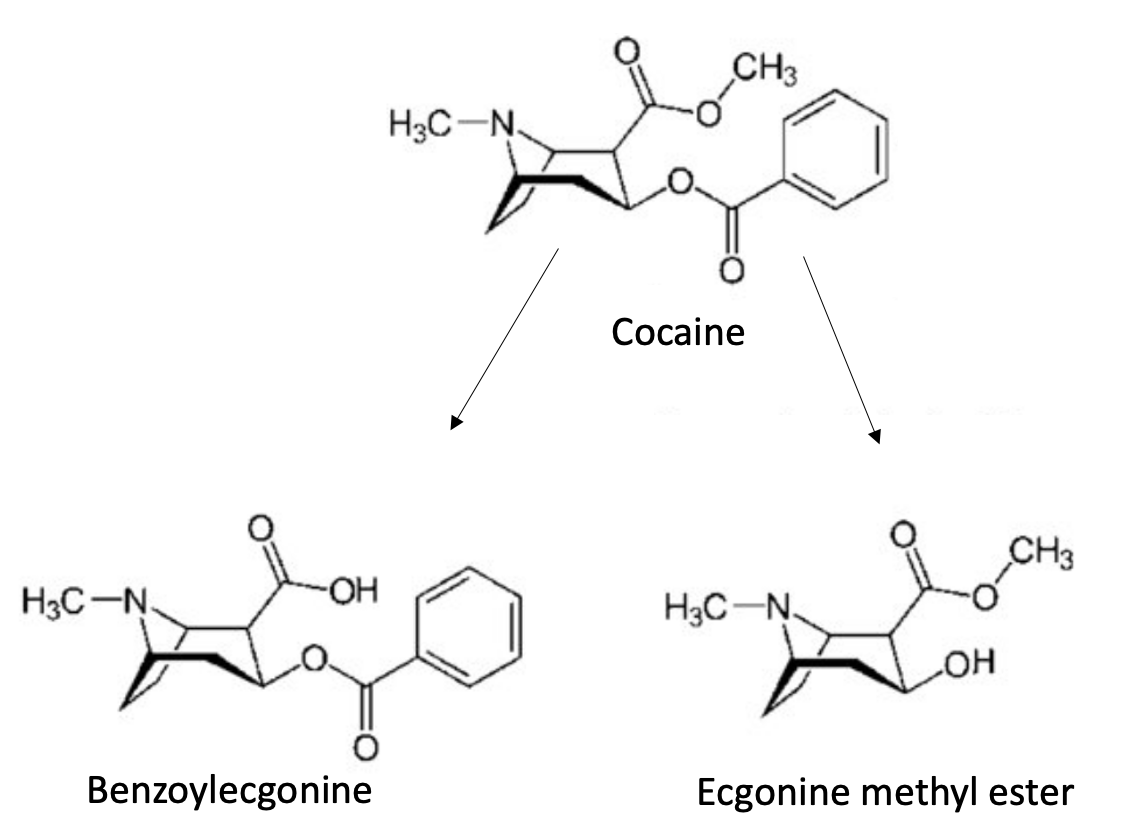
Figure 1. Cocaine is rapidly broken down in the body into two major metabolites, benzoylecgonine and ecgonine methyl ester. While these are generally considered pharmacologically inactive in humans, benzoylecgonine is more stable and persistent, allowing it to accumulate in waterways where it has been shown to alter fish behavior.
How big is the change?
To test this, researchers implanted slow-release devices into juvenile salmon and tracked their movements in a Swedish lake over two months. Instead of gradually calming down and sticking to one area, the exposed salmon kept roaming, with those exposed to the metabolite swimming up to about 1.9 times farther per week and ending up 10–12 kilometers farther from where they started.

Sammy the Salmon is going places. Fast.
Exactly how this happens isn’t clear, but it doesn’t require anything resembling a cocaine high. Benzoylecgonine may be mostly inactive in humans, but fish aren’t people, and the stuff isn’t inert. It can affect blood vessels, energy use, or stress chemistry—none of which sounds like much until you remember that these fish aren't taking toots occasionally; they're exposed all the time. In that setting, even small physiological nudges can turn into real behavioral changes.
And in the wild, behavior is everything. Where a fish goes determines what it eats, what eats it, and whether it ever makes it back to spawn. So no, the salmon aren’t partying—but they may still be getting pushed around chemically in ways that leave them, quite literally, off course.
NOTE
[1] After excretion, drugs and their metabolites enter wastewater systems, where some are removed but many are not. The leftovers are discharged into rivers and lakes, where they may break down, dilute, or persist—depending on the chemistry. Source: PNAS, 2022.

Josh Bloom
Dr. Jonathan (Josh) Bloom, ACSH's Director of Chemical and Pharmaceutical Sciences, earned his Ph.D. at the University of Virginia and completed postdoctoral training at the University of Pennsylvania. During his 20-plus years in drug discovery at Wyeth, his research group discovered the antibiotic Tygacil®, approved in 2005. He holds 25 issued patents and has authored 35 academic papers. Since joining ACSH in 2010, he has written more than 2,000 articles and dozens of op-eds for major newspapers, including The Wall Street Journal and Chicago Tribune.