
It’s All Over the News
Coca‑Cola announced that starting this fall, it will (re)launch a U.S. version of Coke sweetened with cane sugar. The company also clarified that the original high-fructose corn syrup (HFCS) formula will remain available. (Coke has been using high fructose corn syrup since the early 1980s; before that, only cane sugar was used.)
What’s the Deal with HFCS?
Is it good, bad, or neither?
The discussion about the pros and cons of HFCS is like that old Bud vs. Bud Light commercial: two sides fruitlessly yelling at each other. The anti-fructites are both vocal and prodigious. It’s impossible to Google "high-fructose corn syrup" without running into a bazillion haters. This debate has been going on for an eternity, and I want no part of it. As the great Yogi Berra once said, “Include me out.”
Before we move on, one site deserves a "special recognition" award for its extra effort.
The website celestialhealing.net really doesn’t like high-fructose corn syrup — so much so that it lists more than 300 foods that contain it. This brings up a rather interesting paradox. Here's one of the 300:
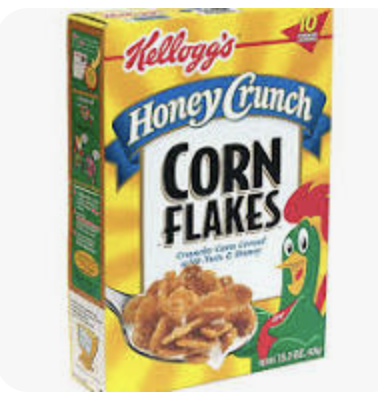
Kellogg's Honey Crunch Corn Flakes. A healthy, non-healthy cereal
Did it make the list because it contains HFCS or honey?
As it turns out, it doesn’t much matter.
Huh?
Sugar Chemistry for Beginners (and Activists)
The type of HFCS used in soda is called HFCS-55, which contains 55% fructose and 45% glucose.
Here’s how HFCS compares to sugar:
- HFCS-55 = 55% fructose + 45% glucose
(Ratio = 1.22, both sugars are free and absorb quickly) - Table sugar (sucrose) = 50% fructose + 50% glucose
(Ratio = 1.0, sugars are chemically bound and must be enzymatically separated in the intestine)
The primary knock on fructose is its metabolism (1), which differs from that of glucose. Even though HFCS and sucrose have similar fructose-to-glucose ratios, HFCS contains free sugars that are absorbed more quickly. This faster delivery of fructose to the liver can potentially lead to greater fat production, especially when consumed in large amounts. Supposedly. Let’s leave it at that.
Natural Honey: Sweet or Sinister?
Here’s the composition of honey (2):
- 38.2% fructose + 31.3% glucose
(Fructose-to-glucose ratio = 1.22)
Well, ain’t that sweet irony. It’s identical to HFCS. (3)
Would someone please explain to me why the food Nazis and anti-soda zealots conveniently ignore this? Or why honey isn’t being taxed like soda in dozens of U.S. cities.
Or perhaps why various Internet creepy crawlers like like Mercola and Adams get away with praising honey while treating HFCS like Agent Orange.
Scorn for Corn. Money for Honey
Anyone even vaguely aware of the shady world of dietary supplements and health gurus shouldn't be the least bit surprised that internet hucksters routinely find something or other to dredge up a scare and sell something to replace it. The same holds true here, in the form of Mike "the Health Ranger," David "Avocado" Wolfe, and (of course) Joe "Crazy Joe" Mercola, the reigning Sultan of Sleaze.
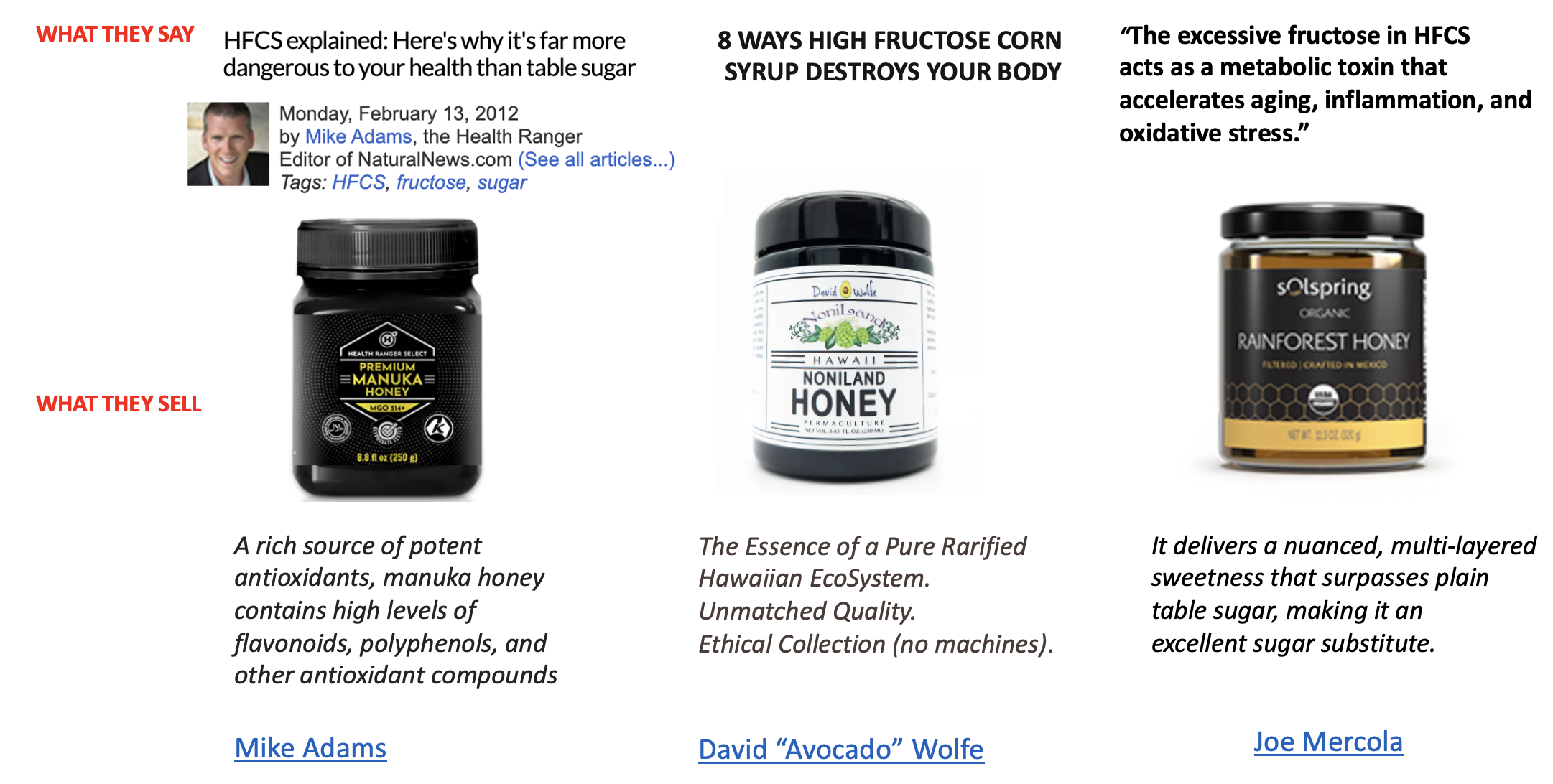
Self-explanatory.
Sweet dreams.
Notes:
(1) The comparative metabolic properties of sugar and HFCS have been widely studied. Here’s one review.
(2) The rest of the honey consists mostly of water and trace sugars, some vitamins, and other stuff.. That’s why the numbers don’t add to 100%.
(3) Obviously, honey and HFCS aren’t identical in every way — taste, smell, viscosity, etc. But in terms of fructose content, and whatever health baggage that carries, they’re functionally the same.

Josh Bloom
Dr. Jonathan (Josh) Bloom, ACSH's Director of Chemical and Pharmaceutical Sciences, earned his Ph.D. at the University of Virginia and completed postdoctoral training at the University of Pennsylvania. During his 20-plus years in drug discovery at Wyeth, his research group discovered the antibiotic Tygacil®, approved in 2005. He holds 25 issued patents and has authored 35 academic papers. Since joining ACSH in 2010, he has written more than 2,000 articles and dozens of op-eds for major newspapers, including The Wall Street Journal and Chicago Tribune.