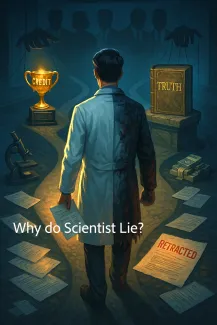
“It’s natural to think of scientists as truth seekers, people driven by an intense curiosity to understand the natural world. Yet this picture of scientists and scientific inquiry sits uncomfortably with the reality and prevalence of scientific fraud. If one wants to get at the truth about nature, why lie?”
- Liam Kofi Bright
Bright’s question points to the internal temptations within science. Still, it applies equally when political administrations, corporate boards, and advocacy groups become influential players in the credit race, deciding which findings are amplified, suppressed, or rewarded, and sometimes bending science toward their preferred narratives.
The Perils of the Race to Be First
Most of the time, the scientific enterprise works remarkably well, with prestige and its accoutrements motivating researchers to test, publish, and share their ideas. But when the golden ring of credit seems just out of reach, scientists may try a shortcut, scientific fraud. Scientific fraud results in:
- Derailing scientific progress as falsehoods lead others down dead ends
- Wastes time and resources as researchers follow those falsehoods or attempt to disprove them.
- Undermines trust and accountability, easily seen in what is frequently described as the “Big Tobacco Playbook” and other forms of conflicts of interest. Moreover, a lack of accountability persists for all of these players. “Culprits,” individuals or organizations retain professional credit even after exposure.
Because of these harms, it is crucial not only to identify fraud but also to discover and mitigate its underlying causes. Before jumping in, a shoutout to Liam Kofi Bright of the London School of Economics for providing the broad outlines of my thinking.
Stereotypes and Incentives
 Consider your stereotypical scientist: a blend of brilliance, focus, and eccentricity, prone to absent-mindedness, yet relentlessly curious. Most importantly, driven by the “scientific method’s” search for the truth.
“An uncompromising adherence to the truth is essential for scientific progress, and it is also an admirable spiritual practice, but it is not a winning political strategy.” – Nexus, Yuval Harari
This is as true in the realm of politics as it is in academia. A scientist whose findings run counter to the priorities of those in power, whether they’re corporate boards, government agencies, or journal editors, may find themselves under subtle or not-so-subtle pressure to frame results in a more favorable light.
If the core of the scientific method is seeking the truth, why sabotage a quest you cherish? Few scientists chase salary; according to Zip Recruiter, the average salary for a Ph.D is $122,000 after seven or more years of college. Many could make more as “quants” on Wall Street or working for industry. For scientists, the quest for credit and recognition, rather than personal wealth, is a core motivation – prestige is the true coin of the realm. The pursuit of Harari’s “political strategy” involves the strategic navigation of people and institutions.
Bright, both economist and philosopher, goes on to “quote” Plato’s categorization of the types of citizens: those seeking material comforts, the many; those concerned with finding the truth and creating harmony, the philosopher rulers; and those concerned with honor and esteem, the guardians. Modern science harnesses the hunger of the guardians. When channeled well, it speeds discoveries, forces scientists to publish rather than hoard, and encourages intellectual trail-blazing. Success in science, from securing grants and jobs to mentoring students, largely depends on how “impressive” one’s work appears to peers, creating a race for “credit” as both a personal ambition and an institutional requirement.
Unfortunately, the very same force can push people over ethical cliffs. To win the accolades, one must be first; speed matters. One need look no further than the continuing controversy over who “discovered” CRISPR. [1] In scientific research, when there are dozens of methodological “forks in the road,” the dishonest can make murky results look crystal-clear. Indeed, to the sufficiently bold, why wait for messy reality to cooperate when you can type numbers straight into a spreadsheet? Coupled with a system that does not reward replication, fewer watchdogs mean a lower risk of getting caught. And when the watchdogs are political actors, the incentive shifts again; more to do with keeping results palatable to those who hold the purse strings or public platforms than passing peer review.
It would seem that we only need to transform our scientist guardians into truth-seeking philosophers and rulers, and the misincentives of our current system would fall away.
Can the Race be Reformed?
Current reformers experiment with gentle steering: rewarding replication, pre-registering studies, making data public, and reshaping hiring and grant criteria, allowing integrity to count as much as being first. Bright questions whether we can retain the benefits of the race to credit while mitigating its darker misincentives. He points out that credit, the fuel driving science, is not so easily tamed.
- Charles Darwin famously delayed publishing his theory of evolution, concerned about its potential to offend religious sensibilities. But when Alfred Russel Wallace independently arrived at a similar idea, Darwin moved quickly to publish—not purely to share, but to secure credit. That same tension between sharing and staking a claim still shapes science today, as seen in the rise of preprints, which let researchers both announce discoveries and circulate data before formal publication.
- Credit can also open new frontiers. When big names and well-funded labs dominate the most obvious research paths, ambitious scientists often seek alternative routes—pursuing untested methods or unconventional ideas. This is the same dynamic that contributed to the diversity of approaches in developing COVID-19 vaccines. Unlike those well-resourced vaccine programs, however, unconventional research often struggles to find funding.
- At its best, credit fosters collaboration. The desire for recognition can drive scientists to release findings quickly, making them available for others to build upon. This is an oddly “communal” outcome for a competitive incentive, illustrating how the same hunger for prestige that fuels rivalries can also accelerate collective progress.
Science, despite its objective trappings, is an all-too-human behavior, part ego, part altruism, wholly unique. Competition fuels science despite some competitors cheating.
The neat fix, “abolish glory, install pure curiosity, ”fails not because it is morally unattractive but because credit is a double-edged tool. As Bright sagely writes,
“We do not have a sufficiently general and well-confirmed theory of science as a social phenomenon that we can confidently predict and assess the overall effects of modifying our culture or institutional structure so as to decrease the significance of scientific [credit]. Without that, it is very hard to say with any measure of confidence what we ought do.”
The Perils of “External” Interference
While Bright focuses on how credit structures within science can tempt dishonesty, external interference, especially from funders, governmental or private, can be just as corrosive. If scientific integrity depends on a self-correcting system of peers, politicizing that system by changing who the 'peers' are, or what findings may be published, reshapes the incentives entirely. The game stops being about truth and starts being about alignment with whoever holds the keys.
External interference is not new—past administrations of both parties have sought to tilt scientific findings toward preferred narratives. Recent changes provide a clear example of how political priorities can reshape the scientific credit race itself.
During the current administration, science is undergoing a not-so-quiet upheaval, marked by budget cuts and, more critically, the redirection of its purpose, oversight, and independence. Federal advisory panels have been reshuffled, stripped of academic and industry experts, and repopulated with “contrarians.” Key environmental and public health agencies, such as the EPA and CDC, see their independent authority challenged, their scientists muzzled, and their findings filtered through a different political lens. Entire areas of research have been defunded, de-emphasized, or actively discredited. Just as they accuse the previous administration of pressuring public health agencies and private enterprises to adhere to a preferred narrative, the current administration is attempting to control the CDC and vaccine messaging to fit their preferred narrative, both administrations ignoring messy scientific realities.
On the surface, these moves might be defended as efforts to "rebalance" or “depoliticize” science, to remove supposed bias. But when held up against Bright’s analysis, it becomes clear these changes fundamentally misunderstand what actually drives both the integrity and the dysfunctions of science.
If scientific fraud arises when the race for credit goes unchecked, then further politicizing the gatekeepers and weakening oversight only opens the door wider. Whether that politicization comes from left, right, or center, the result is the same: scientists start optimizing for political approval rather than empirical accuracy. Science needs more innovative structures from within, ones that channel ambition toward the pursuit of truth, not ideology. Bright’s vision for reform is subtle, emphasizing the preservation of science as a self-correcting, cooperative endeavor, while acknowledging its competitive drive. Rather than inject a different, more American-centric ideology into science, strengthen the institutional cultures that uphold truth as the core value.
[1] Jennifer Doudna and Emmanuelle Charpentier’s group published the landmark 2012 paper showing how CRISPR-Cas9 could be programmed to cut DNA at specific sites in vitro. Feng Zhang’s team at the Broad Institute quickly demonstrated CRISPR’s gene-editing capability inside living eukaryotic cells. Both sides claimed to have made the critical leap that turned CRISPR into a powerful gene-editing tool. The Broad Institute obtained the patent, while Doudna and Charpentier received the Nobel Prize.
Source: Why Do Scientists Lie?

Chuck Dinerstein, MD, MBA
Director of Medicine
Charles Dinerstein, MD, MBA, is the Medical Director of the American Council on Science and Health. A vascular surgeon with more than 25 years of clinical experience, he brings a physician's understanding of medical decision-making, an appreciation for scientific uncertainty, and a broader perspective on healthcare economics and policy to his writing.