The battle is over. "Deadly" Red dye #3 has been banned, and the public will be "healthier." But the battle is meaningless because if the war were serious, MAHA would be talking loudly and often about alcohol, a real and serious threat. But the silence is deafening. Perhaps a new name like "Make American Hangovers Acceptable" would be more accurate.
Politicians love a health crisis that makes for scary headlines, especially when the danger is insignificant or altogether absent. It lets them look productive while doing nothing, and it pushes real and difficult problems neatly out of sight.
Based on his agenda, at least so far, Robert F. Kennedy, Jr. could be setting a new standard for “much ado about nothing” by focusing on imaginary villains while real ones run free.
For example:
I just want to urge all of you, it's not the time to stop; it's the time to redouble your efforts, because we have them on the run now, and we are going to win this battle … And four years from now, we're going to have most of these products off the market, or you will know about them when you go to the grocery store.
RFK, Jr. News Conference, 4/22/25. Source: ABC News
Guess what else is found in grocery stores in most states? Red wine. And various other alcoholic products. It’s not clear what, if anything, Kennedy, who has previously called Red #3 a carcinogen, will do about products like (Johnnie Walker) Red Label. The former killed approximately zero people. The latter? Almost 180,000 (of all alcohol-related deaths (Figure 1).
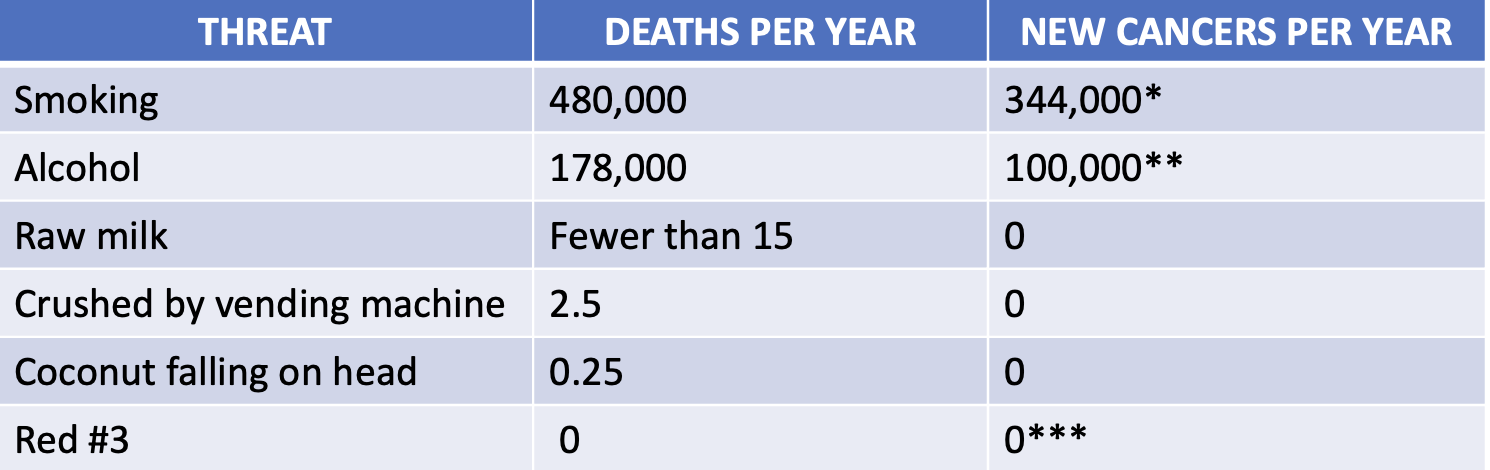
Figure 1. Sources *ASCO, **Food Facts, ***ASCO (ASCO = American Society of Clinical Oncology)
Stay curious. Stay informed. Free, independent writing delivered weekly
— no ads, no sponsored fluff.
Join Now
Donate
So, when Kennedy is railing against “petroleum products” [1] and “re-examining” the non-link between vaccines and autism, a perfectly legal product kills more people annually than fentanyl, auto accidents, and gun deaths combined.
Doesn’t it make you wonder if a name change for the movement is in order? Perhaps...
Make American Hangovers Acceptable
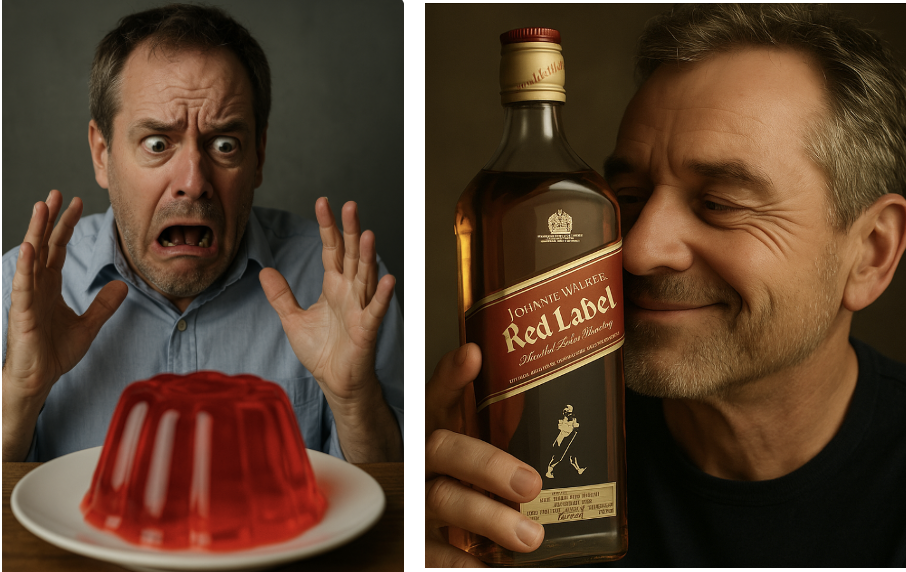
Earl, like most Americans, has some difficulty in assessing relative risk.
Polishing Doorknobs on the Titanic
People are notoriously bad at assessing relative risk. We dread plane crashes, which kill fewer than 400 people in the U.S. each year, but think little of cars, which kill more than 43,000 annually. The same distorted perspective shows up elsewhere: we panic over shark attacks that kill about one person a year, while swimming claims 4,000 lives. Likewise, walk through any airport and the fear of terrorism is everywhere, yet 44,000 people die from falls each year. It’s not Jaws or Al-Qaeda that’s most likely to take you out—it’s your staircase.
Yet, it's precisely this approach that has been "guiding" the MAHA movement so far. While the stated goal is to address real issues that could improve public health, politicians and bureaucrats have instead, at least so far, focused on trivial, easy-to-fix fake issues. This is not simply a waste of time; it's also a waste of lives. The job of public health officials is to educate us about real risks that affect our health. In this regard, so far, MAHA has failed miserably.
Red #3 Does Not Cause Cancer...
The evidence of carcinogenicity of Red #3 lies somewhere between non-existent and invisible. Here is a partial summary:
- High-dose lifetime feeding studies showed thyroid tumors in rats, but only at enormous dietary levels (about 4% of the rats' diet, 2,400 mg per kilogram body weight per day). Remember this number.
- The WHO set an acceptable human daily intake of 0–0.1 mg per kilogram body weight per day.
Think about this. The rat tumors appeared only at doses about 24,000 times higher than what humans ever consume. Even if you ate nothing but maraschino cherries (vile little horrors) for life, you still wouldn’t get there. Of course, direct rat-to-human comparisons of toxicity are not accurate numbers; they are indicators of a potential problem. Perhaps a ten- or one hundred-fold difference in these data could be explained away as a difference in species, but 24,000 cannot.
So, it should not be the least bit surprising that in humans, there is no evidence of carcinogenicity at real-world exposure levels, nor are there epidemiological studies linking Red #3 consumption with thyroid or other cancers.
Table 1 shows a summary of some of the in vitro mutagenicity tests that are used to flag possible carcinogens. There are no flags.
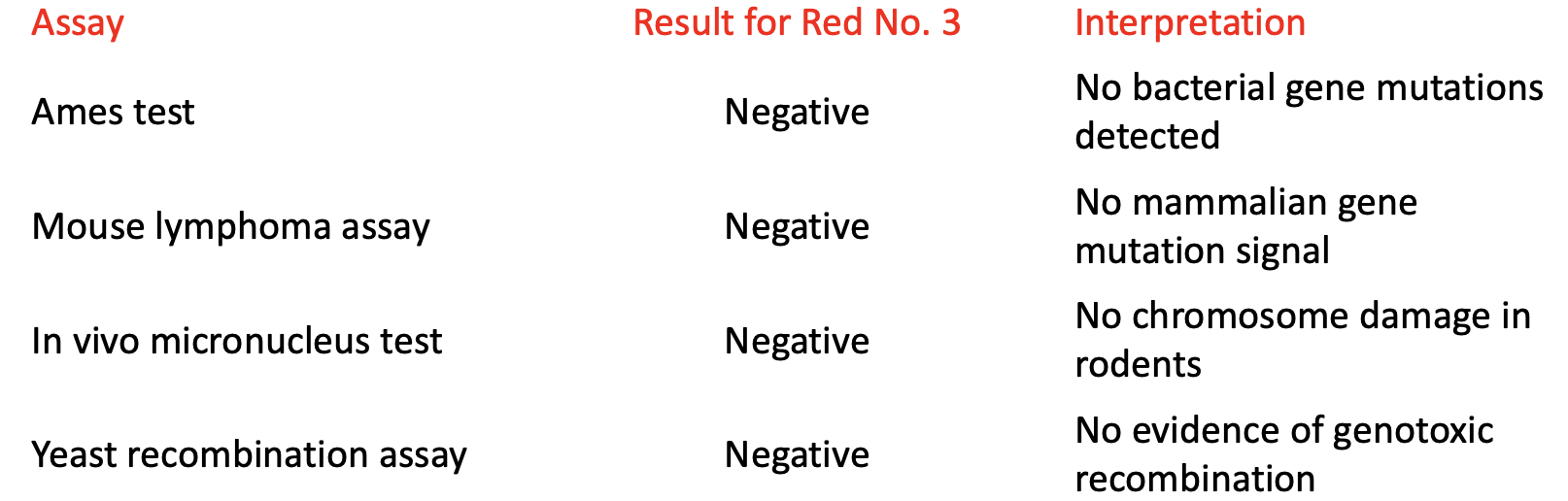
Table 1. Selected mutagenicity assays of Red #3. It is clean.
The Red #3 cancer scare is a bunch of nonsense, not to mention a distraction. In the MAHA world, where there's smoke, there may or may not be a fire.
...but Alcohol Sure Does
Unlike Red #3, the danger from alcohol isn’t hypothetical or buried in obscure rat studies—it’s sitting in your liver every time you drink. [2]
Similar to Red #3, ethanol does not light up mutagenicity assays. It's squeaky clean. That is, if you don't own a liver. Although without a liver, you'd be pretty dead. The carcinogenicity of ethanol arises from a simple oxidation reaction, which takes place in the liver. Here's the chemical reaction.
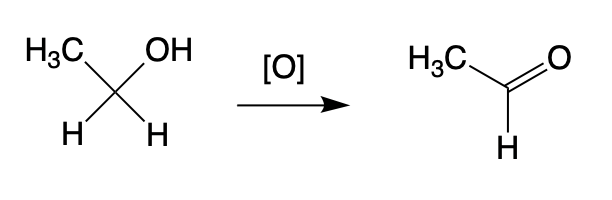
Acetaldehyde is anything but "clean." (Table 2)
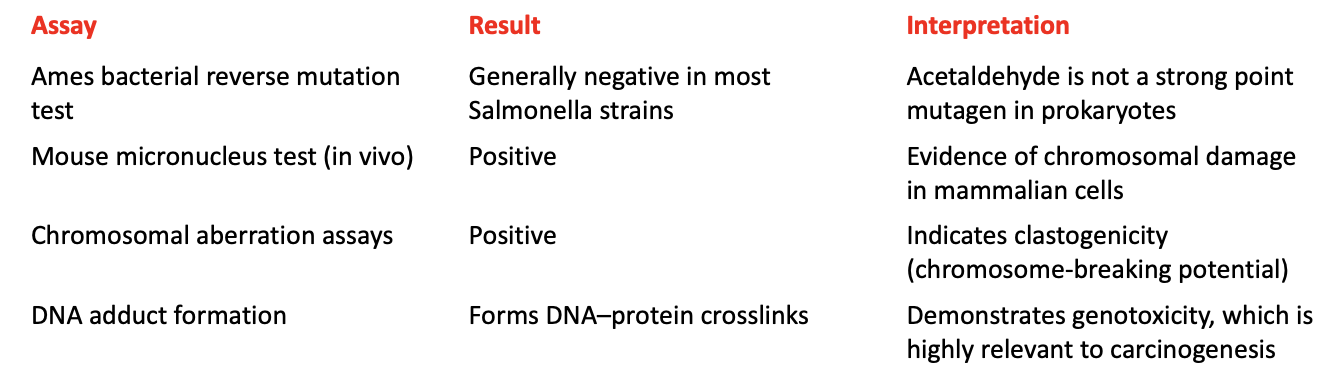
Table 2. If the mutagenicity of acetaldehyde looks scary, it should. Acetaldehyde is a known human carcinogen. [3]
The damage done
Given the carcinogenicity of acetaldehyde in in vitro tests and animal models, it should come as no surprise that it takes a heavy toll on drinkers. What may be surprising is the extent of this toll. The following is a brief summary of some of the evidence linking drinking and cancer.
- Every year, there are about 600,000 cancer deaths in the US.
- Of these, 20,000 deaths are attributed directly to alcohol consumption, independent of smoking or other factors.
- In other words, alcohol is responsible for about 4% of all cancer deaths annually.
- Even one daily drink raises breast cancer risk by about 7%. Women consuming 2–3 drinks per day have a ~20% higher risk compared to non-drinkers.
- It's not just breast cancer. Alcohol consumption increases the risk of at least seven types of cancer, and the relationship is dose-dependent—risks begin at even one drink per day for cancers like breast, mouth, and throat.
- Dose dependence is important because it shows a clear pattern: the more of a substance you’re exposed to, the bigger the effect. This not only helps confirm that the substance is actually causing the outcome, but it also gives scientists a way to figure out safe versus harmful levels. Dose dependence is often considered a gold standard in toxicology, because when stronger effects consistently follow higher doses, it’s one of the clearest signs that the substance really is the cause.
Bottom line
Acetaldehyde is not a baseless scare or theoretically possible, unproven risk. It is a real poison and something that, as an organic chemist, I took great care to avoid being exposed to when I needed to use it. Its toxicity and carcinogenicity are real and backed by irrefutable evidence. One good snootful of the stuff and it feels like you've been kicked in the face by an ostrich with anger-management issues.
The opposite is true with Red #3. Its safety profile is quite good, and most of the criticism of it is based on little or no real evidence.
MAHA, please answer the following. Why raise a red (sorry) flag about a red dye, while not saying a word about the real dangers of alcohol? Banning it (Prohibition #2) is ridiculous and will inevitably end up causing more harm than good [4].
But how about some public health messages or at least an occasional mention? For example, while 89% of American adults know that smoking increases the risk of cancer, only 45% know that alcohol does as well.
If Kennedy’s MAHA crusade were serious, alcohol would be front and center, and food dyes would be a footnote somewhere. Or nowhere.
Their silence here speaks volumes.
NOTES:
[1] Kennedy falsely asserts that the safety of a chemical depends upon whether it is derived from petroleum or from a natural source. Any chemist will tell you this is dead wrong.
[2] Although the half-life of acetaldehyde in humans is about two minutes (it is converted to harmless acetic acid), the constant intake of alcohol provides a constant source of the toxin, giving it the time needed to be absorbed into cells.
[3] Different international agencies rate the carcinogenicity of acetaldehyde, and they don't exactly match. But with acetaldehyde, the ratings range from bad to worse.
[4] For proof, look no further than the so-called "opioid epidemic." By any measure, the more prohibitive the laws, the greater the death toll, thus the term "iron law of prohibition."