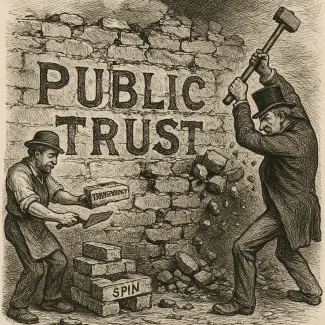
“Today, we are taking a bold step in restoring public trust by totally reconstituting the Advisory Committee for Immunization Practices (ACIP). We are retiring the 17 current members of the committee, some of whom were last-minute appointees of the Biden administration. …In 2000, the House issued the results of an investigation of ACIP and another vaccine advisory committee under the U.S. Food and Drug Administration—the Vaccines and Related Biological Products Advisory Committee. It found that enforcement of its conflict-of-interest rules was weak to nonexistent. …These conflicts of interest persist. Most of ACIP’s members have received substantial funding from pharmaceutical companies, including those marketing vaccines.”
This week, a research letter in JAMA put the veracity of Secretary Kennedy’s claims to the test. He is correct that an investigation conducted a quarter of a century ago found significant conflicts of interest, including a cherry-picked, but nonetheless substantial, 97% rate for a vaccine later recalled. Parenthetically, the vaccine RotaShield had its approval rescinded after reports from the Vaccine Adverse Event Reporting System (VAERS) indicated an increased risk of intussusception following vaccination.
However, a compilation of the CDC disclosures of past, current, and pending conflicts of interest relationships of ACIP members appears to tell a different story. [1]
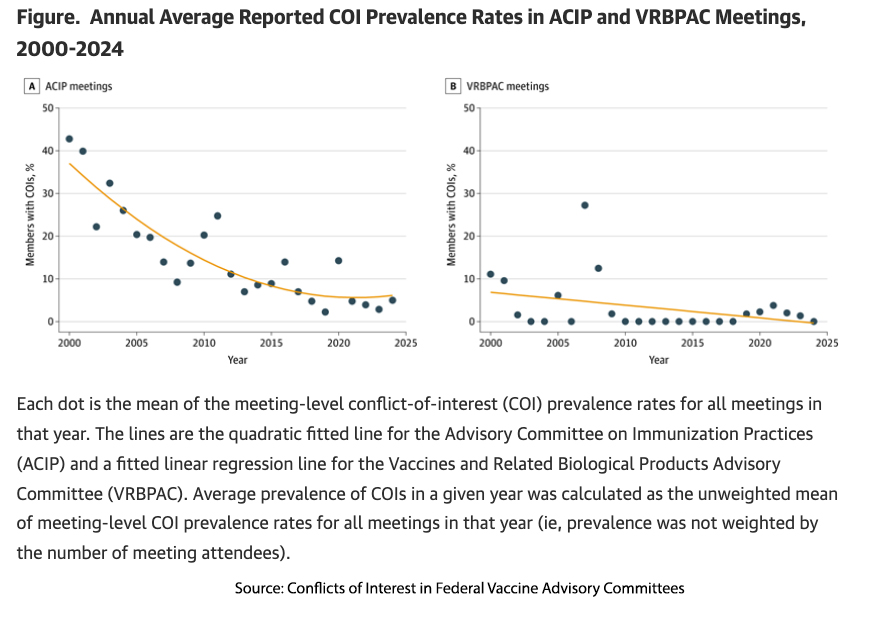
The recently disbanded ACIP’s conflicts of interest were around 5%, for the equally maligned Vaccines and Related Biological Products Advisory Board Committee (VRBPAC) had a reported COI prevalence of “less than 4% since 2010, including 10 years when it was 0%. The most frequent conflict was research or investigator support, affecting 10% of ACIP attendees. It is a fair counterargument that experts will all have funding conflicts – government funding may be just as conflicted as corporate funding. Moreover, expertise in vaccines, as well as other scientific topics, is rarely funded by “effective altruism,” but by those with vested interests
A “Clean Sweep?”
The new limited membership of the ACIP has raised greater concerns about their biases related to vaccines than financial conflicts of interest; however, the vetting of these members has not been made public, despite Secretary Kennedy’s avowed goal of “radical transparency.” Interestingly, the latest CDC disclosures on the new members list only include two of the eight. [2]
Are Secretary Kennedy’s dramatic dismissals of the ACIP a measure of progress or performative politics? Is this the public health equivalent of the Wizard of Oz, featuring lots of smoke, fire, and booming declarations from behind the curtain, but precious little substance once you pull it back? If the Secretary truly wants to restore trust, he should step out from behind the curtain himself and start with full disclosure of the new committee membership’s conflicts.
[1] It is prudent to modify the researchers' findings because the definition of conflicts of interest has evolved over the decades, a weak point in the researchers’ argument. That said, it is the data we have today.
[2] Drs. Meissner and Pebsworth are listed, Drs. Hibbeln, Kulldorff, Levi, Malone, Pagano, and Ross are not.
Source: Conflicts of Interest in Federal Vaccine Advisory Committees JAMA DOI: 10.1001/jama.2025.13245

Chuck Dinerstein, MD, MBA
Director of Medicine
Charles Dinerstein, MD, MBA, is the Medical Director of the American Council on Science and Health. A vascular surgeon with more than 25 years of clinical experience, he brings a physician's understanding of medical decision-making, an appreciation for scientific uncertainty, and a broader perspective on healthcare economics and policy to his writing.