Here are a few questions about influenza and its vaccine. It's not the best vaccine out there, but it's far better than nothing.
Unlike measles or polio, where one vaccine lasts a lifetime because the virus barely changes, influenza evolves continuously, somewhat like COVID. These genetic changes, which are called antigenic drift, alter surface proteins, so last year’s antibodies may not recognize this year’s virus. More on this below.
Flu mutates. Constantly
For stable pathogens like measles, pneumococcus, or HPV, vaccines don’t require constant updating; one or two doses can provide protection for decades, even a lifetime. Influenza, on the other hand, mutates so often that protection fades quickly, which is why the vaccine has to be reformulated every year. [1]
The quadrivalent vaccine (it used to be trivalent) typically reduces symptomatic illness by ~40–60%, varying by season and age. It was below 40% in 2017–18 and can be higher in children, and for preventing hospitalization. Even when the match isn’t perfect, vaccination reduces serious disease. [2]
How is the composition of the upcoming vaccine determined?
This part is tricky.
Global health experts in the WHO Global Influenza Surveillance and Response System use both epidemiologic data from countries as well as lab data to forecast which strains are most likely to circulate. WHO issues recommendations twice a year: February for the Northern Hemisphere (same year’s fall/winter season); September for the Southern Hemisphere (the following year’s season).
Why so long?
The longer the interval between the decision and the administration of the first vaccinations, the greater the chance that a mutation will reduce the vaccine’s match. The total time from decision to first vaccinations is ~5–6 months (timeline below). This is quite long for a vaccine. This is because the vaccine is grown in chicken eggs, which is one of the reasons the process is so slow. Here's a rough timeline of everything that needs to be done:
- February: WHO picks the four strains for the coming fall/winter
- Early summer: The virus strains are grown on a large scale, then harvested.
- Mid-summer: The virus is killed [3], its outer shell is split with a detergent, and the remaining materials (not infectious) are purified. Then the four strains are combined.
- Late summer: Potency and safety testing.
- Aug–Oct: Packaging and distribution; clinics start vaccinations.
When should you get the shot?
That's an easy one. Let's hear from an expert – my colleague Dr. Henry Miller:
Flu shots are beginning to be recommended by chain pharmacies and healthcare organizations, but I think it's too early. Here's why... The incidence of flu is, as yet, minimal throughout the country. The immunity conferred by the vaccine begins to wane after a couple of months and is very low by about five months post-vaccination. Given that the flu season sometimes lasts through March, to ensure that immunity from the shot will last through the season, unless there's a sharp spike in flu cases during the next few weeks, I'd recommend getting the shot in the second half of October.
Henry Miller, M.D. Private communication, 9/12/25
And no, the flu shot cannot give you the flu [4].
Bottom line
The flu is nothing to mess around with. It is a killer (Figure 1), which kills far more people than prescription opioids.
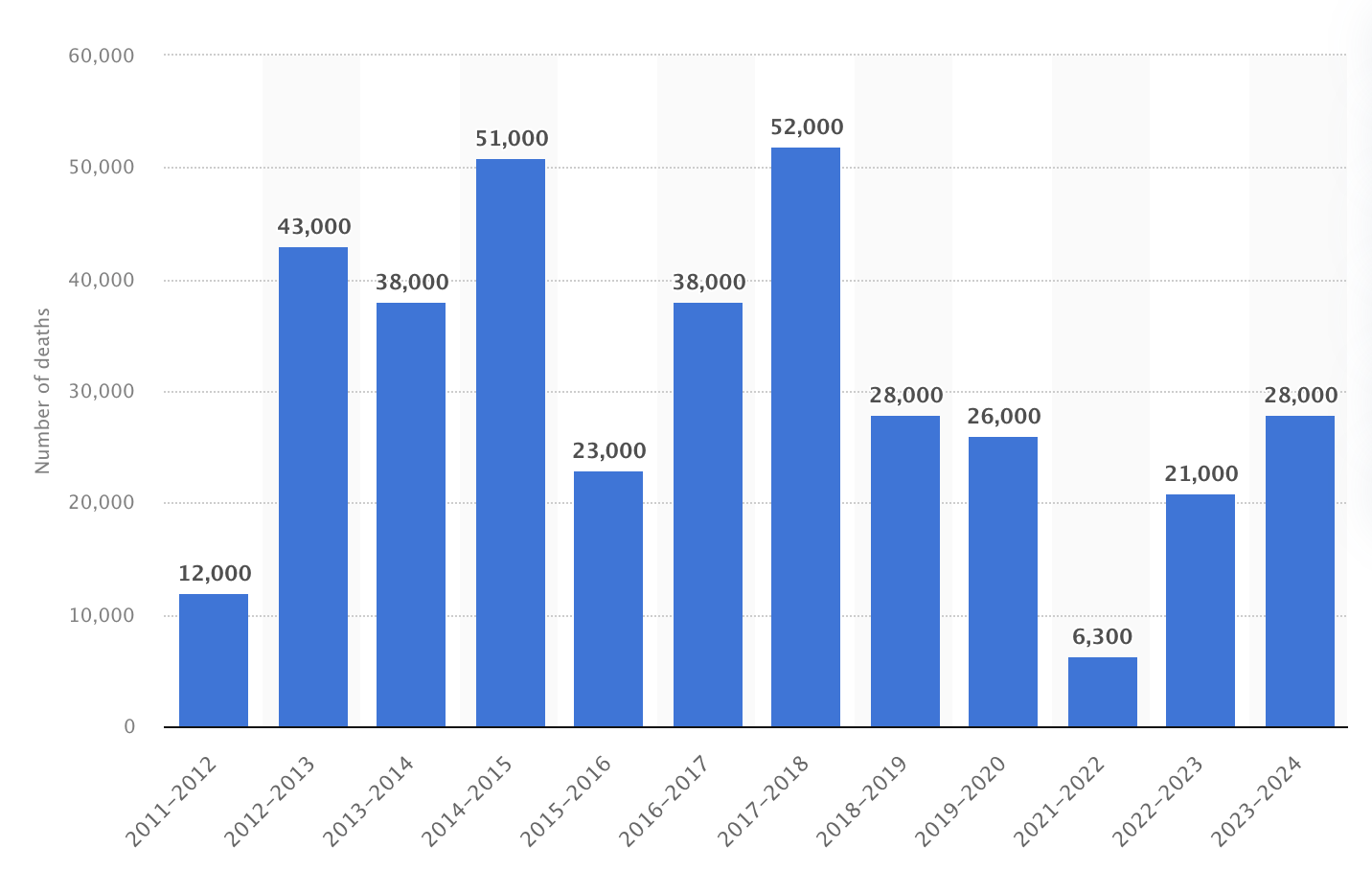
Figure 1. Flu deaths by year. The outlier (2020-1) is due to COVID restrictions. Source: Statista
Get the shot.
NOTES:
[1] People incorrectly call norovirus the "stomach flu," but this is not accurate. Influenza and norovirus are very different. It's been said that norovirus makes you want to die, while influenza makes it hard to believe you won't.
[2] These percentages are approximations because the protection rate of children is higher than that of adults, and I've lumped them together.
[3] "Killing" and splitting open the virus is accomplished by formaldehyde, followed by a detergent. One can argue that the term "killing" is not strictly accurate, since viruses aren't alive to begin with. I prefer "deactivated."
[4] There’s a nasal spray flu vaccine that uses a weakened live virus; it does not cause the flu in healthy people. It’s not recommended for those with weakened immune systems (or for pregnant women); they should receive a non-live flu shot instead.

Josh Bloom
Dr. Jonathan (Josh) Bloom, ACSH's Director of Chemical and Pharmaceutical Sciences, earned his Ph.D. at the University of Virginia and completed postdoctoral training at the University of Pennsylvania. During his 20-plus years in drug discovery at Wyeth, his research group discovered the antibiotic Tygacil®, approved in 2005. He holds 25 issued patents and has authored 35 academic papers. Since joining ACSH in 2010, he has written more than 2,000 articles and dozens of op-eds for major newspapers, including The Wall Street Journal and Chicago Tribune.