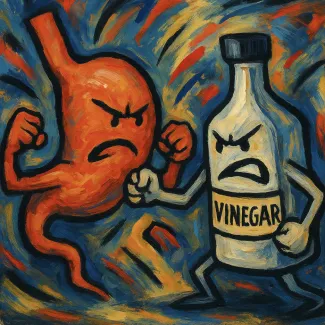
To no one's surprise, a paper in BMJ Nutrition, Prevention and Health, making claims about the benefits of apple cider vinegar was recently retracted. OK, it doesn't do anything useful, but can it be harmful? Let's see.
Acid reflux is often a result of having low stomach acid. If this is the case for you, consuming ACV may help provide relief from acid reflux symptoms by introducing more acid into the digestive tract to prevent acid backflow.
Rachael Link, MS, RD, in a 2024 article on the Dr. Axe (not the sharpest ax in the toolshed) Ancient Nutrition website
Gasoline can put out fires.
Josh Bloom, Ph.D., snotty comment specialist, October 2025
ACV (acetic acid) is acidic
Anyone with even a modestly functioning brain knows that putting more acid into your stomach when you have GERD or heartburn isn't such a hot idea, despite the many unsubstantiated claims that apple cider vinegar can be used to actually treat heartburn.
(Not convinced? Watch this YouTube video to see what vinegar does to steel wool.[1]
If vinegar is acidic enough to dissolve steel wool, there's a pretty good chance that if you've got excess stomach acid, it's probably something to avoid.
But, vinegar neither acidifies nor neutralizes the stomach contents.
Let's take a look at what vinegar might do to your stomach using the concept of pH, something that is taught in first-year chemistry. Does your tummy become more acidic, less acidic, or stay the same? To address this question, we need to make certain assumptions:
- The pH values of the stomach range from 1.0 to 3.5. Let's pick 2.0.
- The volume of hydrochloric acid in the stomach ranges from 20-100 mL. Let's pick 60 mL.
- The pH of vinegar (or apple cider vinegar) typically ranges from 2 to 3.
- The "recommended" dose of apple cider vinegar is 10-20 mL.
Although these are simple calculations that I somehow managed to do 85 years ago when I was in freshman chem, I wouldn't even attempt them now. Fortunately, "someone" can do them for me...
What is the resulting pH of a solution of 60 mL of pH 2 HCl when 10 mL of 5% vinegar is added? Do the same for 20mL.
Chatty: With 10 mL of 5% vinegar added → pH ≈ 2.067. With 20 mL of 5% vinegar added → pH ≈ 2.125
Hmm. At first glance, it might look like vinegar is neutralizing stomach acid — but what’s really happening is dilution [2]
So, what's going on?
Although we associate heartburn with the stomach, it's really an irritation of the esophagus. And the esophagus isn't accustomed to an acidic environment.
The normal pH for the esophagus is close to 7.0. Esophageal pH monitoring looks for lower readings (such as below 4.0) over the course of 30 seconds, indicating higher acidity. High acidity in the esophagus means a surge of stomach acid.
Source: Johns Hopkins
The esophagus, unlike the stomach, lacks built-in mechanisms for protecting the cells that line it. These cells lack a mucus layer, and their surface cells do not secrete bicarbonate ions.
So, if you've got heartburn, which involves excess acid in both the stomach and the esophagus, perhaps you might want to reconsider swallowing something that dissolves steel wool. Or maybe I'm just funny that way.
Finally, a gastroenterologist explains what's going on.
"But being an acid itself, it is not logical to assume that it will help in reducing acid related reflux symptoms. Being acetic acid, apple cider vinegar can lead to caustic injury to the esophageal mucous lining if the concentration exceeds 20%. As the consumer market in this segment is poorly regulated, taking vinegar for the control of reflux symptoms can be counterproductive and prove to be dangerous"
Kiran Peddi, MD, a gastroenterologist writing on The health site
Bottom line
ACV, predictably, did not live up to the hype, despite the assurances of the doctors Oz, Axe, and their ilk. And it can do damage, just like the doctors.
None of this should surprise anyone.
Notes:
[1] Although this is true, it's largely irrelevant. Steel wool does not have the protective mechanisms that exist in the stomach. This is simply a chemistry demonstration of what acid does to certain metals.
[2] It might look like vinegar is neutralizing the acid (since the pH goes up), but in fact, it’s just diluting it, not neutralizing it. The number of hydrogen ions in the stomach remains the same, but the volume is a bit larger, hence the slight increase in pH.

Josh Bloom
Dr. Jonathan (Josh) Bloom, ACSH's Director of Chemical and Pharmaceutical Sciences, earned his Ph.D. at the University of Virginia and completed postdoctoral training at the University of Pennsylvania. During his 20-plus years in drug discovery at Wyeth, his research group discovered the antibiotic Tygacil®, approved in 2005. He holds 25 issued patents and has authored 35 academic papers. Since joining ACSH in 2010, he has written more than 2,000 articles and dozens of op-eds for major newspapers, including The Wall Street Journal and Chicago Tribune.