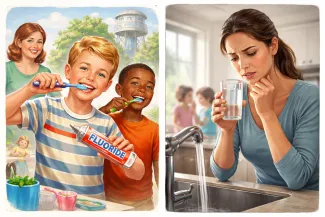
Once upon a time, there was a disease that ravaged the kingdom. It struck quietly at first, one tooth, one child, one aching night at a time. But soon its effects were everywhere: pain, disability, infection, tooth loss so common that it was accepted as ordinary fate.
This plague was not smallpox or cholera. It was dental decay. And for much of American history, it was one of the most widespread chronic diseases in the nation.
The Forgotten Age of Toothaches
Before World War II, oral hygiene in the United States was astonishingly poor. Toothbrushing was not a universal habit. In fact, as late as 1940, only about 7% of Americans brushed their teeth regularly.
The reasons were not mysterious:
- The country had just emerged from the Great Depression
- Toothpaste was a luxury item
- Dental visits could cost a week’s wages
- Rural America often lacked indoor plumbing and access to care
- Dentistry was something you sought when pain forced you; it was reactive, not preventative
The mouth is one of the largest reservoirs of chronic bacterial infection. Untreated caries and periodontal disease are more than cosmetic inconveniences. Even today, in an era with antibiotics, roughly 10-20% of native-value endocarditis (an infection of the heart’s inner lining, most often involving the heart’s valves) is caused by these primarily oral bacteria that enter the bloodstream and attach to vulnerable areas of the heart, leading to inflammation, damage, and potentially life-threatening complications. Cardiac surgeons insist on thorough dental care, including removal of teeth before valve surgery, which is especially susceptible to infection. Poor oral health also means poor nutrition. Missing molars narrowed diets. The dental plague was systemic long before medicine recognized it as such.
WWII Uncovers A Crisis
When the United States began mobilizing troops in the early 1940s, military examiners uncovered a national shock: young men were being rejected from service not because they were weak or blind or unfit—but because their teeth were destroyed.
Dental defects became the single most common cause of military rejection, and in some regions, more than 30% of recruits were deemed unfit because of rotting teeth or abscesses. Even among those accepted, the situation was grim. The average recruit in 1941 had five permanent teeth missing. Military dentists described finding a young man with a full, healthy set of teeth as “genuinely rare.”
Operationally, this became a national security problem. A soldier with a throbbing abscess cannot train, cannot fight effectively. Dental sick call overwhelmed camps. The original 150 military dentists rose to 15,000 or more, working 16-hour days. However, wars are won by healthy men, and the kingdom could not afford this kind of preventable disability.
Wartime’s Hygiene Revolution and the First MAHA Moms
The military did something revolutionary: it made prevention mandatory, and it changed behavior.
Every service member was issued a toothbrush and toothpaste. Brushing was enforced as military discipline, another ritual of readiness alongside drilling and weapons training. Wartime fervor reframed hygiene into patriotism. Clean teeth became part of morale, efficiency, and duty.
Soldiers brought these practices home on furlough. Letters described routines. Families watched sons and husbands brush with seriousness never seen before. Schools began teaching brushing rhymes so children could participate in the war effort in their own small way.
And here we meet, the first generation of what today might be called the MAHA moms. They had lived through an era when cavities were a childhood scourge; when extractions were routine, abscesses common, and tooth loss expected. They wanted a modern world for their children, one with fewer sleepless nights of tooth pain. The mothers of the 1940s and 1950s embraced public health. When fluoride emerged as a naturally occurring protector of enamel, these MAHA moms jumped on it as another tool of prevention, alongside vaccines, pasteurization, and antibiotics.
They were not suspicious of fluoridation; they were grateful.
A Cure Hidden in Nature
While war was transforming behavior, science was uncovering something else entirely.
In the early 1900s, a dentist in Colorado Springs noticed a strange paradox: residents often had mottled, stained teeth (fluorosis), but remarkably few cavities. Decades later, an industrial chemist identified the cause, a cure hidden in nature: naturally occurring fluoride in drinking water. But fluoride levels varied widely across the nation raising the question of whether the kindgome could give this protection to everyone?
Newburgh: Proof, Prevention, and Safety
In 1944, one of the most important public health trials in American history began. Newburgh, New York, adjusted its water fluoride concentration to 1.0–1.2 ppm, while nearby Kingston remained at 0.1 ppm as a control.
Over the next decade, the results were transformative:
- Children exposed since birth experienced a 58% reduction in decayed, missing, or filled teeth
- First molars, the most susceptible to cavities, showed an 88% reduction in tooth loss
Fluoride improved smiles and prevented disease. And the Newburgh study also addressed the most enduring question: safety. Researchers found:
- No differences in child height, weight, or skeletal maturation
- Normal radiographs with no osteosclerosis
- No evidence of kidney injury
- Rapid and efficient fluoride excretion
- A calculated 2,500-fold factor of safety against acute poisoning
- Crippling skeletal fluorosis, they noted, requires 20–80 mg per day, roughly drinking 2 to 5 liters of water daily, for decades, orders of magnitude beyond municipal exposures.
Toothpaste Becomes Medicine, Success Changes the Kingdom
As water fluoridation spread, another transformation followed in the free market. In 1956, Crest introduced fluoride toothpaste. Fluoride was no longer a supplement; toothpaste was no longer merely a cosmetic abrasive. Clinical trials demonstrated a 53% reduction in cavities, and the FDA reclassified toothpaste from a cosmetic product into a regulated drug delivery system.
Mid-century MAHA moms, eager to protect children from the dental suffering they themselves had known, normalize fluoride toothpaste as an everyday act of responsible parenthood.
Today, fluoride exposure is broader than it was in 1945. Water, processed beverages, foods manufactured with fluoridated water, and toothpaste ingestion in children all contribute to our typical daily intake.
- Children: ~2 mg/day
- Adults: ~2.7–2.9 mg/day
Still far below the 20–80 mg/day associated with fluorosis, that skeletal toxicity. However, exposure is no longer single-source, and that is where the modern debate begins.
IQ Concerns and Today’s MAHA Moms
In September, a federal court concluded that current U.S. fluoridation standards may pose an “unreasonable risk,” ordering the EPA to reassess what is flowing through our pipes.
The controversy played out loudly in the media; however, the Court’s reasoning is quieter and more technical: not a declaration of proven harm, but a concern that safety margins may not be as wide as once assumed. But in interpreting the ruling, we must clarify a fundamental point, a concept best captured by the story of the drunk who lost his keys and searched under a streetlight.
Both the Court decision and the National Toxicology Program (NTP) review focus heavily on fluoride concentration in water (mg/L), which makes sense because pipes are what the government controls. However, biologically, concentration is a poor proxy. The developing brain experiences a total dose, the milligrams ingested per day, from all sources, during the mother’s pregnancy and their early childhood
Focusing only on mg/L is like the drunk searching for his lost keys under the streetlight—not because that’s where he dropped them, but because that’s where the light is brightest.
The biologically meaningful question is exposure. Water concentration is simply where regulation can look.
The NTP reviewed 72 studies and concluded that fluoride exposure at or above 1.5 mg/L is associated with cognitive harm.
The Court emphasized that under the Toxic Substances Control Act (TSCA), identifying a hazard does not require absolute proof of causation, only credible association.
Applying default safety margins, the Court reasoned that a “safe” level might be closer to 0.4 mg/L, below the current U.S. recommendation of 0.7 mg/L, concluding fluoride is hazardous at dosages “far too close” to U.S. exposure levels.
The Generational Mirror
The mothers of the 1950s feared cavities because they had seen them. They embraced fluoride because dental disease was obvious, painful, and everywhere. But today’s MAHA moms were raised in a different kingdom. They grew up in a world where childhood caries is no longer universal, where losing teeth at 30 is unimaginable, and where fluoride’s benefits are quietly baked into daily life.
To them, the original plague is invisible. Public health success changes perception. When the plague disappears, the cure raises modern questions, regarding
- overlapping exposure sources
- subtle neurodevelopmental endpoints
- statistical risks rather than obvious disease
Their concern is not irrational; it is generational.
What we need now is neither panic nor dismissal, and certainly not political slogans. If modern public health concerns center on neurodevelopment, then we must stop arguing exclusively about water concentration and start measuring what actually matters: total dose exposure, timing, and susceptible populations.
The drunk will never find his keys if he keeps searching only under the brightest streetlamp. And public health will never resolve this debate until we move beyond pipes and proxies, toward the harder but more honest work of understanding fluoride the way the body does—not as mg/L in the tap, but as mg/day in the patient.
Science is not a fairy tale. But sometimes it begins like one.
For those with an interest, you can read more on the history of fluoride here and the recent Court decision here.

Chuck Dinerstein, MD, MBA
Director of Medicine
Charles Dinerstein, MD, MBA, is the Medical Director of the American Council on Science and Health. A vascular surgeon with more than 25 years of clinical experience, he brings a physician's understanding of medical decision-making, an appreciation for scientific uncertainty, and a broader perspective on healthcare economics and policy to his writing.