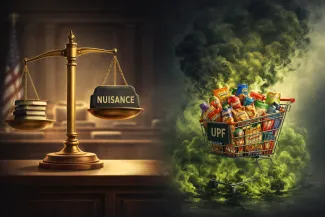
In late December 2024, Bryce Martinez filed a lawsuit against 11 major food manufacturers, including Kraft Heinz, Coca-Cola, and Nestlé, claiming they sold dangerous ultra-processed foods, listing a litany of products alleged to be intentionally designed and marketed to be addictive, mainly targeting children and causing chronic diseases. Court-watchers braced for the onslaught of copycat suits. In August, however, the case was dismissed. Although the plaintiff claimed that Bryce suffered harm (Type 2 diabetes and non-alcoholic fatty liver disease as a teenager), the court ruled the plaintiff failed to prove a causal connection with any specific product and failed to account for confounders such as overall diet and lack of exercise, necessary prerequisites for sustaining negligence and product liability cases. [1] Unsurprisingly, the onslaught of new cases failed to materialize.
Flash forward
In December 2025, the City Attorney for San Francisco, acting on behalf of the People of the State of California, filed a copycat lawsuit (dubbed the Kraft-Heinz case), lifting allegation after allegation from the Martinez case, not surprisingly, since the lawyers, Morgan and Morgan, representing the City are the same. However, instead of claiming that anyone suffered specific harm, the claims alleged that the ten defendants engaged in unfair and deceptive acts, a violation of California’s Unfair Competition Law, creating a public nuisance affecting everyone in California. Raising the alarm, commentators say this is the first time a governmental body has brought suit claiming foods are unhealthy, [2] although private suits are not new.
Court-watchers believe the San Francisco lawsuit is portentous and ominous. Those championing the suit cast the consumer as an unwitting dupe who would love to avoid UPF – if only they hadn’t become addicted by the nefarious practices used by manufacturers to concoct irresistible products, using techniques perfected in the creation of cigarettes, cloaking the food manufacturers with the same evil.
“We must be clear that this is not about consumers making better choices. … These companies engineered a public health crisis, they profited handsomely, and now they need to take responsibility for the harm they have caused.” - City Attorney David Chiu
The complaint is replete with emotionally-laden claims, including creating addictive substances, using “neurobiological techniques” to probe the minds of the consumer to create foods they can’t resist, and developing marketing techniques specifically designed to capture the minds (and mouths) of children, teens, Blacks, and Latinos. However, other than generic dangers of obesity and metabolic diseases, specific harms tethered to specific products or product-groups or even manufacturers are missing.
Should the lawsuit proceed, each product will be evaluated individually concerning claims of deceptive practice; possibly some labels will be altered and fines imposed. The real concern is the claim of public nuisance. [3]
Lawfare and Food Fights
It used to be that unsafe products, including food, were generally addressed through legislation. Only when statutes were violated did lawsuits follow. In fact, legislation has recently been implemented to curtail UPF distribution:
- California enacted a law that provides a statutory definition of UPFs and requires their removal from school meals.
- A West Virginia law bans certain food additives (H.B. 2354).
- Louisiana and Texas passed laws requiring on-package warnings for certain ingredients.
Now, entrepreneurial lawyers partnering with government officials are bypassing the legislature and heading straight to court.
“The filing of Kraft Heinz marks “a rare issue on which the liberal leaders in San Francisco City Hall are fully aligned with the Trump administration, which has targeted UPF as part of its Make America Healthy Again mantra.” - New York Times
The nuisance claim hangs an especially big noose, as the complaint asks the court to declare UPF (undefined for the moment) a public nuisance and to award costs for its abatement. This could include funding for public education or financial resources for the state to alleviate alleged associated health costs, such as increased incidence of childhood metabolic diseases and obesity (which likely have myriad other independent or confounding causes).
The complaint is also seeking an injunction from UPFs, although it is hard to know what that will look like. hard to know what that will look like – other than banning hundreds of products demanded by the consumer.
The Paradox of the Public Nuisance
The real question the case raises is the propriety of using litigation to regulate food safety, when several federal agencies are already tasked with the job. While increasing agency oversight might result in higher taxes, generally, far greater litigation costs are passed on to consumers in the form of significant price increases.
And while the complaint claims that Black and Latino populations are unfairly targeted by marketing tactics resulting in higher consumerism, the correlation of income levels and the prices of these foods as the driver of consumption, rather than the tempting flavor, is ignored.
The claim of public nuisance is paradoxical. In its inception, the claim was intended to protect the public from noxious and odious odors and vapors, dirt, and dust emanating from refuse, excrement, or other unsavory wastes. True, Courts held that public nuisance is "an unlawful act or omission ... which endangers the lives, safety, health, property or comfort of the public or … are obstructed in the exercise or enjoyment of any right common to all," the underlying concept was that it was the unpleasantness of the exposure from a neighboring landowner
As Emily Cockayne noted in Hubbub, Filt, Noise, &Stench in England, the crime of nuisance arose to protect people made uncomfortable by other people’s “noises, appearance, behavior, proximity, and odors, stench and putrefaction, via pig sties and dung ….” Annoyance was often used as a synonym. Although the concept included preservation of health and safety, the infractions targeted were entirely those that offended the senses others had to endure on neighboring lands, including those of a moral nature, like brothels.
Today, we find the claim permuted to remove exposure to products designed to be hyperpalatable, fragrant, and lovely to look at, based on a rising cadence that they are all equally unsafe.
The drumbeats of unsafety, however, could provide shelter for manufacturers. As one court notes in a similar case, Pelman v. McDonald's Corp, discussing the assignment of legal responsibility:
“If consumers know (or reasonably should know) the potential ill health effects of eating at McDonald's, they cannot blame McDonald's if they, nonetheless, choose to satiate their appetite with a surfeit of supersized McDonald's products.”
Only if the consumer were unaware of dangers known solely to the defendants could there be any viable claim. The complaint has pages and pages of information about the methods of manufacture, determining customer preference, and marketing, all of which are difficult to prove “dangerous” in themselves.
Public nuisance was born to clear the air of stench and filth, not grocery shelves of consumer-chosen foods, many of which, while ultra-processed, are also highly nutritious. If courts stretch the doctrine to police taste, marketing, and metabolism, they won’t just be regulating food—they’ll be rewriting the boundary between personal choice and public wrong. And when every social problem becomes a nuisance, the law itself starts to stink.
[1] An amended complaint was filed in late November 2025 and is currently pending
[2] This is not true; the first case was United States v. Forty Barrels and Twenty Kegs of Coca-Cola, brought in 1906 when the federal government sought to have caffeine removed from Coca-Cola.
[3] Black’s Law Dictionary defines public nuisance, in part, as “Any unreasonable interference with rights common to all members of the community in general and encompasses public health, safety, peace, morals or convenience.” The comparative dangers of UPFs to public health (vs. natural foods) have yet to be determined by any court or governmental agency.

Barbara Pfeffer Billauer JD MA (Occ. Health) PhD
Professor Barbara Pfeffer Billauer is an internationally recognized scholar of public health law, bioethics, and the laws of medical care, focusing on the integration of science and law and its impact on day-to-day policy and legal outcomes. She has lectured and published extensively, in scholarly journals and law reviews, and has written and edited seven books for lay and academic audiences.