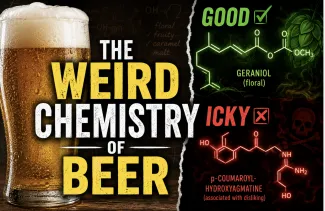
At the risk of being labeled as an extraterrestrial entity, I’ll make my disclosure up front: I don’t like beer. [1] Let the hating begin.
So today’s announcement about the discontinuation of Schlitz beer after 177 years normally wouldn’t have grabbed my attention. But it coincided with an interesting new paper published in the Journal of Agricultural and Food Chemistry, which claimed that certain organic chemicals in beer are associated with its palatability.
Like organic chemistry itself, it’s all about taste.
The study itself was surprisingly ambitious. Researchers evaluated 18 different lager beers using both consumer taste testing and advanced chemical analysis. A total of 134 drinkers participated, and the consumers naturally split into two groups: people who preferred milder lagers and those who liked fuller, more flavor-forward beers.
The scientists then subjected the beers to what amounts to a chemical strip search using liquid chromatography, gas chromatography, and mass spectrometry — sophisticated techniques capable of identifying tiny amounts of volatile and nonvolatile compounds. In total, thousands of chemical features were detected.
This emerging field is sometimes called “flavoromics,” a branch of analytical chemistry that attempts to connect specific molecules with human sensory perception.
The beers preferred by “high-flavor-liking” consumers tended to contain elevated levels of fruity esters, floral compounds, and caramel-like chemicals derived from malt and fermentation. Compounds such as geraniol contributed floral notes, while others added fruity or sweet aromas.
So far, so unsurprising. Brewers have known for centuries that hops, yeast, and fermentation chemistry influence flavor.
But then things got weird.
The researchers identified four nonvolatile compounds strongly associated with consumer disliking.
Inside the beer, however, the story changed completely. Then, the tasters picked them out. Weird?
What makes beer taste icky?
Some of the compounds associated with better-tasting beers were easy to understand. Fruity esters, floral terpenes, and caramel-like molecules generally improved consumer ratings. No shock there.
The “bad actor” list was more interesting.
The researchers identified four nonvolatile compounds that strongly correlated with consumer disliking, including feruloyl 3-hydroxagmatine, p-coumaroyl-hydroxyagmatine, and N1,N10-diferuloylspermidine — names that sound less like beer ingredients and more like rejected villains from a Marvel movie. What is intriguing here is that, despite the bizarre collection of names, they all share a common fragment that forms the basis of cinnamon's flavor (Figure 1).
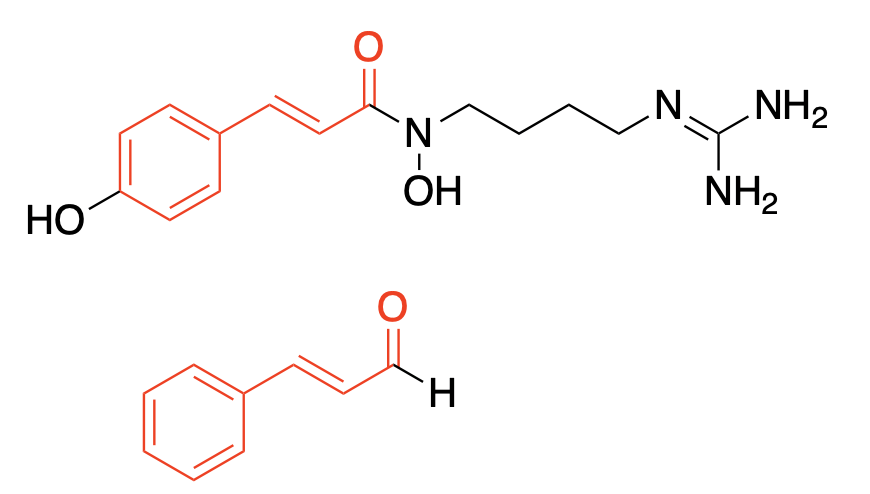
Figure 1. p-Coumaroyl-hydroxyagmatine (top) and cinnamaldehyde (bottom) share the cinnamic fragment (shown in red). One contributes to cinnamon’s aroma. The other apparently helps make beer taste lousy.
A few of the volatile compounds were oddly interesting as well. One of them, ethyl 3-methylthiopropionate (Figure 2), can rightly be called bipolar. This is because it contains two functional groups: a thiol and an ester. The thiol part is notorious for being responsible for some of the worst stenches in chemistry – the kind that can clear a lab of even the most hardened organic chemists in a Miami minute.
Joke time!
Q: What is the definition of an organic chemist?
A: Someone who washes his hands before he goes to the bathroom
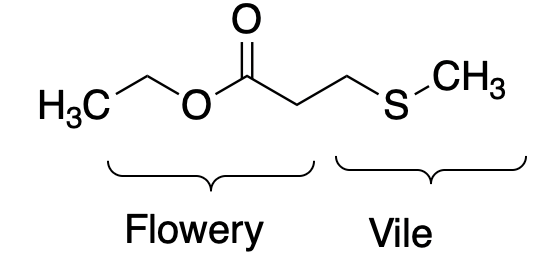
Figure 2. Ethyl 3-methylthiopropionate – one molecule, multiple personalities
But the other fragment, an ester, is a diverse class of volatile compounds found throughout nature in some of the most delightful flowery scents and fruity flavors.
What happens when these two fragments are combined into a single molecule? Oddly, you get both, as evidenced by some of the bizarre descriptions found in the literature.
- sweet onion
- onion-like, fruity, sweet odor
- sulfurous
- fruity
- tinny pineapple
- musty tomato with metallic ripe and canned notes,
- savory green with hints of horseradish and tropical notes
- cheesy
- cabbage
Even stranger
But here’s the strange part: when several of the “bad” compounds were dissolved in plain water, trained tasters could barely detect them. Yet when the same compounds were added back into beer, drinkers described the result as harsher, sharper, and more bitter.
That finding points to one of the central lessons of flavor chemistry: taste is not simply the sum of individually detectable ingredients. Flavor emerges from complicated interactions among alcohol, aroma compounds, bitterness, sweetness, carbonation, and the brain itself.
The important point is not that beer contains exotic chemicals with terrifying names. It’s that human flavor perception is extraordinarily sensitive to subtle molecular interactions. Compounds barely detectable on their own can still reshape how the brain interprets bitterness, smoothness, harshness, and aroma once embedded within beer’s enormously complicated chemical soup.
Back to Schlitz. Whether the company’s collapse can truly be blamed on subtle changes in beer chemistry remains debatable. But this study suggests consumers may be far more sensitive to those changes than breweries once realized.
At least for the first six-pack.
NOTE
[1] It’s not just beer. Alcohol just tastes nasty to me. Go figure

Josh Bloom
Dr. Jonathan (Josh) Bloom, ACSH's Director of Chemical and Pharmaceutical Sciences, earned his Ph.D. at the University of Virginia and completed postdoctoral training at the University of Pennsylvania. During his 20-plus years in drug discovery at Wyeth, his research group discovered the antibiotic Tygacil®, approved in 2005. He holds 25 issued patents and has authored 35 academic papers. Since joining ACSH in 2010, he has written more than 2,000 articles and dozens of op-eds for major newspapers, including The Wall Street Journal and Chicago Tribune.