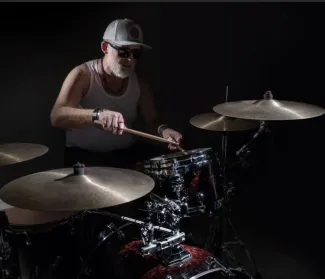
At 75, I sat behind a drum kit for the first time—sticks clumsy, foot pedal an alien contraption. The sounds I produced were chaotic thuds. Was I self-conscious? Absolutely! But that discomfort was exactly why I was there. My brain had grown too comfortable on autopilot; I craved something truly novel.
I am not claiming that drum lessons are a cure for aging or a substitute for exercise, sleep, or medical management. My claim is more modest: beginning drum lessons at 75 is a real-world experiment in cognitive enrichment. It asks an aging brain to do what it still can: learn, adapt, struggle, and form new patterns.
(You can read a companion piece about my colleague Josh Bloom's battle against aging with classical piano here.)
Learning as Cognitive Enrichment
Dementia risk is influenced by 14 modifiable risk factors across the life course. The 2024 Lancet Commission on dementia prevention emphasized that addressing these factors could potentially delay or prevent up to 45% of dementia cases (Table 1)[1].
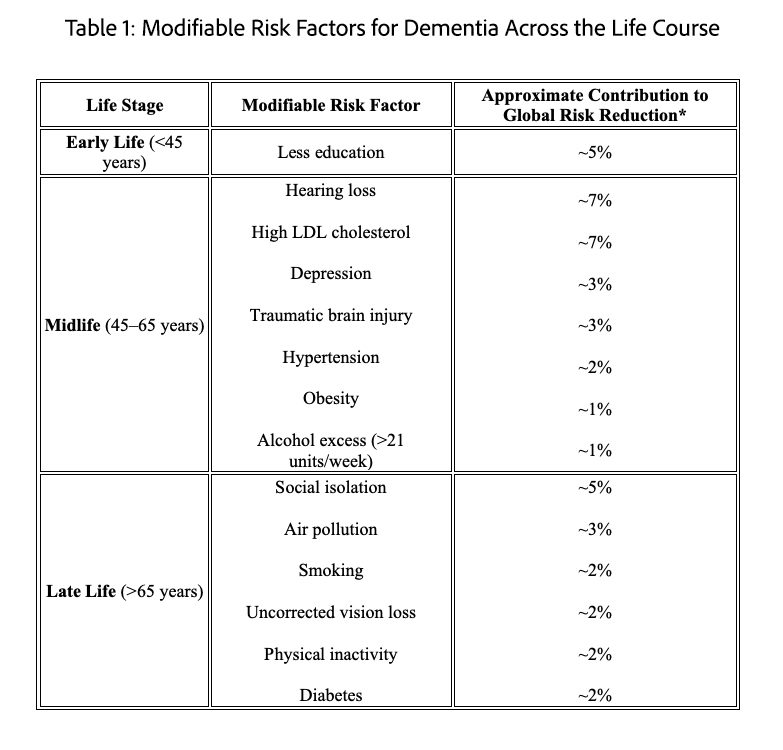
*The 2024 Lancet Commission identifies 14 modifiable dementia risk factors and estimates that addressing them could prevent or delay a substantial proportion of dementia cases; a summary from University College London reports the Commission’s estimate that up to 45% of dementia cases could potentially be delayed or reduced. Source: Livingston G, Huntley J, Liu KY, et al. Dementia prevention, intervention, and care: 2024 report of the Lancet Standing Commission. Lancet. 2024;404(10452):572–628. doi:10.1016/S0140-6736(24)01296-0.
While no single hobby can neutralize all risks—drumming will not erase genetics or vascular disease—certain complex activities may strengthen what researchers call cognitive reserve, or the brain’s functional resilience to age- or disease-related changes. Drumming belongs in this category because it combines cognitive, motor, auditory, and emotional demands. More than merely movement, it is a complex exercise that requires the brain and body to work together.
The Neuroplasticity Advantage
Neuroplasticity is the brain’s ability to change in response to experience. Because the brain is not fixed like a machine, it adapts to what it is repeatedly asked to do. Practicing, making and correcting errors, and repeating a task is how neural networks are refined. Over time, frequently used connections may become more efficient while unused pathways may weaken.
While this plasticity is generally faster and more flexible in youth, older brains retain a meaningful capacity to rewire and adapt [2]. The difference is that older adults require more repetition, patience, and personal motivation to see results. It is easy to assume that cognitive difficulty means incapacity, but in this context, the struggle simply means that the brain is being successfully pushed out of its comfort zone to handle the unfamiliar.
Being older does not mean the brain can no longer learn. It means the learning environment must be realistic, enjoyable, and sustained.
Why Learning Matters More Than Performance
My goal is not to become a professional drummer, but to create meaningful cognitive demand. A senior beginner must simultaneously manage physical and cognitive demands: learning to hold the sticks, sitting with balance, striking consistently, listening for rhythm, and coordinating limbs. Furthermore, simply tolerating being a beginner requires psychological discipline—you must stop and restart after mistakes, remember patterns, and commit to practice between lessons.
These are not trivial tasks. They recruit attention, working memory, sequencing, motor planning, auditory and visual processing, emotional regulation, and executive function. This multidimensional demand is supported by a 2025 systematic review and meta-analysis of randomized trials, which demonstrated that music-based interventions significantly improve global cognition, memory, and executive function in older adults—even though individual domains do not improve consistently and larger studies are still required [3]. In this sense, the beginner’s struggle itself is the therapeutic ingredient.
Drumming as Whole-Brain Learning
I used to listen to music passively. As a beginner with no musical background, I had to learn a new perceptual language. At first, I could not hear the architecture of music—the snare, bass drum, cymbals, and melody all blurred together. I had to learn to listen actively, separating the parts to find the pulse, the meter, and the deliberate silences that give music its shape.
The physical reality of the instrument is just as demanding. Drumming requires controlled movement of the hands, wrists, arms, legs, and feet. At first, the body wants to move as a single unit. But drumming asks the limbs to separate: one hand keeps time and the other strikes accents, while the feet independently operate the bass drum and the hi-hat. This full-body exertion transforms the activity into a rigorous physical workout, stimulating the brain to produce Brain-Derived Neurotrophic Factor—a key chemical catalyst that protects neurons and actively fuels neuroplastic rewiring [4].
At the same time, the intense cognitive workout requires the brain to coordinate multiple streams of action at once. I had to anticipate and prepare for the next beat before it arrived rather than simply reacting to it. A basic drum pattern is a strict exercise in sequencing. To a musician, counting four beats, striking the hi-hat on each beat, adding the bass drum on one and three, and striking the snare on two and four sounds elementary. At age 75, it feels vastly more challenging.
These challenges were accentuated because I had never listened closely to music. Yet, this is exactly where growth happens. The repeated cycle—attempt, error, correction, repetition—is slowly teaching me how to hear.
The Real Challenges for a 75-Year-Old Beginner
A science-based argument should not romanticize the process. Older drumming beginners face real barriers that include physical limitations like arthritis, tendonitis, stiffness, neuropathy, back pain, poor balance, fatigue, and reduced endurance. The massive cognitive load of frequent frustration while learning music and correcting mistakes also matters.
Hearing issues are especially critical; drumming is loud, and distinguishing distinct instruments through hearing aids (and sometimes tinnitus) is taxing. Addressing hearing health is a vital prerequisite for cognitive longevity; indeed, the landmark ACHIEVE randomized trial demonstrated that while hearing interventions may not alter cognition in healthy cohorts, they slow cognitive decline by 48% over three years in older adults who possess higher baseline risk factors [5]. Balancing auditory strain at the drum kit requires deliberate volume control to keep the activity sustainable.
Finally, there is the ego. Starting from zero can feel embarrassing, but that discomfort signals that the brain is being tasked with new work. The achievable sweet spot lies between challenge and humiliation.
This novelty itself may increase neuroplastic demand. Prior musical experience may make learning easier, but as a non-musician I am not simply reactivating familiar pathways; I am building new associations among sound, rhythm, movement, timing, memory, and attention. The benefit to the aging brain comes not from mastery but from activities that are new, effortful, and rewarding.
What Evidence Shows
So, is there definitive proof that drumming can prevent dementia? No. What the scientific literature suggests is that cognitively engaging leisure activities, including playing a musical instrument, are associated with a lower risk of cognitive decline.
Our current understanding relies on a careful balance between two distinct types of clinical data. On one hand, long-term observational tracking gives us the big picture. In a well-known prospective cohort study of adults older than 75, leisure activities such as reading, playing board games, playing musical instruments, and dancing were associated with reduced dementia risk [6]. The authors found that greater participation in cognitive leisure activities was associated with lower dementia risk, but they also noted that controlled trials were needed to determine whether these activities were truly protective.
Building on those findings, a 2022 systematic review combined results from several of these large-scale tracking studies and found that older adults who played a musical instrument were less likely to develop dementia than those who did not [7]. In plain language, the combined data showed that the difference was roughly equivalent to about one-third lower risk. But this finding must still be interpreted carefully; because the studies were observational, they cannot prove that playing music caused the lower risk. People who play instruments may also differ from nonplayers in education, income, health, social engagement, cognitive reserve, and lifelong habits.
To test cause and effect, we have to look instead at randomized controlled trials to see where the data shift from association to active impact. The 2025 Tang et al meta-analysis of randomized trials found that in cognitively normal adults age 60 and older, music-based interventions significantly improved global cognition, memory, and executive function but not attention [3].
When it comes to drumming specifically, the neuroimaging data are early but promising. A 2025 randomized trial using brain scans of 40 adults over 55 showed that just four weeks of structured drumming paired with conventional memory exercises improved task performance and increased oxygenated hemoglobin in the brain’s left orbitofrontal cortex, demonstrating heightened activation in the brain’s executive control centers [8]. While this small, short-term study doesn’t prove that drumming prevents long-term neurodegeneration, the scientific conclusion remains clear: drum lessons are a plausible, low-risk, high-reward activity that supports cognitive vitality. The evidence supports drumming as cognitive enrichment, not as a guaranteed shield.
Bottom Line
Drumming can be one part of a broader approach to healthy cognitive aging. It can complement physical activity, hearing correction, sleep, blood pressure control, depression treatment, diabetes management, social connection, and intellectual engagement.
As for me, I do not harbor secret ambitions of rock stardom. The attraction is that it reaches a part of the brain that my usual activities of reading and writing may not. Drumming demands listening, coordination, and the humility to begin badly. With each failure, the brain is forced to remember, adjust, and try again.
That is the promise of drum lessons in later life: a way to keep the brain active, challenged, and alive to new experience. The value of drumming may not be in keeping perfect time, but in refusing to let time end the possibility of learning.
References
- Livingston G, Huntley J, Liu KY, et al. Dementia prevention, intervention, and care: 2024 report of the Lancet Standing Commission. Lancet. 2024;404(10452):572–628. doi:10.1016/S0140-6736(24)01296-0
- Park DC, Bischof GN. The aging mind: neuroplasticity in response to cognitive training. Dialogues Clin Neurosci. 2013;15(1):109-119. doi:10.31887/DCNS.2013.15.1/dpark
- Tang Y, et al. Music-based interventions for cognitive function in older adults: a systematic review and meta-analysis of randomized controlled trials. Frontiers in Psychology. 2025;16:1632873. doi:10.3389/fpsyg.2025.1632873
- Vidyanti AN, Rahmawati F, Rahman RH, Prodjohardjono A, Gofir A. Lifestyle interventions for dementia risk reduction: a review on the role of physical activity and diet in Western and Asian countries. J Prev Alzheimers Dis. 2025;12(2):100028. doi:10.1016/j.tjpad.2024.100028
- Lin FR, Pike JR, Albert MS, et al; ACHIEVE Collaborative Research Group. Hearing intervention versus health education control on 3-year cognitive decline in older adults with hearing loss (ACHIEVE): a multicentre, randomised controlled trial. Lancet. 2023;402(10404):786-797. doi:10.1016/S0140-6736(23)01406-X
- Verghese J, Lipton RB, Katz MJ, et al. Leisure activities and the risk of dementia in the elderly. N Engl J Med. 2003;348(25):2508-2516. doi:10.1056/NEJMoa022252
- Arafa A, et al. Playing a musical instrument and the risk of dementia among older adults: a systematic review and meta-analysis of prospective cohort studies. Neuroepidemiology. 2022;56(5):332-341. doi:10.1159/000525946
- Nam YG, Kwon BS. Effects of drumming-based cognitive and physical training on cognitive performance and brain activity in older adults: a randomized controlled trial. Appl Sci. 2025;15(9):5062. doi:10.3390/app15095062

Lynn Webster, MD
Lynn R. Webster, MD, is a physician, researcher, and author specializing in pain and addiction medicine. He is a Senior Fellow at the Center for U.S. Policy and co-author of Deconstructing Toxic Narratives: Data, Disparities, and a New Path Forward in the Opioid Crisis.