A new CDC report should be old news for ACSH readers.
According to the agency, cannabis hyperemesis syndrome (CHS), better known by the lovely term “scromiting" (a contraction of screaming and vomiting), is getting more common and hitting younger users.
The report found that ER diagnoses involving the severe nausea, abdominal pain, and uncontrollable vomiting associated with frequent marijuana use jumped 16% between October 2025 and May 2026. While some of that increase may simply reflect doctors now having a specific diagnostic code (R11.16) for the condition, cases were already rising well before that change.
What is news is that CHS, once thought to occur mainly after years of heavy marijuana use, is now turning up in people within their first year of use. No one has established exactly why, but today's much more potent cannabis, especially THC concentrates used in vaping and dabbing, is an obvious suspect.
Four years ago, I interviewed Dr. Roneet Lev, the former head of the Emergency Department at Scripps Mercy Hospital in San Diego and the first Chief Medical Officer of the White House Office of National Drug Control Policy. Dr. Lev is also an expert in cannabis-related illness and addiction. (Yes, you heard that right.) Given the sea change in recreational marijuana use as legalization and decriminalization have spread, along with the profound increase in marijuana potency, it seems like a good time to revisit that interview.
She saw it coming.
(Originally published in 2022)
JB: Dr. Lev, thanks very much for taking some of your valuable time to share your expertise with us.
RL: It's my pleasure, and I'd also like to thank you for discussing opioids on my High Truths on Drugs and Addiction podcast.
JB: Speaking of opioids, it's a bit ironic that as anti-opioid fever continues to rage in the US, making it difficult for legitimate pain patients to get their medications, marijuana, which has questionable medical utility, now gets a free pass just about everywhere. What are your thoughts about this?
RL: My sympathies to the many people with chronic pain who have been unfairly cut off opioids without humane weaning or alternatives. I have spoken to family members whose loved ones were driven to suicide because of abrupt opioid withdrawal. And it's not just patients who have suffered in today's climate. Lawsuits, threats to medical licenses, publicized law enforcement investigations, and vigilant government monitoring have scared the medical community from overprescribing to under-prescribing. There are agencies that have blood on their hands for their action.
JB: What is your philosophy regarding prescribing powerful drugs?
RL: I promote the Goldilocks method of prescribing: not too much, not too little, but just right. While denial of opioid pain medications to patients who truly need them is tragic, just as tragic is that the marijuana industry preys on people with chronic pain and leads them from opioids to pot. It is medically safer to take regulated and prescribed opioids such as hydrocodone or oxycodone under a doctor’s supervision than unregulated high-dose THC products with various contaminants and adulterants.
This is worth repeating:
It is medically safer to take regulated and prescribed opioids such as hydrocodone or oxycodone under a doctor’s supervision than unregulated high dose THC products with various contaminants and adulterants.
Roneet Lev, M.D.
To clarify definitions, cannabis refers to all products from the Cannabis sativa plant. THC is the most common psychoactive chemical. CBD (cannabinoid) is another common component of the plant. Marijuana refers to parts or products from the plant that contain substantial THC. The medical literature uses both cannabis and marijuana interchangeably, so I do as well.
I agree with your irony assessment. Opioids, FDA-approved medications, have many barriers. Cannabis products, which have no FDA approval, have been declared a medicine, but without the science. As a physician, I must follow the standard of care before I prescribe any medication. I obtain a medical history, check vital signs, ask about other medications and allergies, and perform a physical exam. My license would be in jeopardy without keeping medical records. Non-health professionals can recommend high-potency cannabis products with significant health risks without following medical standards and with little accountability.
JB: Most people I speak with are astounded to find out that Emergency Department visits for marijuana overdoses are not rare. In fact, they're rather common. How frequently do you see overdoses at your hospital?
RL: Every shift, I take care of marijuana poisoning. Every emergency department in America treats cannabis-related illnesses every day. I don't refer to it as "marijuana overdose" because people think of an opioid overdose where someone stops breathing and almost dies. Instead, I refer to the cases as cannabis poisoning, an adverse event due to cannabis.
JB: Can you describe the symptoms of cannabis poisoning?
RL: The list of cannabis-related illnesses is long. The two most common symptoms are cannabis hyperemesis syndrome and cannabis-induced psychosis.
Cannabis Hyperemesis Syndrome (CHS) is associated with long-term cannabis use, typically of the smoked product. The symptoms of CHS have been described as “scromiting”, screaming and vomiting. There are reported deaths with CHS caused by electrolyte imbalance. The problem is caused by the inundation of the cannabinoid receptors by THC over a long period of time, causing the neurons to act erradically.
Cannabis-induced psychosis is also common. THC is lipophilic, meaning it is absorbed by fat, and the brain is a fatty organ. The greatest problem in emergency departments across the nation is the increase in the volume of mental health emergencies. The issue is exacerbated due to the lack of mental health beds. We have patients who live in our emergency department for weeks waiting for placement. Some of them have cannabis-induced psychosis.
JB: How do you treat these conditions?
RL: THC and CBD do not have an antidote. Opioids are unique because of the availability of an overdose reversal agent, naloxone. Most other drugs, including cannabis products, cannot be reversed.
Patients simply need to wait until the cannabis is metabolized and removed from the body. That can take hours and sometimes days. In emergency cases, we direct our efforts to treat symptoms. Psychosis can be treated with antipsychotic medications. Blood pressure, fast heart rate, nausea, and vomiting can also be treated.
JB: Can you compare this to what you observed five years ago? How about 15 years ago?
RL: When I started my career as an emergency doctor in the 1990s, I never saw cases of cannabis poisoning; there was no such thing as cannabis hyperemesis syndrome. Marijuana in those days was just weed – low potency, 3% THC flower rolled in a joint or blunt. Today, low-potency weed is long gone - try finding a marijuana plant with less than 10% THC. If you walk into a present-day cannabis dispensary, you'll see the new world order of dabs, shatters, oils, concentrates, vapes, sodas, candies, suppositories – seemingly endless possibilities. The high-potency THC products behave more like a stimulant such as methamphetamine, a hard drug.
Data from 2019 in San Diego showed 13,525 primary and secondary diagnoses of marijuana-related emergency department visits, or 37 cases a day. In 2014 there were 10,302, and in 2006 there were 1,108. California emergency department visits for cannabis rose 53% between 2016 and 2019. That’s a steep trajectory.
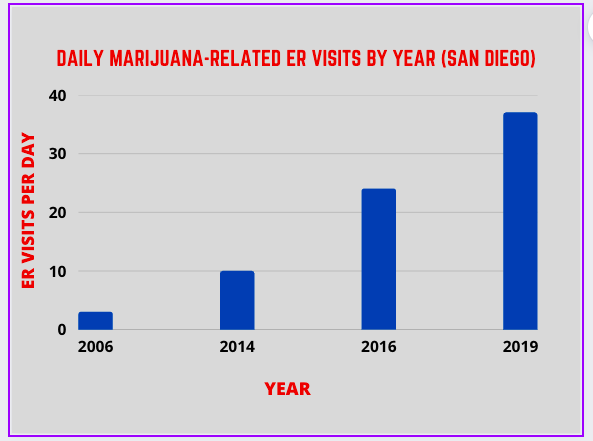
Graph created using Canva
JB: It is well known that the concentration of psychotropic chemicals, particularly the dozens of cannabinoids in the plant, is far higher than in marijuana a generation ago. But the availability of marijuana is also far greater. Which of these factors do you consider to be more relevant to the two factors?
RL: Both factors are important – potency and availability. I treat a lot of patients with methamphetamine poisoning. We studied 150 consecutive urine drug screens from our emergency department and 76% were positive for methamphetamine. Meth is cheap to make and purchase, readily flows across the Mexican border to San Diego, and the manufacturing method produces a purer chemical. The devastation to our population is caused by purity (potency) and availability.
Similarly, cannabis products are ever more available and the products are more potent. In the same emergency department drug surveillance study, 50% of drug screens were positive for THC.
JB: You're clearly not a big fan of unrestricted use of marijuana. What will be the negative fallout from the enormous experiment that is now underway?
RL: I wouldn’t describe my views on marijuana as being a fan or not a fan. I want the public to make informed decisions. If people drink alcohol, they understand the risk of addiction, liver disease, and drunk driving. If people smoke cigarettes, they know the risk of addiction, lung cancer, and emphysema. The opioid risks are well known. What makes marijuana different is that the risks are being hidden and denied.
JB: Most people will look at you like you're insane if you suggest that marijuana is addictive. What would you say to them now?
RL: I would tell people to follow the science. Cannabis use disorder or addiction is defined using the same DSM V 11-point criteria as alcohol use disorder or opioid use disorder. Approximately 1 in 10 people who use marijuana will become addicted. If starting before age 18, the rate of addiction rises to 1 in 6.
Cannabis withdrawal is reported in up to 30% of regular users and in 50-90% of heavy users. Many cannabis users do not believe they suffer from withdrawal until they understand that the symptoms of cannabis withdrawal are different than alcohol or opioid withdrawal. The common symptoms of cannabis withdrawal are irritability, anxiety, insomnia, and headache, and significant cravings for marijuana. Typically, these symptoms last for about 2 weeks after cessation.
JB: It was ridiculous to imprison people for possessing small amounts of marijuana for personal use, so decriminalization makes quite a bit of sense. But have we gone too far? What policy makes the most sense to you?
RL: I agree along with most Americans that marijuana should be decriminalized. But the savvy Marijuana Industry has used the popular decriminalization stance and extended it to legalization for both recreational and medical use. It is now openly promoting high-potency THC products.
There are different philosophies on drugs. Some support legalizing all drugs – cocaine, methamphetamine, and illicit fentanyl. I support a public health approach, especially one that protects our youth and allows for transparency and informed consumers.
Current legalization has gone too far because it has grown with little regulation. There is no deterrence or consequences for making false health claims or selling high-potency products. There is no childproof packaging for babies. There is little consequence for promoting products to youth. Why does the world need Wheetos that look like Cheetos and send babies to the emergency room?
Smart policy would be to follow the science. We have a duty as a society to protect our youth and most vulnerable. All drugs that can be addicting should be avoided until the brain completes myelination and synaptic pruning. Adults should be aware of the various medical risks and make informed decisions.
JB: Are there known issues using marijuana with other medications?
Yes. Both THC and CBD are metabolized by the cytochrome P450 system and therefore may interact with many medications – over 300 for THC and over 500 for CBD. There are many pain medications and psychiatric medications that cause drug interactions with cannabis.
For example, I treated a man who was admitted three times to the hospital with internal bleeding. Each time he received blood transfusions and endoscopies to evaluate a source of bleeding. On his third visit, I asked him about drug use. He admitted to being a regular cannabis user with no problems. The problem was that he was on a blood thinner for her heart stents. The cannabis interacted with his blood thinner and was causing bleeding that could have been fatal.
I encourage people to use the Drugs.com medication interaction checker. Enter cannabis for THC or cannabidiol for CBD and check your medications for interactions.
--------------------------------------------------------------------------------------
I would like once again to thank Dr. Lev for her time and also the extremely valuable information that will probably surprise many of our readers. Additionally, we will publish two more articles on this topic that delve more deeply into the science and medicine of this important topic.
My colleagues, Cameron English and (Up)Chuck Dinerstein, have also covered this topic. You can listen to their podcast here.

Josh Bloom
Dr. Jonathan (Josh) Bloom, ACSH's Director of Chemical and Pharmaceutical Sciences, earned his Ph.D. at the University of Virginia and completed postdoctoral training at the University of Pennsylvania. During his 20-plus years in drug discovery at Wyeth, his research group discovered the antibiotic Tygacil®, approved in 2005. He holds 25 issued patents and has authored 35 academic papers. Since joining ACSH in 2010, he has written more than 2,000 articles and dozens of op-eds for major newspapers, including The Wall Street Journal and Chicago Tribune.