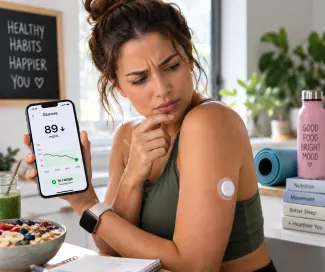
Continuous glucose monitoring (CGM) measures glucose levels between cells, giving people with diabetes up-to-the-minute information on whether their blood glucose is above, below, or within range. In the quarter-century since its FDA approval, it has undergone a form of “mission creep.” What began largely as a supplement to finger-stick testing for people with Type 1 diabetes is now used by people with Type 2 diabetes, particularly those at risk of dangerously low blood sugar, or hypoglycemia. More recently, CGMs have moved beyond diabetes care altogether, attracting people with prediabetes and even healthy consumers curious about their metabolism.
But does having a continuous stream of glucose data improve health or change behavior—not only for people with Type 2 diabetes, but also for those with prediabetes or normal glucose regulation? A new review assesses the evidence.
Where CGMs Help
Using CGM instead of traditional finger-stick monitoring in people with Type 2 diabetes (adult-onset, the most common form) shows a statistically significant, modest decrease in average HbA1c of roughly 0.3% to 0.4%. As a reminder, HbA1c measures long-term glycemic control. One possible reason for the improvement is convenience: CGMs collect readings automatically, rather than requiring users to stop and check their glucose manually.
For individuals using insulin, where hypoglycemia is a greater concern, CGMs reduce the duration of low blood sugar by about half an hour per day. However, as the researchers point out, hypoglycemia requiring emergent third-party intervention, usually to supply rapidly absorbed glucose, (e.g., orange juice), is rare in clinical trials and has not improved with CGMs.
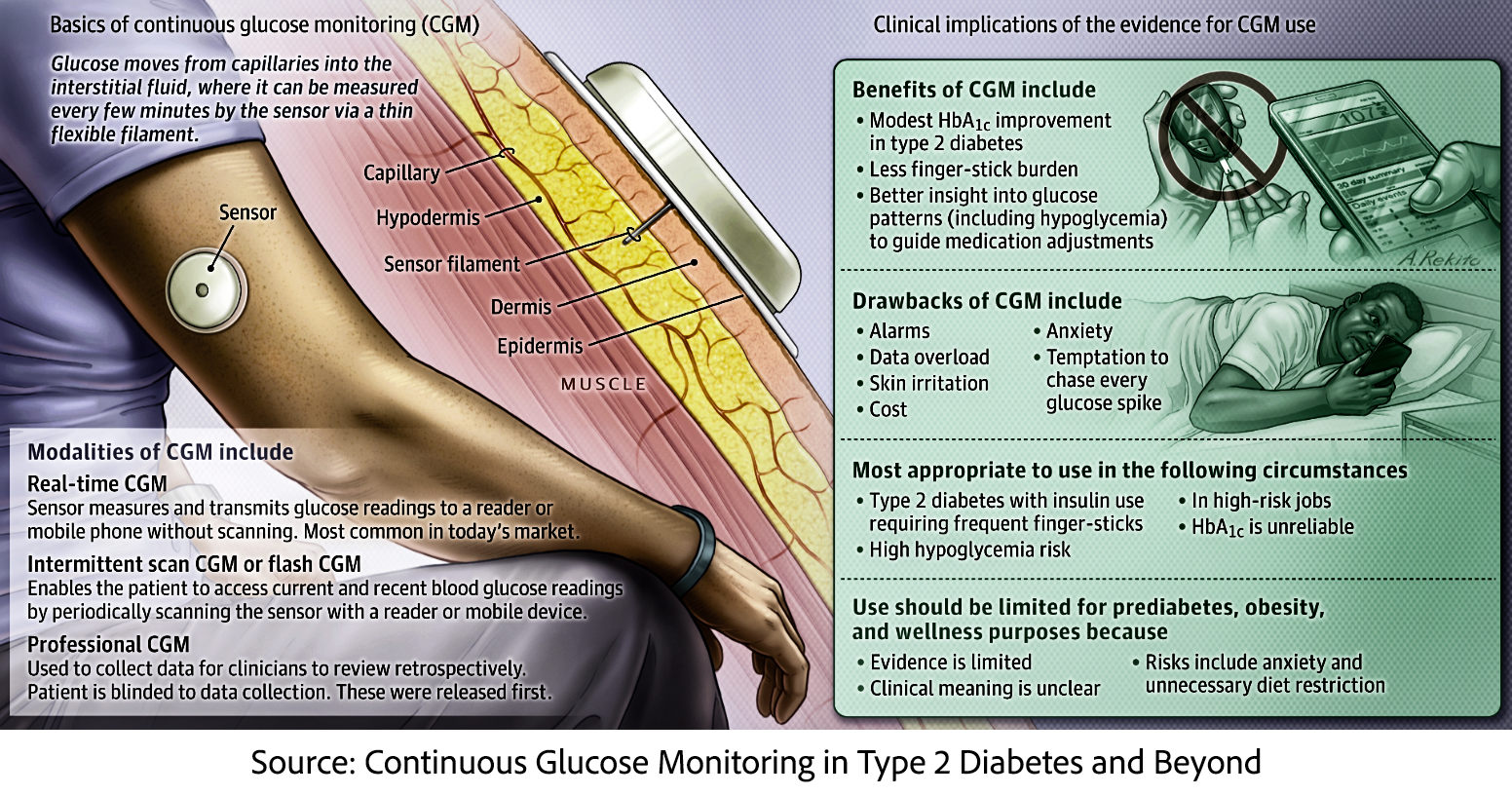
Long-term studies on the impact of CGMs on diabetes’ cardiovascular complications are scarce, and the few studies on quality of life show no benefit for CGM users. Overall, the evidence supports specific benefits for people managing diabetes. But does that mean the same technology provides useful information to people whose glucose regulation is already normal?
From Diabetes Care to Wellness
Continuous glucose monitors (CGMs) are increasingly crossing over from diabetes care into mainstream wellness culture, heavily marketed as tools to detect metabolic risks and optimize health for people without diabetes. The appeal is easy to understand: instead of waiting for an occasional lab test, users can monitor glucose levels and potentially link changes to food, exercise, sleep, or stress. But clinical evidence that this information improves health in people without diabetes is scarce.
A systematic review evaluating behavioral outcomes found no statistically significant reductions in body weight, body mass index (BMI), or daily caloric intake. A trial focused on adults with prediabetes, itself an ambiguous diagnosis, found a slight reduction in blood glucose without a significant change in time spent within targeted glucose ranges.
One reason benefits may be difficult to demonstrate is more fundamental: in people without diabetes, it is not always clear which CGM readings should prompt concern or provoke action.
What Counts as Abnormal?
While accepted thresholds exist for glucose variability in individuals with either type of diabetes, the lack of consensus on what constitutes “normal” for the walking well creates a significant challenge for interpretation and for the flag needed to provoke behavior change. Healthy individuals spend most of the day within the standard range of 70–140 mg/dL. Glucose “spikes” occur routinely after meals, and drops below 70 mg/dL are rare. Without validated, universal guidelines developed specifically for non-diabetic populations, micro-analyzing these daily shifts risks mistaking routine physiological variation for a sign of metabolic malfunction.
CGMs also do not measure blood glucose directly. They measure glucose in the fluid surrounding cells, and it can take roughly 10 to 20 minutes for changes in the bloodstream to appear there. As a result, the number displayed on a CGM may lag behind what is happening in the blood, complicating the interpretation of rapid changes around events such as meals or exercise.
Even after a meal, interpreting the data is not straightforward. A person's glucose response reflects more than the food just consumed. Sleep, physical activity, stress, individual biology, and other factors may all influence the shape of the post-meal glucose curve. Attributing a single spike to a single food therefore risks oversimplifying a much more complex physiological response.
Those uncertainties matter even more when a device is used to search for abnormalities in a population where true abnormalities are uncommon.
Signal to noise
When a condition is extremely rare in a population, identifying the “highs” and “lows” is inherently difficult. Because actual pathological sugar spikes or dangerous drops rarely occur in healthy people, the majority of flagged "extremes" are false alarms. CGMs, like any device, operate within a margin of error, typically 8-10%. For a normal individual with a low baseline glucose, say 75 mg/dL, a normal 10% measurement variance can drop the display reading to 67 mg/dL, signaling hypoglycemia.
In healthy people, rising blood glucose after a meal triggers insulin release, helping move glucose into tissues and bring circulating levels back toward baseline. Diabetes disturbs this regulation to varying degrees, which is one reason glucose monitoring can provide clinically useful information in that population. In people with normal glucose regulation, however, post-meal rises are generally part of a functioning feedback system. Combined with the lag between blood and interstitial glucose, this makes individual CGM peaks difficult to interpret in isolation. For healthy users, the challenge is determining which fluctuations contain useful information and which are normal physiology or measurement noise.
While wearable sensors are intuitively appealing to health-focused individuals, rigorous evidence of improved metabolic or psychological outcomes is currently lacking, suggesting CGMs belong in research rather than wellness.
Source: Continuous Glucose Monitoring in Type 2 Diabetes and Beyond: A Review JAMA Internal Medicine DOI: 10.1001/jamainternmed.2026.2772

Chuck Dinerstein, MD, MBA
Director of Medicine
Dr. Charles Dinerstein, M.D., MBA, FACS is Director of Medicine at the American Council on Science and Health. He has over 25 years of experience as a vascular surgeon.