Brown rice is supposed to be the virtuous choice, a whole grain, with more nutrients and more fiber. It also contains more arsenic than white rice, a fact the Environmental Working Group turns into a particularly effective scare story involving children. But the actual data tell a more nuanced story about dose, age, geography, and an uncomfortable nutritional truth: sometimes processing makes food safer.
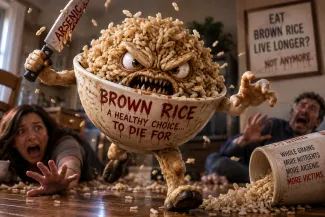
The 1973 movie Sleeper tells the story of a health food store owner who is accidentally cryogenically frozen in 1973 and wakes up 200 years later. Puzzled by the absence of his friends, he asks where they are. He is told they have died. “But how can that be? They all ate brown rice.” The latest missive from the Environmental Working Group (EWG) to my inbox suggests that those friends died not of old age, but possibly from arsenic poisoning.
The EWG insight picturing an innocent child being presumably fed poison cites a 2025 study on arsenic levels in brown vs. white rice. We can skip the EWG innuendo and go right to the study to put this fear into proper perspective.
The Brown Rice Tradeoff
Brown rice is widely promoted as nutritionally superior to white rice because its bran and germ provide extra fiber and nutrients, consistent with dietary guidelines that favor whole grains. Yet brown rice also contains more arsenic than white rice, a tradeoff rarely emphasized in nutrition messaging.
Rice accumulates ten-fold more arsenic than other grains largely because it is grown in flooded paddies, where roots readily take up arsenic from the soil and water. Inorganic arsenic, the more bioavailable and toxic form, accumulates more in the roots and shoots, but also accumulates in both the husk, which makes the brown rice brown, and, to a lesser extent, in the endosperm itself, the white in white rice.
The EPA and FDA have already set regulatory limits for arsenic in water (10 parts per billion). In rice cereal for infants (100 parts per billion), so for consumers the key question is whether the nutritional benefits of retaining the bran and germ outweigh the additional arsenic exposure.
Dose Makes the Difference
As with all studies of this type, it begins by estimating both our rice consumption and the possible levels of arsenic they contain. Estimates are notoriously variable, so we needn’t worry about precision or accuracy, but can settle for the gist of the findings.
The nutritional benefits of brown rice—the additional vitamins, minerals, and fiber—are well documented, as is the finding that brown rice is not as frequently consumed as white rice globally or in the US. Total arsenic levels are 70% to 100% higher in brown than in white rice. However, US-produced rice has lower levels because growing conditions matter. Typically, arsenic levels are 40% higher in brown rice.
The most critical group is children under five, because they consume substantially more rice relative to body weight than older children and adults. The highest-risk group is those between six and 24 months, who consume 1 to 2 grams of rice per kilogram of body weight daily and eat the most brown rice. Combining high intake per kilogram of body weight with greater developmental susceptibility to arsenic toxicity suggests a significant concern. However, here is what the researchers concluded:
“The values reported in the analysis indicate that there is a potential risk of harmful exposure to arsenic from brown rice among children under the age of 5. However, the daily inorganic arsenic exposure for most Americans within the analysis did not rise to a level that was a concern to pose elevated risks of harmful health outcomes.”[emphasis added]
Processing Giveth and Takeff Away
I would be remiss not to mention the paradoxical impacts of rice processing.
US rice is grown in soils that naturally contain arsenic. Still, grain concentrations have historically been higher in the south-central rice belt—particularly Arkansas, Louisiana, Texas, and Mississippi—than in California. Some southern soils also carry a legacy of arsenic-containing pesticides once used in cotton production. Rice is especially susceptible because flooded fields create chemical conditions that release arsenic bound to soil minerals, making it easier for the plant to absorb. As a result, arsenic levels in rice reflect not simply soil contamination, but a combination of geography, agricultural history, soil chemistry, and irrigation practices.
On the other hand, it is post-harvest processing, including removing the bran and additional “polishing” of the endosperm, that results in the lowest arsenic levels. So processing may be friend or foe, once again showing the label's limited utility as a marker of nutrition or healthy outcomes. With today’s manufacturing safeguards, roughly 75% of infant rice cereals contain 100 parts per billion or less of arsenic. Generally speaking, infant brown rice cereals fill a niche market for parents looking for whole-grain products.
When Risk Becomes a Scare Card
I wrote recently about another EWG fairytale fear delivered weekly to my inbox, and I was reminded of this quote by Craig Cormack in The Science of Communicating Science:
“The more emotive somebody is about a topic, the less likely they are to be influenced by any facts and figures. So look around and see who is playing the ‘scare card’ and whipping up a bit of emotional concern about things.”
What does this promotion of fear, or at the very least uncertain concern, accomplish? None of EWG’s Dirty Dozen caused the outbreaks of food-borne illness this summer. The EWG remains primarily a “policy shop” seeking to shape our environment through regulation and laws. But to drive their success, they need funding, primarily from individual donations and corporate sponsors, “including organic food, personal care products, and financial services.”
A Grain of Truth, Seasoned With Fear
Arsenic in rice is real, and it deserves attention for very young children. But “contains arsenic” is not the same as “dangerous to eat.” For most Americans, the study itself found exposures below levels expected to produce harmful health effects.
The more interesting lesson may be what happens when nutrition is reduced to simple labels. Brown is not automatically better than white, whole is not invariably safer than processed, and “natural” tells us remarkably little about risk. Milling away the nutritious bran also mills away some of the arsenic. That is precisely the kind of tradeoff that disappears when a complicated question of dose and exposure is converted into a frightening picture of a child being fed poison.
Which brings us back to Sleeper. Two hundred years from now, perhaps the joke won’t be that everyone who ate brown rice died. It will be that we once thought we could divide foods so neatly into good and bad.
Category

Chuck Dinerstein, MD, MBA
Director of Medicine
Charles Dinerstein, MD, MBA, is the Medical Director of the American Council on Science and Health. A vascular surgeon with more than 25 years of clinical experience, he brings a physician's understanding of medical decision-making, an appreciation for scientific uncertainty, and a broader perspective on healthcare economics and policy to his writing.